
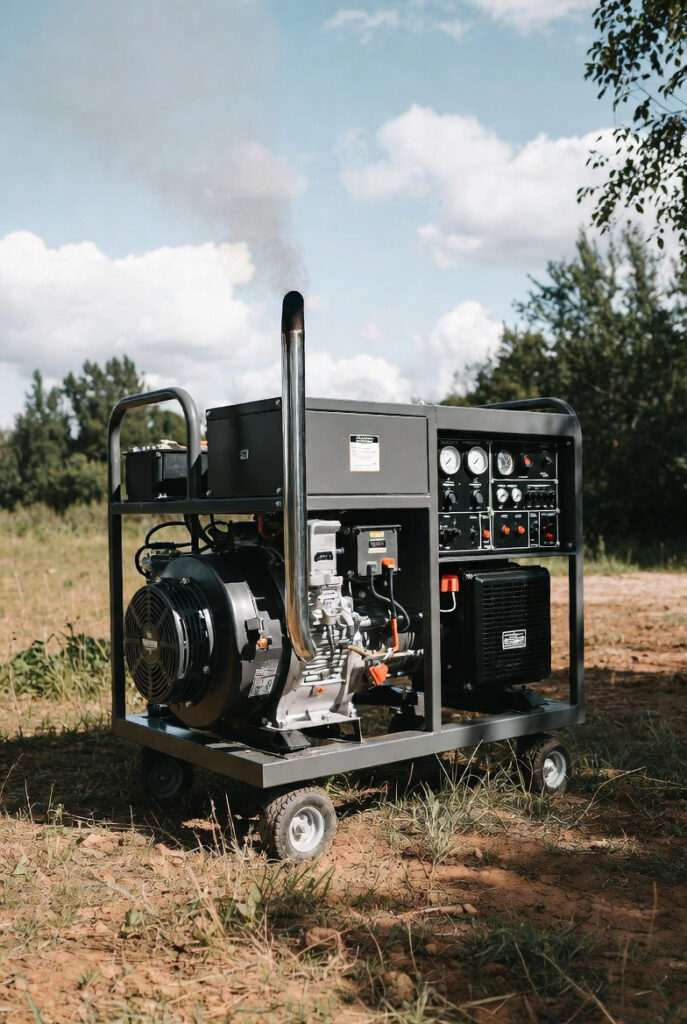
A transfer switch solar installation is the mechanical interlock that prevents the most dangerous electrical mistake in off-grid systems, backfeeding grid power from a generator through a live utility connection and killing the utility worker who is trying to restore power to your street. The transfer switch solar system is the break-before-make device that ensures your solar inverter, your utility grid connection, and your generator can never touch each other simultaneously, not even for a millisecond. Without a transfer-switch solar system, you are one forgotten breaker away from a utility worker fatality and a criminal-negligence charge. Before understanding the transfer-switch solar standard, determine how much solar power you actually need. The AC output configuration of your inverter determines which transfer switch specification is correct.
Transfer Switch Solar: The Backfeed Fatality
What backfeed is: When a generator is connected to a house panel through the dryer outlet or any other outlet with the main breaker still closed, the generator pushes AC voltage backward through the house wiring, through the main breaker, through the utility meter, and into the utility transformer. The utility transformer steps this voltage up by its turns ratio. A 240V generator connected to a residential transformer that normally steps 7,200V down to 240V will push 7,200V back onto the utility distribution line. That distribution line is dead. The utility has opened its upstream to protect workers doing repairs. A utility worker touching what they believe is a de-energized line receives 7,200 volts. This is the backfeed fatality. One forgotten breaker. One dead utility worker.
The suicide cord: A male-to-male extension cord with both ends having male three-prong plugs is the tool used for illegal panel backfeed. The cord is called a suicide cord because one end is live while the other is inserted into the outlet. The exposed male prongs at the live end are at full line voltage while the installer holds them. The suicide cord is the most dangerous improvised electrical device in existence. It is illegal under NEC 702, CEC Section 6, and every provincial electrical code in Canada. There is no safe way to use one. There is no legitimate reason to own one.
Why the transfer switch solar system prevents this: A transfer switch solar system physically disconnects the utility connection before connecting the generator and physically disconnects the generator before connecting the utility. The mechanical interlock in the transfer switch makes it physically impossible to connect both sources simultaneously. There is no procedure. There is no sequence. There is no way to create the backfeed condition with a properly installed transfer switch solar system.
I found a suicide cord at a Rockwood property last spring. The owner had been backfeeding his panel from a 3,500W generator via the dryer outlet whenever the power went out. The cord was stored in the electrical room, coiled neatly, right next to the panel. He had been using it for three years without incident and did not understand why I was concerned. I explained the backfeed physics, the utility transformer turns ratio, the 7,200V on the dead line, and the utility worker with his hands on the wire. He went quiet. I explained the CEC Section 6 prohibition and the criminal negligence consequence. He asked me what the right solution was. I told him: a transfer switch solar system, three positions, solar, off, generator mechanical interlock, break before make, $200-400 installed. He ordered the parts that afternoon. As covered in our Grounding vs Bonding Solar guide, the neutral-to-ground bond is transferred to the source. The transfer switch solar system must handle this bond transfer correctly.
The Break-Before-Make Mechanism – How the Transfer Switch Solar Works
What break-before-make means: A break-before-make transfer switch physically disconnects the current source before connecting the new source. The switch mechanism passes through an OFF position, a dead zone where all sources are disconnected between any two source positions. It is mechanically impossible to transition from SOLAR to GENERATOR without passing through OFF. During the OFF position, the load is completely de-energized. The source transition happens in the OFF position; the new source is not connected until the old source is confirmed disconnected. This is the break-before-make principle, and it is the only acceptable transfer switch solar standard.
Why the neutral dead zone matters: The OFF position, the neutral dead zone between sources, provides three critical benefits that a make-before-break switch cannot provide. First, it prevents any momentary interconnection of sources; even a millisecond of simultaneous solar and generator operation can cause equipment damage and violate NEC 702 and CEC Section 6. Second, it allows connected electronics, inverters, charge controllers, and sensitive appliances to de-energize completely before receiving a new source, preventing damage from voltage spikes caused by the source transition. Third, it provides a visual confirmation that the house is completely dark, confirming that the previous source is disconnected before the new source is connected. The Victron MultiPlus-II internal transfer relay handles the solar-to-grid transfer automatically with its own break-before-make relay. The external manual transfer switch handles the generator connection that the MultiPlus-II internal relay does not cover.
The three-position switch standard: The manual three-position transfer switch solar system has three positions: SOLAR/INVERTER, OFF, and GENERATOR. Position 1 connects the inverter AC output to the load panel. Position 2 (OFF) disconnects all sources. Position 3 connects the generator to the load panel. The switch rotates through these positions in sequence; you cannot skip the OFF position. The mechanical interlock inside the switch body ensures this sequence is enforced regardless of operator error, panic, or haste. As covered in our Emergency Stop Solar guide, the fail-safe principle applies to every switching device in the Fortress; the transfer switch solar system must be mechanically incapable of creating the dangerous condition it is designed to prevent.
The Victron MultiPlus-II Internal Transfer Relay
What the internal relay does: The Victron MultiPlus-II includes an internal AC transfer relay that connects the AC input (grid or generator) directly to the AC output when acceptable power is detected, and disconnects the AC input and switches to inverter mode when grid or generator power is lost or out of specification. This is the automatic transfer switch for the solar function during grid connection. When grid power is present and within specification, the MultiPlus-II relay closes, grid power feeds the loads directly, and the MultiPlus-II charges the battery bank. When grid power fails, the relay opens in approximately 20 milliseconds, ds and the MultiPlus-II begins inverting from the battery bank. The transition is seamless for most loads.
What the internal relay does not cover: The MultiPlus-II internal relay automatically handles solar-to-grid transfer. It does not handle a manual generator connection as an additional source in addition to the AC input. For a system that includes a generator as a third-source solar inverter, utility grid, and generator, a manual transfer switch is required at the AC input of the MultiPlus-II or at the main load panel to manage the generator connection separately. The Victron Cerbo GX VRM portal shows the AC input connection status in real time, and the transfer relay position is visible on the VRM dashboard.
The generator connection sequence:
- Confirm transfer switch is in SOLAR/INVERTER position loads running on inverter
- Start the generator allow it to warm up and stabilize at rated frequency and voltage, age approximately 2-3 minutes
- Rotate transfer switch to OFF, loads de-energize, the inverter continues running unloaded, and the
- Confirm generator output with a multimeter 120V ±5%, 60Hz ±0.5Hz
- Rotate the transfer switch to GENERATOR loads; connect to the generator.
- Confirm that loads are running normally, and the generator handling the load is
The Automatic Transfer Switch Upgrade
What an ATS does: An automatic transfer switch (ATS) solar system monitors the primary source and automatically switches to the backup source when the primary source fails, without human intervention. For a full off-grid system, the ATS monitors the inverter AC output voltage and frequency. If the inverter fails or the battery bank reaches low-voltage cutoff, the ATS automatically connects the generator if it is running, or signals the generator to start. As covered in our Low Voltage Cutoff guide, the low-voltage cutoff event is exactly the condition where an ATS provides the most value: automatic generator start before the battery bank reaches the black-start threshold.
The solar system is the correct choice. It is simpler, more reliable, and less expensive, and provides the operator with full visibility and control over source transitions. The ATS adds complexity and failure modes. A malfunctioning ATS can connect sources at the wrong time or fail to connect the backup source when needed. The manual transfer switch solar system cannot malfunction in ways that create dangerous conditions; its mechanical interlock is the protection. As covered in our Off-Grid Solar Maintenance guide, the transfer switch solar system requires annual inspection, contact resistance check, mechanical operation test, and label verification.
I was installing a three-position manual transfer switch solar system on a Guelph Fortress build last October. The client had never experienced a complete source transfer before. I walked him through the sequence — SOLAR to OFF to GENERATOR. When I rotated to the OFF position, the house went completely dark. Not dim — dark. Every light, every appliance, the refrigerator, the inverter display. He stood in the dark for the two seconds it took me to rotate to GENERATOR and said, “So that is what the dead zone feels like.” That is exactly what it feels like. That two-second dark is the mechanical confirmation that the previous source is disconnected and the new source is not yet connected. It is the proof that the break-before-make principle is working. No backfeed is possible during those two seconds. He understood it immediately. As covered in our Solar System marker-resistant labels are visible in low light.
NEC 702 and CEC Section 6 -The Transfer Switch Solar Code Standard
NEC 702 – USA: National Electrical Code Article 702 governs optional standby systems, which include residential generator backup systems. NEC 702.6 requires that transfer equipment be designed and installed to prevent the inadvertent interconnection of all sources of supply, the break-before-make requirement. NEC 702.6 also prohibits the use of any device that allows simultaneous connection of multiple sources. The suicide cord is explicitly prohibited under this section. A properly installed transfer-switch solar system satisfies NEC 702.6 through mechanical design the interlock prevents simultaneous source connection regardless of operator action.
CEC Section 6 – Canada: The Canadian Electrical Code Section 6 governs service entrance equipment, including transfer switches. CEC Rule 6-106 requires that transfer switches be of the break-before-make type, preventing simultaneous energization of the load from multiple sources. The CEC Section 6 requirement is enforced by ESA inspectors in Ontario. A, top, transfer switch solar represents the professional installation standard that satisfies both NEC and CEC requirements simultaneously.
Quick Reference – Transfer Switch Solar Selection Guide
| Type | Positions | Source Transition | Best For | Code Compliance |
|---|---|---|---|---|
| Manual 3-position | Solar – OFF – Generator | Operator initiated | Residential off-grid Fortress | NEC 702.6, CEC Rule 6-106 ✅ |
| Automatic (ATS) | Auto-switching | Automatic on source failure | Systems requiring unattended operation | NEC 702.6, CEC Rule 6-106 ✅ |
| MultiPlus-II internal relay | Inverter Grid | Automatic 20ms | Solar-to-grid only | NEC 702.6, CEC Rule 6-106 ✅ |
| Suicide cord | N/A | Simultaneous | NEVER -criminal negligence | NEC 702.6, CEC Rule 6-106 ❌ |
Pro Tip: Test the transfer switch solar system quarterly by cycling through all three positions: SOLAR to OFF to GENERATOR, then back to SOLAR. During the GENERATOR position, confirm generator voltage and frequency with a multimeter before connecting loads. A generator producing 130V or 55Hz will damage sensitive electronics. During the return transition, GENERATOR to OFF to SOLAR, allow the inverter 30 seconds to stabilize its AC output before connecting loads. As anomalies. The transfer switch that has never been tested is the transfer switch that fails during the event it was installed to manage.
The Verdict
A transfer switch solar system is the mechanical interlock that makes it physically impossible to kill a utility worker with your generator.
Three steps to implement the transfer switch solar standard today:
- Install a break-before-make three-position manual transfer switch SOLAR/INVERTER, OFF, GENERATOR, mechanical interlock required NEC 702.6 and CEC Rule 6-106 compliance mandatory,
- Destroy any suicide cords, male-to-male extension cords. They are illegal, lethal, and have no place in a Fortress build
- Test quarterly all three positions, generator output verified with multimeter, transition documented in maintenance log
Break before make. Every source transition. Every time.
Disclosure: This article contains affiliate links. If you buy through them, GridFree Guide earns a small commission at no extra cost to you.
Questions? Drop them below.
About the Author
Robert Bertrand spent 20 years as a service advisor in the automotive industry (Lexus and Nissan), where precision diagnostics, wiring integrity, and documentation standards were non-negotiable. He brings that same technical discipline to GridFree Guide, where he researches, tests, and documents off-grid solar systems for Ontario conditions. Based in Rockwood, Ontario, every article is built on verified specifications, manufacturer data, and the real-world climate constraints of Canadian off-grid living.
As an Amazon Associate I earn from qualifying purchases. This site also contains affiliate links to other products and services. GridFree Guide earns a small commission at no extra cost to you.