
The grounding vs bonding solar distinction is the most misunderstood concept in off-grid electrical safety and getting it wrong does not produce a tripped breaker or a blown fuse, it produces a chassis that is live at line voltage waiting for a person to touch it and complete the circuit. Grounding is the connection from the system to the earth the grounding electrode, the ground rod, the path that dissipates lightning surges and static charge. Bonding is the connection that ties all metal parts together and to the neutral the path that fault current takes to trip the breaker when a hot wire touches a metal chassis. Without a proper neutral-to-ground bond at the right place in the system the fault has no return path, no current flows, no breaker trips, and the metal chassis of every appliance in the system sits waiting. Before understanding the grounding vs bonding solar standard understand how much solar power you actually need the system voltage and AC output configuration determine where the single bond point must be located.
Grounding vs Bonding Solar: The Floating Neutral Hazard
What grounding is: Grounding connects the electrical system to the earth through the grounding electrode, the ground rod driven into the soil, and the grounding electrode conductor that connects the system’s grounding busbar to the rod. As covered in our Grounding Electrode guide the grounding electrode provides the reference potential that dissipates lightning surge energy, equalizes static charge, and establishes the system’s relationship to earth potential. Grounding does not provide the fault current return path that trips breakers.
What bonding is: Bonding connects all non-current-carrying metal parts equipment chassis, conduit, panel enclosures, appliance housings to the neutral conductor at a single point. This neutral-to-ground bond is what creates the low-impedance fault current return path. When a hot conductor contacts a metal chassis a frayed cord inside a toaster, a chafed wire inside a range hood the fault current flows from the hot conductor through the chassis, through the bonding conductor, to the neutral, and back to the source. This fault current is large limited only by the impedance of the fault path and it trips the breaker. This is the fail-safe mechanism. Without the bond the fault current has no return path. Nothing trips.
The floating neutral failure mode: When the neutral is not bonded to ground a floating neutral a fault from a hot conductor to a metal chassis produces no fault current. The chassis rises to line voltage through the fault impedance. A person touching the chassis while standing on a grounded surface a concrete floor, a wet ground becomes the fault current return path. The current flows through the person. The breaker does not trip because the fault current through a human body typically 10-50 milliamps is far below the breaker trip threshold of 15-20 amps. This is the grounding vs bonding solar failure mode that produces electrocution without a tripped breaker.
I was called to a Guelph cabin installation where the owner was getting a mild shock when touching the range hood while standing on the concrete floor. Not a tingle a genuine shock that made him step back. I measured the voltage between the range hood chassis and the concrete floor with a multimeter: 45V AC. The range hood was live at 45V to earth. I traced the fault a failing appliance cord had allowed the hot conductor to contact the range hood chassis. The range hood chassis was bonded to the equipment ground correctly. But the neutral-to-ground bond was missing at the inverter panel. The fault current had nowhere to go. No return path. No breaker trip. Just 45 volts on every metal surface in the kitchen waiting for someone to complete the circuit. The fix was a single wire the neutral-to-ground bond at the Victron MultiPlus-II panel. The voltage on the range hood dropped to zero. The breaker tripped immediately as the fault current now had a return path. As covered in our Chassis Ground Solar guide the equipment bonding and the neutral-to-ground bond are two separate connections that both must be present for the system to fail safe.
The Single Bond Point Rule – Why Only One
Why multiple bonds create a ground loop: A neutral-to-ground bond at two points in the system creates a closed loop the neutral conductor forms one side of the loop and the grounding conductor forms the other. Any electrical noise, switching transient, or induced voltage difference between the two bond points drives a circulating current around this loop through the grounding conductors. This circulating current is the ground loop. It produces electromagnetic interference the radio hum, the 60Hz buzz in audio systems, the display flicker in sensitive electronics. It also produces resistive heating in the grounding conductors proportional to I²R the grounding conductors were sized for fault current duty, not continuous circulating current.
The Victron MultiPlus-II internal bonding relay: The Victron MultiPlus-II includes an internal neutral-to-ground bonding relay a relay that closes the neutral-to-ground bond when the MultiPlus-II is operating in inverter mode and opens the bond when grid or generator power is present at the AC input. This relay is the correct implementation of the single bond point requirement for a system where the inverter is the AC source. When the relay is closed the MultiPlus-II is the single bond point no additional neutral-to-ground bond is required or permitted anywhere else in the system. When grid power is present the relay opens the bond transfers to the grid’s neutral-to-ground bond at the utility transformer. The Victron Cerbo GX VRM portal shows the bonding relay status in real time inverter mode shows the bond active.
Where the single bond point must be: For an off-grid system with the Victron MultiPlus-II as the AC source the internal bonding relay satisfies the single bond requirement. No manual bond at the AC distribution sub-panel. For systems without an internal bonding relay the single neutral-to-ground bond installs at the main service panel the first panel downstream of the inverter AC output. Sub-panels, branch circuit panels, and all downstream distribution panels must have their neutrals and grounds separated. This is the grounding vs bonding solar single bond point rule.
I found a double bond installation at a Rockwood off-grid property last spring the MultiPlus-II internal bonding relay was active (inverter mode, relay closed) AND the homeowner had installed a manual neutral-to-ground bond in the AC sub-panel because they had read online that “neutrals and grounds need to be bonded.” Both bonds were active simultaneously. I measured the circulating current in the grounding conductor between the two bond points: 340 milliamps. At 340mA through the grounding conductor resistance the grounding conductors between the inverter and the sub-panel were carrying continuous load and running measurably warm. The radio in the kitchen had a persistent 60Hz hum. The fix was removing the manual bond from the sub-panel the MultiPlus-II relay was already providing the single bond point correctly. The hum disappeared. The grounding conductors returned to ambient temperature. As covered in our Equipment Bonding guide every grounding conductor in the system must carry only fault current not continuous circulating current from a ground loop.
The Sub-Panel Separation Standard
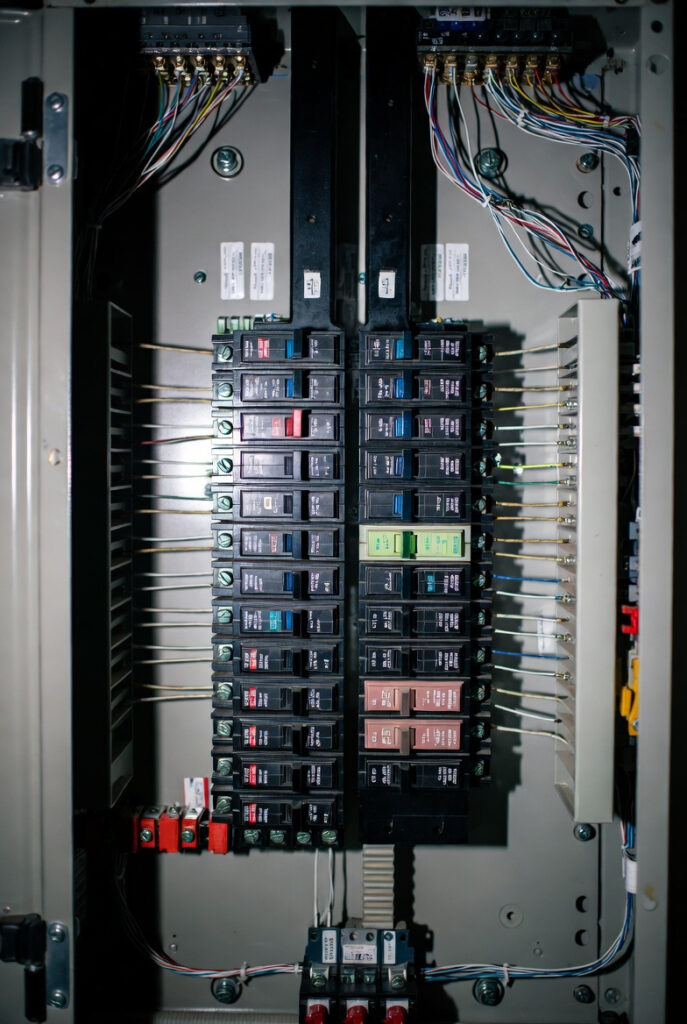
Why sub-panels are different from main panels: In a main service panel or at the inverter output panel where the single bond is located the neutral bus and the ground bus are bonded together and to the grounding electrode. In every sub-panel downstream of this point the neutral bus and ground bus must be separated the neutral bus is insulated from the panel enclosure and the ground bus is bonded to the panel enclosure. The neutral carries return current from loads. The ground carries fault current only. They must not be connected in the sub-panel because connecting them creates a second bond point and the ground loop described above.
Visual identification in a correctly wired sub-panel:
- The neutral bus has an insulating spacer between it and the panel enclosure the neutral bus floats, isolated from metal
- The ground bus is bonded directly to the panel enclosure the ground bus screws directly to the panel metal
- Neutral wires (white) connect to the neutral bus
- Ground wires (green or bare) connect to the ground bus
- The two buses are separate no jumper wire between them
The generator connection: When a generator connects to the Victron MultiPlus-II AC input the MultiPlus-II bonding relay opens the inverter is no longer the AC source. The generator becomes the AC source and must provide its own neutral-to-ground bond. As covered in our Generator Bonding guide the generator floating neutral vs bonded neutral determination is the critical configuration check before connecting any generator to the MultiPlus-II AC input.
The Verification Test Confirming the Bond Is Present and Single
Test 1 – Confirm the bond exists: With the system operating in inverter mode and no loads connected measure the AC voltage between the neutral bus and the grounding bus at the main inverter panel with a multimeter set to AC voltage. A correctly bonded system reads zero volts the neutral and ground are at the same potential because they are bonded. A floating neutral reads 1-5V AC or higher the neutral is not bonded and the system is operating with a floating neutral hazard.
Test 2 – Confirm only one bond exists: With the system operating measure the AC current on the grounding conductor between the inverter panel and any sub-panel using a clamp meter. A correctly single-bonded system reads zero amps on the grounding conductor no circulating current. A double-bonded system reads measurable current 100mA to several amps depending on the ground loop impedance. Any measurable current on a grounding conductor indicates a second bond point that must be identified and removed.
Test 3 -Confirm sub-panel separation: At each sub-panel visually confirm that the neutral bus is isolated from the panel enclosure the insulating spacer is present and intact and that no jumper wire connects the neutral bus to the ground bus. Use a multimeter set to resistance between the neutral bus and the panel enclosure a correctly separated sub-panel reads infinite resistance (open circuit). A bonded sub-panel reads near-zero resistance.
NEC 250 and CEC Section 10 – The Code Standard
NEC 250 – USA: National Electrical Code Article 250 governs grounding and bonding. NEC 250.24 requires that the neutral conductor be bonded to the grounding electrode at the service entrance or at the first means of disconnect for off-grid systems. NEC 250.142(B) prohibits neutral-to-ground bonds in sub-panels downstream of the service entrance the neutral and ground must be separated at all points downstream of the single bond. NEC 250.6 governs objectionable current on grounding conductors the ground loop circulating current produced by a double bond is explicitly prohibited as objectionable current under NEC 250.6.
CEC Section 10 – Canada: The Canadian Electrical Code Section 10 governs grounding and bonding. CEC Rule 10-106 requires that the system neutral be bonded to the grounding conductor at the service entrance or at the inverter output for off-grid systems. CEC Rule 10-210 requires that the neutral and grounding conductors be kept separate at all points downstream of the single bond the grounding vs bonding solar single bond point rule is a CEC Rule 10-210 compliance requirement. As covered in our Lightning Arrestor Solar guide the complete grounding system grounding electrode, equipment bonding, and neutral-to-ground bond must all be present and correctly implemented for the system to be both safe and code compliant.
Quick Reference – Grounding vs Bonding Solar Single Bond Standard
| Location | Neutral-Ground Bond | Required? | Reason |
|---|---|---|---|
| Victron MultiPlus-II (inverter mode) | Internal relay — automatic | Yes — single bond point | Inverter is AC source |
| Inverter AC panel (no internal relay) | Manual bond — one wire | Yes — single bond point | Manual bond required |
| AC sub-panel | None — neutral and ground separated | Never | Second bond creates ground loop |
| Generator AC input | Generator internal bond | Generator dependent | Check generator bonding configuration |
| Grounding electrode connection | Grounding electrode conductor | Yes — at bond point only | Earth reference — not fault return path |
Pro Tip: Check the MultiPlus-II internal bonding relay setting in VictronConnect before commissioning navigate to MultiPlus-II settings → AC → Ground Relay. Confirm the ground relay is enabled. If the ground relay is disabled the MultiPlus-II will not create the neutral-to-ground bond in inverter mode and the system will operate with a floating neutral. This is the single most common grounding vs bonding solar commissioning error in Victron off-grid installations the relay setting ships enabled by default but can be inadvertently disabled during configuration. Confirm it. Document it in the commissioning log as covered in our Off-Grid Solar Maintenance guide. A floating neutral on commissioning day is the Guelph range hood story waiting to happen.
The Verdict
The grounding vs bonding solar standard comes down to one rule: one bond point, at the inverter or main panel, never in the sub-panel.
Three verification steps today:
- Measure neutral-to-ground voltage at the main panel zero volts confirms the bond is present any voltage confirms a floating neutral that must be fixed before the system is used
- Measure grounding conductor current with a clamp meter zero amps confirms a single bond any measurable current confirms a ground loop that must be resolved
- Confirm sub-panel neutral bus is isolated from panel enclosure infinite resistance between neutral bus and panel metal confirms correct separation
One bond. One path home. Every fault trips the breaker. Every time.
Disclosure: This article contains affiliate links. If you buy through them, GridFree Guide earns a small commission at no extra cost to you.
Questions? Drop them below.
About the Author
Robert Bertrand spent 20 years as a service advisor in the automotive industry (Lexus and Nissan), where precision diagnostics, wiring integrity, and documentation standards were non-negotiable. He brings that same technical discipline to GridFree Guide, where he researches, tests, and documents off-grid solar systems for Ontario conditions. Based in Rockwood, Ontario, every article is built on verified specifications, manufacturer data, and the real-world climate constraints of Canadian off-grid living.
As an Amazon Associate I earn from qualifying purchases. This site also contains affiliate links to other products and services. GridFree Guide earns a small commission at no extra cost to you.