
A drip loop solar cable installation is the 10-second mechanical solution that costs nothing and prevents the most common cause of water-damaged inverters in off-grid systems surface tension wicking driving rainwater along the cable surface, through the wall penetration, and directly onto the circuit boards of your charge controller. You spent weeks mounting the panels, running the homerun cable, and sealing the roof penetrations. Then you drilled a hole in the wall and ran the cable straight in because it was the shortest path and the silicone looked solid. It was not solid. Water is patient. Water is lazy. And water will follow a cable downhill through the best silicone sealant you can buy given enough Ontario rainstorms. Before understanding the drip loop standard understand how much solar power you actually need the system current determines the cable gauge and the cable gauge determines the surface tension wicking rate.
Drip Loop Solar: The Surface Tension Wicking Problem
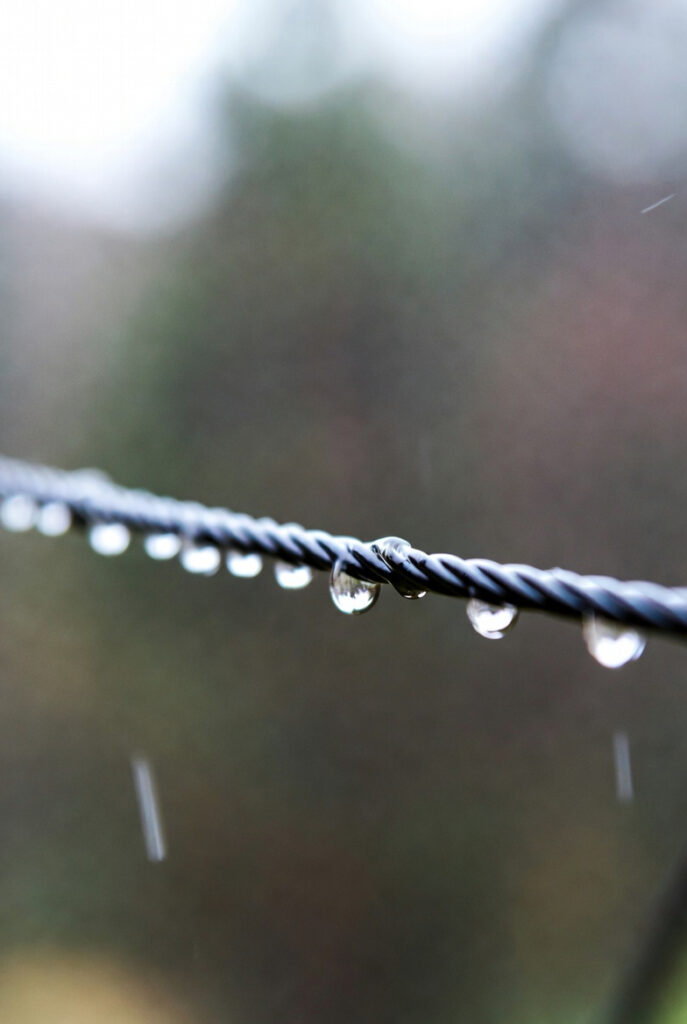
What surface tension wicking is: Water does not just fall straight down. On a curved surface a cable, a wire, a pipe, water molecules cling to the surface through surface tension forces. The adhesion between the water molecule and the copper or polymer cable surface is stronger than the gravitational force on the water droplet at small scales. The result: water clings to the cable surface and follows it downhill, uphill around gentle curves, and through small gaps where the cable penetrates a surface. This is the same capillary force covered in our Heat Shrink Battery Cable guide the same physics that wicks moisture up copper strands also drives rainwater along cable surfaces and through wall penetrations.
Why the downward cable entry is a funnel: When a solar homerun cable enters a building on a downward angle from the roof or wall-mounted panel array down to the equipment room the cable is a gravity-assisted water guide. Every raindrop that lands on the cable between the panel and the wall runs downhill along the cable surface. The wall penetration is at the lowest point of the exposed cable run. Water accumulates at this point. Silicone sealant provides a temporary barrier but under the continuous hydrostatic pressure of accumulated water the silicone bond to the cable jacket fails over time. Ontario freeze-thaw cycling accelerates this failure water that has forced its way under the sealant expands when it freezes and opens the penetration wider.
The creepage damage mechanism: Once moisture enters the equipment enclosure it deposits on circuit board surfaces the PCB material, the copper traces, and the component bodies. Water is not a perfect conductor but it is a sufficient conductor at the voltage differentials present on a solar charge controller PCB. The creepage distance the minimum distance between adjacent circuit traces that prevents current from arcing through a wet surface is typically 1-2mm on a residential solar charge controller PCB. A thin film of condensed moisture bridges this creepage distance creating a partial conductive path between adjacent traces. At 40-80V DC the current through this partial path is sufficient to cause component damage, trace corrosion, and progressive PCB degradation.
I opened a Victron SmartSolar MPPT at a Guelph cabin installation last summer the owner had been experiencing intermittent charging failures for two months, the VRM showing the MPPT going offline randomly during rain events. The correlation was obvious once I heard it described. I removed the MPPT from the wall and opened the enclosure. The terminal block for the PV input was visibly corroded green copper oxide on the terminal faces and traces of white mineral deposit on the PCB surface from repeated moisture cycling. The solar homerun cable entered the equipment room through a drilled hole in the exterior wall with no drip loop running straight from the roof panel array downward through the wall directly to the MPPT PV input terminal. Every rainstorm was wicking water along the cable surface, through the sealant, and depositing moisture into the terminal block. The MPPT cost $250. The repair including the service call was $320. A drip loop solar installation on commissioning day would have cost 6 inches of extra cable and 10 seconds of time. As covered in our Surge Protection guide moisture damage and lightning induction are the two most common causes of charge controller failure in Ontario off-grid installations the drip loop prevents one, the surge protector prevents the other.
The Drip Loop – The Mechanical Solution
What a drip loop is: A drip loop is a U-shaped section of cable that drops below the wall penetration point before looping back up to the entry hole. The physics is simple. Water follows the cable surface downhill to the bottom of the U. At the bottom of the U the water drops fall, gravity wins and the water falls to the ground. The water cannot climb back up the return leg against gravity. The entry point is always at or above the top of the U water cannot reach it. The drip loop is a gravity check valve that requires no moving parts, no maintenance, and no power.
The minimum drop dimension: The minimum drop below the entry point is 150-200mm (6-8 inches). At this drop height the gravitational pull on the water column in the cable surface film is sufficient to overcome the surface tension force that drives the water up the return leg. A loop that drops less than 150mm may not provide sufficient gravitational head to reliably prevent water from wicking up the return leg in heavy rain conditions. More is always better a 250mm drop provides reliable protection even in the horizontal wind-driven rain conditions common in Ontario storms.
The horizontal separation: The bottom of the drip loop should be at least 100mm horizontally away from the wall face preventing splashback from the falling water droplets from contacting the wall and re-wetting the cable above the entry point. A drip loop that hangs too close to the wall allows falling droplets to splash back onto the cable above the entry partially defeating the drip protection.
I was installing a drip loop solar demonstration for a client who was skeptical he had been running cables straight through walls for years without visible water damage and did not see the need. I asked him to hold a garden hose on the cable above the entry point while I watched inside. Water appeared at the wall penetration within 15 seconds. No drip loop. I then formed a 200mm drip loop in the cable, re-sealed the penetration, and repeated the test. The water ran to the bottom of the loop and dripped to the ground. Nothing at the penetration. He did not argue after that. As covered in our Solar System Labeling guide we labeled the cable at the drip loop position – DRIP LOOP – DO NOT SUPPORT OR ELIMINATE – so the Next Guy who works on the system understands why that loop is there.
The Cable Entry Gland — The Professional Seal Standard
What a cable entry gland is: A cable entry gland also called a cable strain relief fitting or PG fitting is a threaded fitting that installs in the wall penetration hole and provides both mechanical cable retention and environmental sealing. The gland has two sealing elements: an outer seal against the wall surface and an inner seal against the cable jacket. Together they provide IP68 sealing submersion-rated protection at the cable entry point.
Why silicone alone is insufficient: Silicone sealant applied around a cable in a drilled hole provides a single-point seal between the silicone and the cable jacket. This seal is adequate when the cable is stationary. Cable thermal expansion and contraction 4/0 AWG cable expands approximately 0.5mm per metre per 10°C temperature change stresses the silicone-to-jacket interface at every temperature cycle. Over three Ontario winters and summers this cycling opens micro-gaps at the silicone-to-jacket interface the same gaps that the drip loop solar is designed to prevent water from reaching.
The IP68 cable gland specification: A quality cable entry gland for solar homerun cable provides:
- IP68 environmental rating -submersion-rated sealing against the wall surface
- Cable clamping range that matches the cable jacket diameter 10 AWG to 4/0 AWG
- UV-resistant nylon or stainless steel body rated for outdoor exposure
- Double-seal construction outer seal against the wall penetration, inner seal against the cable jacket
- Strain relief prevents cable flex stress from being transmitted to the terminal connections inside
The combination standard: The professional drip loop solar installation combines both elements the drip loop provides the gravity check valve that stops water from reaching the entry point, and the cable entry gland provides the hermetic seal at the entry point for any water the drip loop does not stop. Belt and suspenders. Neither alone is the Fortress standard. Both together are.
The Complete Cable Routing Sequence
The Renogy 100W panel homerun cable drip loop installation:
- Run the homerun cable from the panel junction box down the mounting structure to the wall the cable runs downward on the exterior wall
- At the point where the cable reaches the wall penetration height continue the cable past the penetration point drop the cable an additional 200mm below the penetration height
- Form the U-loop bring the cable back up to the penetration height the bottom of the U is 200mm below the penetration
- Install the cable entry gland in the wall penetration hole thread the cable through the gland before forming the final connection
- Seal the gland flange to the wall surface with exterior-grade silicone as a secondary seal
- Secure the drip loop cable to the wall with a cable clamp at the top of each leg of the U maintaining the loop geometry permanently
- Complete the cable run inside to the Victron SmartSolar MPPT PV input terminals
The Victron MultiPlus-II AC cable entry: The same drip loop solar principle applies to the generator inlet cable and any AC cable that enters the equipment room from an exterior source. The generator cable runs from the outdoor inlet receptacle down the exterior wall and loops below the wall penetration before entering through a cable entry gland. Generator cable entries without drip loops are the second most common water entry path in off-grid equipment rooms after solar homerun cables.
NEC 230.54 and CEC Section 6 – The Code Standard
NEC 230.54 – USA: National Electrical Code Section 230.54 governs service entrance conductors and requires that service entrance cables be arranged to form a drip loop at the point of connection to the service head or weatherhead preventing water from entering the service entrance equipment. While NEC 230.54 is written specifically for utility service entrances the same physics and the same code intent apply to solar homerun cable entries. NEC 110.12 the workmanlike manner requirement extends the drip loop solar requirement to all cable entries subject to water exposure.
CEC Section 6 – Canada: The Canadian Electrical Code Section 6 governs service entrance conductors and requires drip loops for all service entrance conductors entering a building. The CEC interpretation for off-grid solar systems where the solar array is the power source applies the same drip loop requirement to the solar homerun cable as it would to a utility service entrance conductor. The CEC Section 6 requirement is enforced by ESA inspectors in Ontario a solar homerun cable entering a building without a drip loop and cable entry gland is a CEC Section 6 deficiency. As covered in our Equipment Bonding guide the complete weather protection standard for the equipment room includes cable entry sealing as a fundamental requirement alongside chassis bonding.
Quick Reference – Drip Loop Solar Installation Standards
| Element | Minimum Standard | Fortress Standard | Why |
|---|---|---|---|
| Loop drop below entry | 150mm (6 inches) | 200-250mm | Gravitational head overcomes surface tension |
| Horizontal standoff | 50mm from wall | 100mm from wall | Prevents splashback re-wetting |
| Cable entry sealing | Silicone sealant | IP68 cable entry gland + silicone | Gland survives thermal cycling |
| Loop support | Unsupported U | Cable clamps at each leg | Maintains loop geometry permanently |
| Label | None | DRIP LOOP — DO NOT ELIMINATE | Next Guy protection |
Pro Tip: Test every drip loop solar installation with a garden hose before closing up the exterior wall not after. Run water on the cable above the entry point for 30 seconds and check inside for any moisture at the cable gland or wall penetration. This is the 30-second commissioning test that confirms the drip loop and cable entry gland are working before the equipment room is sealed. If any moisture appears inside during the hose test disassemble the entry point check the gland seating, check the silicone secondary seal, and verify the loop geometry. Do not assume the seal is good. Test it. As covered in our Off-Grid Solar Maintenance guide document the hose test result in the commissioning log pass or fail with the date.
The Verdict
A drip loop solar cable installation costs nothing but 6 inches of extra cable and 10 seconds of time and it protects a $250 charge controller from the most common water entry failure in off-grid systems.
Three steps to implement the drip loop standard today:
- Drop the cable 200mm below the wall entry point before looping back up the bottom of the U must be at least 150mm lower than the entry point
- Install an IP68 cable entry gland at the wall penetration silicone sealant alone is insufficient for thermal cycling environments
- Test with a garden hose before commissioning confirm no moisture inside before the equipment room is sealed
Gravity is free. Use it to your advantage. Every cable entry. Every time.
Disclosure: This article contains affiliate links. If you buy through them, GridFree Guide earns a small commission at no extra cost to you.
Questions? Drop them below.
About the Author
Robert Bertrand spent 20 years as a service advisor in the automotive industry (Lexus and Nissan), where precision diagnostics, wiring integrity, and documentation standards were non-negotiable. He brings that same technical discipline to GridFree Guide, where he researches, tests, and documents off-grid solar systems for Ontario conditions. Based in Rockwood, Ontario, every article is built on verified specifications, manufacturer data, and the real-world climate constraints of Canadian off-grid living.
As an Amazon Associate I earn from qualifying purchases. This site also contains affiliate links to other products and services. GridFree Guide earns a small commission at no extra cost to you.