
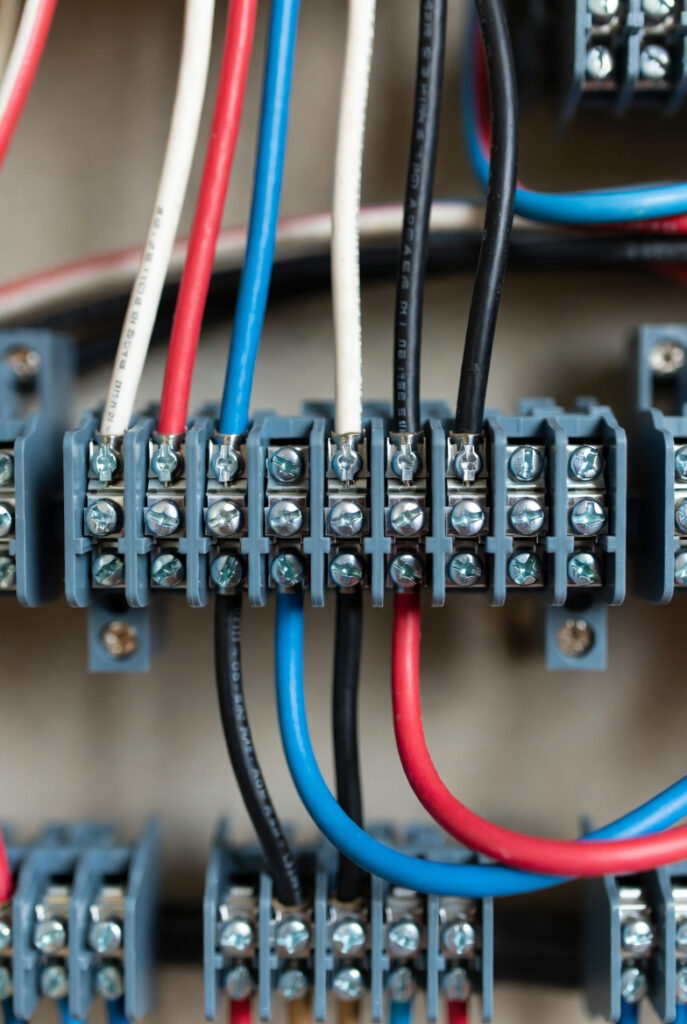
A ferrule wire termination is the difference between a screw terminal connection that lasts 25 years and one that melts the breaker housing in 18 months silently, without tripping the breaker, while you assume the system is running perfectly. Fine-stranded copper wire is flexible, easy to route, and the correct choice for any wiring run that must flex or bend. But when that fine-stranded wire lands in a screw terminal without a ferrule the individual strands splay outward under the screw pressure the center strands compress, the outer strands escape and you end up with approximately 60% contact area where you need 100%. Before understanding the ferrule standard understand how much solar power you actually need the system current determines how much heat a degraded terminal connection generates.
Ferrule Wire Termination: The Splayed Strand Problem
What happens without a ferrule: Fine-stranded wire the flexible copper wire used for most off-grid wiring runs consists of dozens to hundreds of individual copper strands. The flexibility comes from the strand count: the more strands, the more flexible the cable. The problem appears at termination. When the bare wire end is inserted into a screw terminal and the screw is tightened the screw face contacts the topmost strands and drives them downward. The center strands compress. The outer strands at the perimeter have no lateral restraint they splay outward, escaping the terminal bore, forming a ring of exposed wire around the terminal entry point.
The contact area calculation: A correctly installed ferrule wire termination achieves approximately 95-100% contact between the copper strands and the terminal bore the solid ferrule body presents a flat, uniform copper surface to the screw face. A naked fine-stranded wire termination achieves approximately 55-65% contact the strands that remain within the bore are in good contact, but the splayed strands that escaped contribute nothing to the electrical connection and instead create a stray strand hazard.
The I²R heat calculation: Contact area reduction increases terminal resistance. At 60% effective contact area the terminal resistance is approximately 0.8 milliohms above nominal the same resistance increase mechanism covered in our Busbar Torque Spec guide for under-torqued busbar connections. At 60A: P = 60² × 0.0008 = 2.88 watts concentrated at a single screw terminal. At nearly 3 watts in the confined space of a plastic circuit breaker housing the local temperature rises to 80-120°C above the ABS plastic housing rating of 70-80°C. The plastic softens. The terminal geometry shifts. The contact resistance increases further. The heat increases further. The plastic chars. The breaker never trips because the current never exceeded its rated threshold it was a slow thermal failure, not a short circuit.
I was inspecting a Rockwood garage solar installation last spring the client had noticed a burning smell from the equipment panel during a sunny day at full production. I found a 60A DC breaker with a charred and partially melted plastic housing. The wire entering the terminal was fine-stranded 6 AWG with no ferrule. I removed the breaker and examined the terminal: outer strands splayed, visible oxidation on the escaped strand tips, the compressed center strands discolored from heat. I measured the terminal resistance with a milliohm meter 0.81 milliohms above the nominal clean terminal value. At 60A production: P = 60² × 0.00081 = 2.92 watts at that one terminal. The breaker housing had been absorbing nearly 3 watts continuously during every sunny day for 18 months. A ferrule wire termination installed at commissioning would have prevented every joule of that heat. As covered in our Thermal Imaging guide the thermal camera would have flagged this connection at the 5°C yellow threshold long before it reached the charring stage but only if the commissioning scan had been run.
The Stray Strand Ground Fault – The Silent Failure Mode
What a stray strand is: When fine-stranded wire is terminated without a ferrule the splayed outer strands that escape the terminal bore are not contained. In an AC distribution panel or inverter terminal block these stray strands individual copper wires 0.1-0.3mm in diameter can bridge the 2-6mm gap between an energized terminal and the adjacent grounded chassis or neutral conductor. A single 0.1mm copper strand bridging a 2mm gap creates a partial fault path that the breaker may not see coming.
The partial fault current: A 0.1mm diameter copper strand with 2mm length has a resistance of approximately 4.4Ω. At 120VAC: I = 120V / 4.4Ω = 27A sufficient to cause severe arcing and component damage. At 240VAC: I = 240V / 4.4Ω = 54A. The fault current through the stray strand vaporizes it almost instantly but the arc that forms as the strand vaporizes can ignite adjacent insulation material before the breaker responds. The ferrule wire termination eliminates this failure mode entirely by physically containing every strand within the ferrule sleeve.
Where stray strands cause the most damage:
- AC distribution panel terminals 120/240VAC with chassis ground adjacent
- Victron SmartSolar MPPT PV input terminals – high DC voltage with chassis ground nearby
- Victron Cerbo GX communication terminal blocks- low voltage sensitive electronics
- Inverter AC output terminal block 120VAC with chassis ground adjacent
The Ferrule Specification – Size, Color, and Crimp Standard
What a ferrule is: A ferrule is a tin-plated copper sleeve typically 10-12mm long that slides over the stripped end of a fine-stranded wire. The ferrule body encapsulates all the strands within its bore. When the ratcheting crimper compresses the ferrule body the strands are cold-welded into a solid copper block all strands in contact, no gaps, no splaying possible. The crimped ferrule end presents a solid, flat copper face to the screw terminal 100% contact area, zero strand gaps, zero stray strand risk.
The IEC 60228 ferrule color code:
- 0.5mm² wire: white ferrule
- 0.75mm² wire: grey ferrule
- 1.0mm² wire: black ferrule
- 1.5mm² wire: blue ferrule
- 2.5mm² wire: red ferrule
- 4.0mm² wire: grey ferrule (double entry)
- 6.0mm² wire: yellow ferrule
- 10mm² wire: orange ferrule
- 16mm² wire: light blue ferrule
The ratcheting crimper requirement: As with MC4 connector crimping covered in our MC4 Connector Crimping guide the ferrule wire termination requires a ratcheting crimper a tool that will not release until the full compression cycle is complete. The WBHome ratcheting ferrule crimper is the correct specification for residential off-grid ferrule work it includes dies for the full range of ferrule sizes from 0.5mm² to 16mm² and the ratcheting mechanism prevents partial crimps.
The correct ferrule installation procedure:
- Strip the wire to the correct strip length typically equal to the ferrule body length no bare wire should be visible beyond the ferrule sleeve
- Insert all strands fully into the ferrule body – no strands outside the ferrule
- Place the ferrule in the correct die matched to the ferrule size and wire gauge
- Close the ratcheting crimper fully, the tool releases automatically when compression is complete
- Inspect the ferrule body is uniformly compressed and the wire is immovable by hand tension
- Insert the ferrule end into the screw terminal, the solid copper face seats against the terminal bore
- Tighten the terminal screw to specification the flat ferrule face distributes the clamp force uniformly
I was demonstrating the ferrule wire termination to a client who had been terminating all his wiring naked he had built three prior solar systems and had never heard of ferrules. I crimped a ferrule on a piece of 6 AWG fine-stranded wire and handed him the ferrule end to feel. Solid. Like a machined copper pin. I then handed him the naked wire end of the same cable and told him to push on the strands. They moved. He looked at me and said: these go into breaker terminals? These go into breaker terminals. He ordered a ferrule kit and a ratcheting crimper before I left the driveway.
When Ferrules Are Required vs Optional
Required – ferrule wire termination mandatory:
- Fine-stranded wire at any screw terminal / breakers, terminal blocks, charge controller inputs, inverter terminal strips
- Any wire landing in a terminal block where adjacent energized conductors are within 6mm stray strand hazard zone
- Manufacturer specifications that explicitly require terminated wire ends Victron, Schneider, and Midnite Solar all publish these requirements
Not required – ferrule optional or unnecessary:
- Solid wire at screw terminals – the solid conductor provides adequate contact area without a ferrule
- Pre-tinned wire ends – the factory solder-tinned tip provides a solid termination surface
- Ring terminal or fork terminal connections – the mechanical terminal provides full contact area
The manufacturer warranty consideration: Most professional off-grid equipment manufacturers including Victron specify in their installation manuals that wire terminations at screw-type terminals should use appropriate termination methods for the conductor type. A melted terminal on a unit connected with naked fine-stranded wire is exactly the installation condition that allows a warranty denial on grounds of improper installation. The ferrule wire termination is not just good practice it is the manufacturer compliance standard that keeps warranties intact.
UL 486A-486B and CEC Section 12 – The Termination Standard
UL 486A-486B – USA: UL Standard 486A-486B governs wire connectors and soldering lugs for use with copper conductors. The standard establishes that termination methods must ensure adequate contact area and mechanical retention for the conductor type and gauge. A ferrule wire termination on fine-stranded wire satisfies UL 486A-486B by providing the solid contact surface and full strand encapsulation that the standard requires for screw-type terminal connections.
CEC Section 12 – Canada: The Canadian Electrical Code Section 12 connection requirements mandate that all electrical connections be made in a manner that ensures adequate contact and long-term integrity. As covered in our Busbar Torque Spec guide the CEC Section 12 standard applies to every terminal in the system including the small-gauge screw terminals at charge controllers, communication interfaces, and AC distribution panels. A naked fine-stranded wire termination that achieves only 60% contact area does not satisfy the CEC Section 12 long-term integrity requirement. As covered in our Battery Cable Crimping guide the cold weld standard applies at every conductor termination in the system from 4/0 AWG battery lugs down to 18 AWG ferrule terminations at communication terminals.
Quick Reference – Ferrule Wire Termination Selection Guide
| Wire Gauge | Ferrule Size | IEC Color | Application |
|---|---|---|---|
| 18 AWG (0.75mm²) | 0.75mm² | Grey | Communication wiring, signal circuits |
| 16 AWG (1.5mm²) | 1.5mm² | Blue | Control circuits, small AC loads |
| 14 AWG (2.5mm²) | 2.5mm² | Red | 15-20A branch circuits |
| 12 AWG (4.0mm²) | 4.0mm² | Grey | 30A branch circuits, MPPT outputs |
| 10 AWG (6.0mm²) | 6.0mm² | Yellow | 60A breakers, MPPT PV inputs |
| 8 AWG (10mm²) | 10mm² | Orange | 80A circuits, main AC inputs |
Pro Tip: Buy the ferrule kit that includes the ratcheting crimper not the ferrule sleeves alone. The crimper die geometry determines the quality of the cold weld compression. A generic plier-type crimper on a ferrule produces the same oval compression problem as pliers on an MC4 terminal partial compression, strand gaps, elevated resistance. The ratcheting crimper with the square or hexagonal die produces the uniform compression that delivers the 100% contact area the ferrule is designed for. A quality ferrule kit with ratcheting crimper and a full assortment of sizes from 0.5mm² to 16mm² costs approximately $35-50. The melted 60A breaker housing costs $45-80 to replace plus the investigation, the downtime, and the warranty exposure. As covered in our Solar System Labeling guide label the ferrule crimper storage location in the equipment room the Next Guy needs to know where it is when they add a circuit.
The Verdict
A ferrule wire termination is a $0.10 component and 30 seconds that prevents an $80 melted breaker, a warranty denial, and a potential stray strand fault.
Three steps to implement the ferrule standard today:
- Audit every fine-stranded wire screw terminal in the system any naked wire end is a ferrule wire termination deficiency that needs correction before the next full-production day
- Install the correct size ferrule — match the IEC color code to the wire gauge crimp with the ratcheting tool
- Inspect after installation the ferrule end should be solid and immovable, the terminal screw should contact a flat copper face, not individual strands
Dress the wire for success. Every terminal. Every time.
Disclosure: This article contains affiliate links. If you buy through them, GridFree Guide earns a small commission at no extra cost to you.
Questions? Drop them below.
About the Author
Robert Bertrand spent 20 years as a service advisor in the automotive industry (Lexus and Nissan), where precision diagnostics, wiring integrity, and documentation standards were non-negotiable. He brings that same technical discipline to GridFree Guide, where he researches, tests, and documents off-grid solar systems for Ontario conditions. Based in Rockwood, Ontario, every article is built on verified specifications, manufacturer data, and the real-world climate constraints of Canadian off-grid living.
As an Amazon Associate I earn from qualifying purchases. This site also contains affiliate links to other products and services. GridFree Guide earns a small commission at no extra cost to you.