
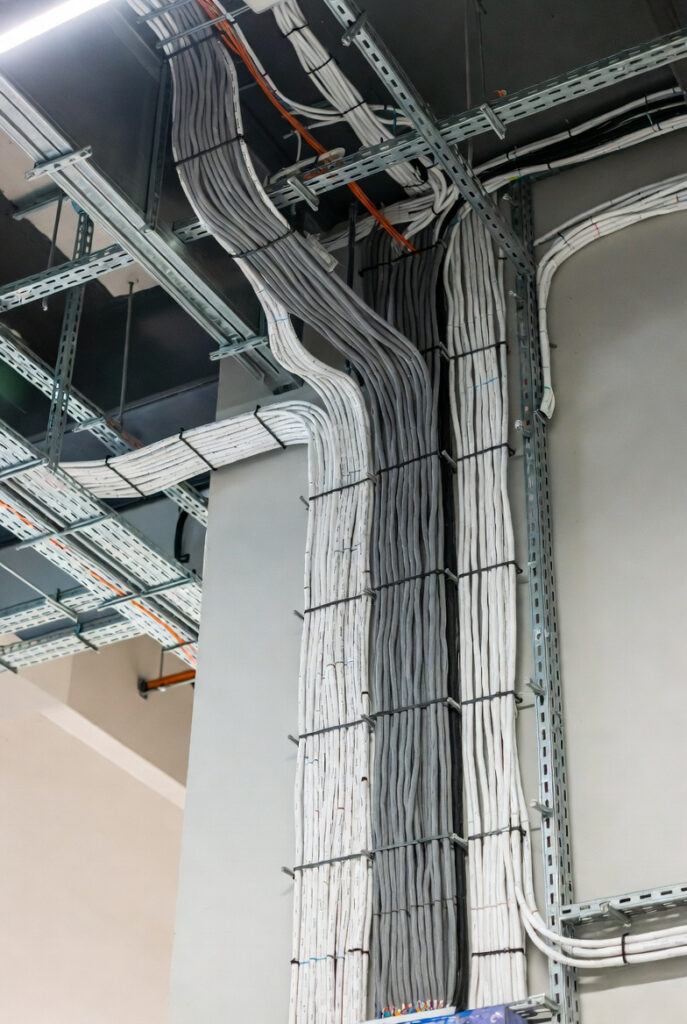
The busbar layout solar equipment room standard is the difference between an inverter running at full rated output all summer and one that throttles to 50% because the equipment room turned into a heat trap. Most DIY off-grid equipment rooms have one thing in common: 4/0 AWG cables bundled together and zip-tied in a tight cluster because it looks tidy. It does not look tidy. It looks like a rat’s nest and more importantly it is derating the cable ampacity, elevating the ambient temperature, and pushing the Victron MultiPlus-II toward its thermal derating threshold before the hottest day of the Ontario summer arrives. Before organizing the equipment room understand how much solar power you actually need the system current determines how much heat the cables generate and how critical the busbar layout solar spacing standard becomes.
Busbar Layout Solar: The Physics of Cable Heat
Why 4/0 AWG cables generate heat: Every current-carrying conductor generates heat proportional to I²R the current squared times the conductor resistance. A 4/0 AWG copper conductor has a resistance of approximately 0.0001604Ω per foot. At 200A: P = 200² × 0.0001604 = 6.4 watts per foot of conductor. In a typical equipment room with 3 feet of main cable run the cable generates approximately 19 watts of heat. This heat must be dissipated into the surrounding air through convection or it accumulates in the conductor and raises the temperature above the insulation rating.
The convection cooling mechanism: Natural convection works by allowing warm air adjacent to the cable surface to rise and be replaced by cooler ambient air from below. The convection rate depends on the temperature differential between the cable surface and the ambient air, and on the available surface area exposed to free air. A 4/0 AWG cable with 25mm of clear air space on all sides has its full surface area available for convection the warm air rises freely, cool air replaces it, and the cable temperature stabilizes well below the insulation rating.
What bundling does to convection: When two or more 4/0 AWG cables are bundled together touching or within a few millimeters the contact surfaces between cables are insulated from convection entirely. Each cable generates 6.4 watts per foot. The adjacent cable generates another 6.4 watts per foot. The heat from both cables must now escape through the outer surface of the bundle half the surface area for twice the heat. The bundle temperature rises until the outer surface can dissipate the combined heat load. The inner cables run significantly hotter than the outer cables. The inner insulation ages faster. The system fails from the inside out.
The NEC 310 Ampacity Derating – The Code Consequence of Bundling
What ampacity derating means: National Electrical Code Section 310.15(B)(3)(a) requires that when more than three current-carrying conductors are bundled together or installed in a raceway the ampacity of each conductor must be reduced derated to account for the mutual heating effect. The derating factors:
- 4-6 conductors bundled: derate to 80% of rated ampacity
- 7-9 conductors bundled: derate to 70% of rated ampacity
- 10-20 conductors bundled: derate to 50% of rated ampacity
What this means for 4/0 AWG: A 4/0 AWG copper conductor has a rated ampacity of 230A at 75°C insulation rating in free air. If four 4/0 AWG conductors are bundled together the derated ampacity is: 230A × 0.80 = 184A. A system drawing 200A continuous through these bundled cables is exceeding the derated ampacity by 8.7% a NEC 310 violation that produces exactly the overheating and insulation degradation the derating factor was designed to prevent.
The minimum air gap standard: NEC 310.15(B)(3)(a) Note 1 specifies that conductors separated by a distance greater than their diameter are not considered bundled for derating purposes. For 4/0 AWG cable with an outer diameter of approximately 20-22mm the minimum air gap that prevents bundling derating is approximately 22mm call it 25mm for margin. This is the busbar layout solar air gap standard: 25mm minimum between all current-carrying conductors.
I opened an equipment room enclosure on a client system last autumn for a routine thermal camera scan as covered in our Thermal Imaging guide. The main positive and negative 4/0 AWG cables were bundled together with three zip ties for the 18-inch run between the battery and the busbar. Under a 180A load the thermal camera showed the bundle at 67°C. The individual cable runs at the battery terminal and the busbar connection were at 38°C the same cable, the same current, 29°C hotter in the bundle. The derating factor for the bundled pair applied the cables were rated for 184A derated but the bundle temperature at 180A was already within 8°C of the 75°C insulation limit. We separated the cables with a 30mm PVC spacer and re-ran the thermal scan. Bundle temperature: 41°C at the same 180A load. As covered in our Busbar Torque Spec guide the cable separation also improved the lug contact geometry at the busbar terminals two improvements from one 10-minute fix.
The Inverter Thermal Derating – Why Equipment Room Temperature Matters
What inverter thermal derating is: Every inverter has a thermal derating curve a specification that defines the maximum output power as a function of ambient temperature. The Victron MultiPlus-II begins output derating at approximately 40°C ambient temperature. Above 40°C the maximum output power decreases linearly until at approximately 60°C ambient the output is derated to approximately 50% of rated power. A 3000VA MultiPlus-II in a 60°C equipment room delivers 1500VA maximum on the hottest afternoon of an Ontario August when the AC and the well pump are both running.
How cable bundling contributes to equipment room temperature: The 19 watts of heat generated by the main cable run in a properly spaced busbar layout solar installation dissipates into the equipment room air and exits through ventilation. The same 19 watts generated in a bundled run where the bundle temperature reaches 67°C radiates heat to the adjacent inverter and busbar components rather than dissipating cleanly. The equipment room ambient temperature rises. The inverter ambient temperature rises. The thermal derating curve engages. The system that was designed for 3000VA continuous delivers 2100VA on the day it is needed most.
The Victron Cerbo GX temperature monitoring: The Cerbo GX VRM portal logs the inverter internal temperature continuously. An inverter showing progressive temperature increases over the summer while the load profile remains constant is the signature of increasing equipment room ambient temperature from bundled cable heat accumulation. Review the VRM temperature log before each summer season as covered in our Off-Grid Solar Maintenance guide.
The Professional Busbar Layout – The Fortress Standard
The cable routing principles: A professional busbar layout solar installation follows these routing principles:
- Positive and negative cables run in parallel not bundled with 25mm minimum separation
- Cable runs follow the shortest path between connection points – no slack loops
- All cables are dressed parallel to the equipment room walls or busbar face – no diagonal runs
- Cable crossovers are minimized where unavoidable they cross at 90° and are separated by a cable clamp spacer
- The Victron Lynx Power-In and Lynx Distributor are mounted at a height that allows the 4/0 AWG homerun cables to drop vertically from the busbar to the battery the natural cable route that minimizes run length and eliminates bundling
The inverter mounting position: The MultiPlus-II ventilation slots are on the sides and back of the enclosure. The inverter must be mounted with a minimum 200mm clear space on both sides and 150mm behind not flush against the equipment room wall. The clear space allows the inverter’s internal fan to draw cool air in through the sides and exhaust warm air upward. Mounting the inverter flush against a wall blocks the side ventilation and raises the internal temperature toward the derating threshold.
The visual standard: I completed the cable layout on a Rockwood Fortress build last November every cable run parallel and horizontal, 30mm spacers between positive and negative homerun cables, each run labeled with heat-shrink identification markers, the Lynx Power-In centered on the equipment room wall at eye level, the MultiPlus-II mounted with 250mm clearance on both sides. The client walked in and stood there for a moment. He said: it looks like something out of a factory. That is the standard. The Lexus engine bay, not the junk drawer. Equipment that looks engineered runs like it was engineered. As covered in our Solar System Labeling guide the labeled cable runs are the final step that makes the installation legible to anyone who opens the equipment room door including the insurance adjuster and the electrical inspector.
CEC Section 4 – The Canadian Ampacity Standard
CEC Section 4 – Canada: The Canadian Electrical Code Section 4 ampacity tables and correction factors include equivalent bundling derating requirements to NEC 310. CEC Rule 4-004 requires that conductors installed in conduit or bundled together have their ampacity adjusted for the number of current-carrying conductors present. The CEC bundling derating factors align with NEC 310.15(B)(3)(a) the 25mm air gap standard that prevents bundling classification satisfies both NEC and CEC requirements simultaneously. The busbar layout solar standard 25mm minimum separation between all current-carrying conductors is the single layout rule that satisfies NEC 310, CEC Section 4, and the inverter thermal derating management requirement in one physical arrangement. As covered in our Battery Fortress guide the enclosure design must accommodate the 25mm air gap standard from the planning stage retrofitting proper cable separation into an undersized enclosure is significantly more difficult than designing for it from the start.
Quick Reference – Busbar Layout Solar Spacing Standards
| Cable Situation | NEC/CEC Status | Temperature Impact | Action Required |
|---|---|---|---|
| Single 4/0 AWG in free air | Compliant full ampacity | Baseline 38°C at 180A | No action |
| Two 4/0 AWG bundled touching | Non-compliant 80% derating | +29°C above baseline | Separate with 25mm spacer |
| Three+ 4/0 AWG bundled | Non-compliant 70% or less | +40°C or more above baseline | Immediate separation required |
| Inverter flush against wall | Ventilation blocked | Thermal derating engaged | Remount with 200mm clearance |
| Cables 25mm apart in free air | Compliant full ampacity | Near baseline temperature | Fortress standard met |
Pro Tip: Use the thermal camera scan as the final quality control step after any cable layout change before closing up the equipment room. Run the system at 70-80% load for 15 minutes to allow thermal equilibration, then scan every cable run and connection point. Any cable showing more than 10°C above an adjacent cable running the same current is either undersized, underseparated, or has an elevated resistance connection. The thermal scan is the objective confirmation that the busbar layout solar standard has been achieved not just visually but thermally. Photograph every scan and store it in the commissioning log as covered in our Thermal Imaging guide the baseline scan is the reference that makes future scans meaningful.
The Verdict
A professional busbar layout solar installation runs 10°C cooler, stays within NEC 310 and CEC Section 4 ampacity requirements, and keeps the inverter out of thermal derating on the hottest day of the Ontario summer.
Three layout rules to implement today:
- Separate all current-carrying conductors by 25mm minimum – no bundling, no zip-ties pulling cables together use PVC spacers or cable clamps
- Mount the inverter with 200mm clear space on both sides – never flush against the equipment room wall
- Run the thermal camera scan after layout and confirm no cable more than 10°C above its neighbor at the same current
The Lexus engine bay, not the junk drawer. Every time.
Disclosure: This article contains affiliate links. If you buy through them, GridFree Guide earns a small commission at no extra cost to you.
Questions? Drop them below.
About the Author
Robert Bertrand spent 20 years as a service advisor in the automotive industry (Lexus and Nissan), where precision diagnostics, wiring integrity, and documentation standards were non-negotiable. He brings that same technical discipline to GridFree Guide, where he researches, tests, and documents off-grid solar systems for Ontario conditions. Based in Rockwood, Ontario, every article is built on verified specifications, manufacturer data, and the real-world climate constraints of Canadian off-grid living.
As an Amazon Associate I earn from qualifying purchases. This site also contains affiliate links to other products and services. GridFree Guide earns a small commission at no extra cost to you.