
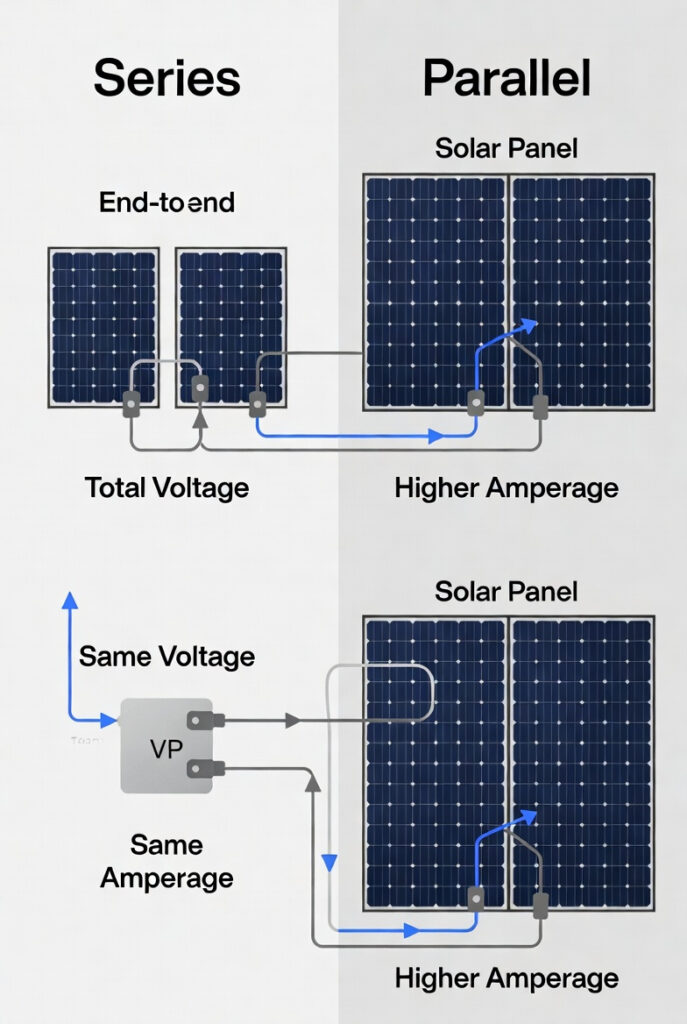
Two 400W solar panels. You can wire them in series or in parallel. Series gives you 80V at 10A. Parallel gives you 40V at 20A. Same panels. Same power. Completely different behavior from your MPPT charge controller. Get it wrong and your 48V battery bank sits uncharged all morning because the array voltage never exceeded the battery voltage. Or your MPPT blows on a cold January morning because the series string VOC hit 152V on a controller rated for 150V. Series parallel solar wiring is not a preference it is a calculation. Before wiring a single panel understand how much solar power you actually need the battery bank voltage and the MPPT specifications determine which configuration is correct.
Series Parallel Solar Wiring: The Physics of Voltage and Current
What happens in series: In a series connection the positive terminal of one panel connects to the negative terminal of the next. The voltages add two panels each rated at 40V VOC produce 80V VOC as a string. The current stays the same the string carries the same amperage as a single panel (typically 10-12A for a standard 400W panel). The series string is the high-pressure configuration high voltage, limited current. As covered in our Wire Gauge guide high voltage circuits carry less current for the same power level and less current means less line loss over long cable runs.
What happens in parallel: In a parallel connection all panel positives connect together and all panel negatives connect together through MC4 branch connectors. The currents add wo panels each producing 10A deliver 20A to the MPPT. The voltage stays the same as a single panel (40V VOC). The parallel array is the high-flow configuration same voltage, doubled current.
The fundamental trade-off: Neither series nor parallel is inherently superior. The correct series parallel solar wiring configuration depends on four factors:
- MPPT maximum input voltage — the series string VOC must never exceed this at any temperature
- MPPT minimum start voltage — the array VOC must exceed the battery voltage by at least 5V
- Shade exposure — series strings are vulnerable to shade, parallel arrays are shade-tolerant
- Cable run length — series strings carry lower current and lose less power over long cable runs
Why Your 48V System Needs More Than 40V Panels in Parallel
The MPPT minimum start voltage problem: The Victron SmartSolar MPPT 100/50 and all MPPT charge controllers require that the solar array voltage exceed the battery voltage by a minimum margin before the controller begins charging. For a 48V LiFePO4 bank at full charge (56.8V absorption voltage) the MPPT requires the solar array to present at least 61-62V before it can begin tracking and charging.
What this means for full parallel wiring on a 48V system: A standard 400W panel has a VOC of approximately 40-48V and a VMPP of approximately 32-36V. Two panels in parallel: VOC = 40-48V, VMPP = 32-36V. On a clear morning the MPPT sees 42V from the parallel array and the battery is at 53V resting. The array voltage (42V) is below the battery voltage (53V). The MPPT cannot begin charging. The array sits in open circuit producing zero power until the battery discharges low enough that the array voltage exceeds it. This is the full parallel failure mode on a 48V system with standard voltage panels.
The series solution: Two panels in series: VOC = 84-96V, VMPP = 64-72V. On a clear morning the MPPT sees 88V from the series string and the battery is at 53V. The array voltage (88V) exceeds the battery voltage by 35V well above the minimum start margin. The MPPT begins tracking immediately. The system produces maximum power from the first usable irradiance of the day.
The Shade Tolerance Problem – Why Series Fails in Wooded Lots
The Christmas light problem: A series string behaves like a series circuit the current of the entire string is limited by the weakest panel. If one panel in a series string receives 30% shade its current output drops to 30% of rated. The entire string current drops to 30% even though the other panels in the string are fully illuminated. One bad panel takes out the strand.
The parallel advantage: In a parallel array each panel operates independently. A shaded panel produces less current but the other panels continue producing at full current. Two panels in parallel one fully shaded, one fully illuminated produces 50% of rated array current from the illuminated panel alone.
I diagnosed a series-wired system on a wooded Rockwood lot last autumn the owner had wired four panels in a single series string. One large spruce tree shaded panel 2 of the 4-panel string from approximately 10am to 2pm the peak solar window. The VRM data showed the string output during this window: 85W actual vs 1,200W rated 7% of rated output during peak sun hours. The shading on one panel was collapsing the current of all four panels. We rewired to a 2S2P configuration two strings of two panels in parallel. When the spruce shaded panel 2 the affected series string dropped to reduced output while the unaffected series string continued at full output. Peak window output: 680W 57% of rated vs the previous 7%. The shade was the same. The series parallel solar wiring configuration made all the difference. As covered in our Solar Combiner Box guide the combiner box is where the parallel strings come together each string individually fused.
The 2S2P Standard – The 48V Fortress Configuration
What 2S2P means: 2S2P means 2 panels in Series, 2 of those series strings in Parallel. For a 4-panel 400W array on a 48V system:
- String 1: Panel A + Panel B in series = 80V VOC at 10A
- String 2: Panel C + Panel D in series = 80V VOC at 10A
- Strings 1 and 2 in parallel: 80V VOC at 20A total
Why 2S2P solves the trade-offs:
- MPPT start voltage: 80V VOC well above the 56.8V full-charge battery voltage
- Shade tolerance: two independent strings shading on one string does not collapse the other
- Cold weather VOC: 80V nominal × 1.175 temperature correction = 94V at -25°C within the 100V MPPT maximum
- Wire gauge: 10A per string 10 AWG solar cable is correct for most residential cable run lengths
Scaling for larger arrays:
- 8-panel array: 2S4P — two panels per string, four strings in parallel
- 12-panel array: 3S4P or 2S6P depending on panel VOC and MPPT maximum input voltage
- Always verify the cold weather VOC for the series component before finalizing the configuration
The Cold Weather VOC Calculation – The Ontario Safety Check
Why cold weather increases VOC: Solar panel voltage increases as cell temperature decreases. The temperature coefficient for VOC is typically -0.35%/°C for crystalline silicon panels for every degree Celsius below 25°C (Standard Test Condition) the VOC increases by 0.35%.
The Ontario winter calculation: For a -25°C Ontario January morning the temperature delta from STC is 50°C below STC. VOC increase: 50°C × 0.35%/°C = 17.5% above rated STC VOC.
For a 2-panel series string with a panel VOC of 40V:
- Series string STC VOC: 80V
- Cold weather VOC: 80V × 1.175 = 94V at -25°C
- Victron SmartSolar MPPT 100/50 maximum input voltage: 100V
- Safety margin: 100V – 94V = 6V — acceptable for 2S configuration ✅
The dangerous 3S configuration: For a 3-panel series string with the same 40V panel:
- Series string STC VOC: 120V
- Cold weather VOC: 120V × 1.175 = 141V at -25°C
- MPPT maximum input voltage: 100V
- Overvoltage by 41V immediate controller damage on first clear cold morning ❌
I caught this exact scenario on a client’s design before they installed. They had planned three panels in series with their Victron MPPT 100/50. The panel VOC was 41V. Three in series: STC VOC 123V. Cold weather VOC at -25°C: 123V × 1.175 = 144.5V – 44.5V above the 100V MPPT limit. The MPPT would have been destroyed on the first clear January morning. We redesigned to 2S2P. Cold weather VOC: 82V × 1.175 = 96.4V within the 100V limit with 3.6V to spare. The Renogy 100W panel VOC specification is the starting point for this calculation always verify with the actual panel datasheet before finalizing the series parallel solar wiring configuration.
Line Loss – Why Series Wins on Long Cable Runs
The line loss calculation: Power lost in a cable run is: P_loss = I² × R_cable. For 10 AWG solar cable with a resistance of approximately 0.003Ω per foot (round trip):
Series configuration (80V at 10A) over a 50-foot homerun:
- R_cable = 100 feet round trip × 0.003Ω/ft = 0.3Ω
- P_loss = 10² × 0.3Ω = 30 watts 3.75% of 800W array
Parallel configuration (40V at 20A) over the same run:
- Same cable resistance: 0.3Ω
- P_loss = 20² × 0.3Ω = 120 watts 15% of 800W array
The series configuration loses 30W. The parallel configuration loses 120W. Same cable. Same array. Same run. Four times the line loss in the parallel configuration because line loss scales with current squared. As covered in our MC4 Connector Crimping guide every connection in the homerun adds resistance the lower current of the series configuration minimizes the impact of every joint resistance in the system.
NEC 690.7 and CEC Section 64 – The Cold Weather Code
NEC 690.7: National Electrical Code Section 690.7 requires that the maximum system voltage for a photovoltaic system be calculated using the cold weather voltage correction factor. NEC 690.7(A) requires that for crystalline silicon panels the voltage temperature coefficient be applied at the lowest expected ambient temperature for the installation location. For Ontario the lowest expected ambient temperature for code purposes is typically -20°C to -30°C. The resulting cold weather VOC must not exceed the MPPT maximum input voltage the series parallel solar wiring configuration must satisfy this requirement before energization.
CEC Section 64 – Canada: The Canadian Electrical Code Section 64 for photovoltaic systems includes equivalent cold weather voltage requirements. Every series parallel solar wiring configuration must be verified against the cold weather VOC calculation before energization the MPPT maximum input voltage is the hard limit that the cold weather VOC must not exceed. As covered in our System Voltage guide the 48V system voltage standard is what drives the 2S configuration requirement lower system voltages may accommodate different series parallel solar wiring approaches.
Quick Reference – Series Parallel Solar Wiring Comparison
| Configuration | Voltage | Current | Shade Tolerance | Line Loss | Best For |
|---|---|---|---|---|---|
| Full series (4S) | 160V | 10A | Poor | Lowest | Long runs, low shade |
| Full parallel (4P) | 40V | 40A | Excellent | Highest | Short runs, high shade |
| 2S2P | 80V | 20A | Good | Low | Most Ontario cabin builds |
| 3S (3 panels) | 120V+ | 10A | Poor | Lowest | Check cold VOC first |
Pro Tip: Always verify the cold weather VOC before purchasing your MPPT charge controller not after. The cold weather VOC of your planned series configuration determines the minimum MPPT maximum input voltage you need. If the cold weather VOC is 94V buy the MPPT 100/50 (100V maximum). If the cold weather VOC is 120V you need the MPPT 150/60 (150V maximum) or a redesigned configuration. Buying the MPPT first and designing the array around it rather than calculating the cold weather VOC first leads to the three-panels-in-series-on-a-100V-controller scenario that has cost more than one client a fried charge controller.
The Verdict
Series parallel solar wiring is a calculation not a preference. The 2S2P hybrid is the standard for most 48V Ontario cabin installations because it satisfies all four constraints simultaneously.
Before energizing any array:
- Confirm the 2S2P cold weather VOC is below the MPPT maximum input voltage with at least 5% margin
- Confirm the MPPT start voltage is achievable series string VOC must exceed battery voltage by at least 5V
- Confirm wire gauge is correct for the parallel current 10 AWG for 10A strings, 8 AWG for 20A combined homerun
The panels are the engine. The wiring configuration is the transmission. Get the gear ratio right.
Disclosure: This article contains affiliate links. If you buy through them, GridFree Guide earns a small commission at no extra cost to you.
Questions? Drop them below.
About the Author
Robert Bertrand spent 20 years as a service advisor in the automotive industry (Lexus and Nissan), where precision diagnostics, wiring integrity, and documentation standards were non-negotiable. He brings that same technical discipline to GridFree Guide, where he researches, tests, and documents off-grid solar systems for Ontario conditions. Based in Rockwood, Ontario, every article is built on verified specifications, manufacturer data, and the real-world climate constraints of Canadian off-grid living.
As an Amazon Associate I earn from qualifying purchases. This site also contains affiliate links to other products and services. GridFree Guide earns a small commission at no extra cost to you.