
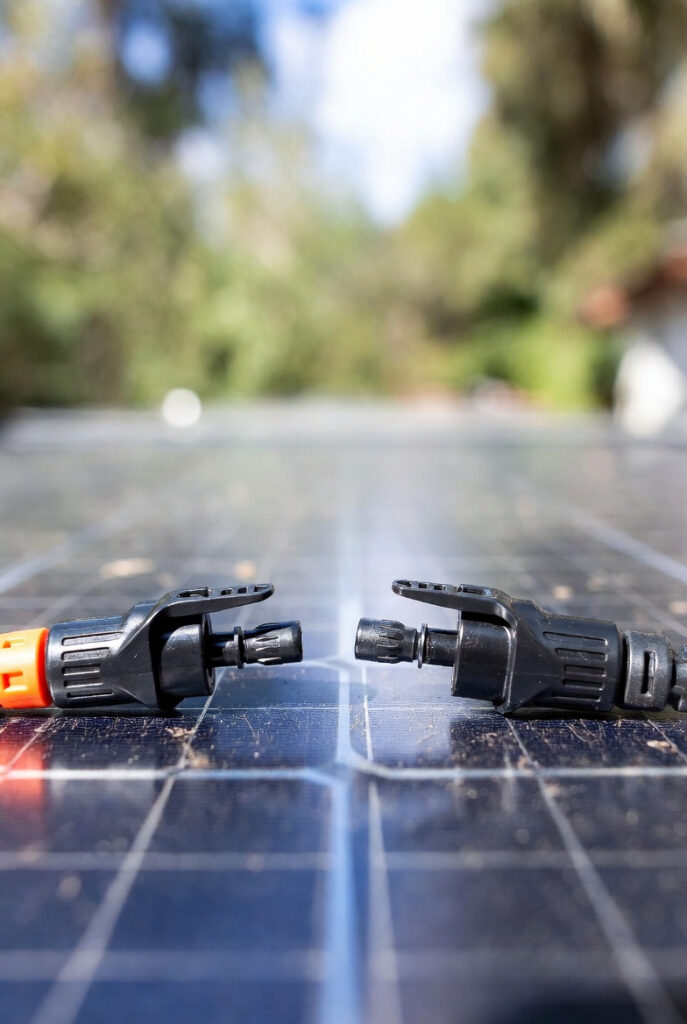
Every watt your solar panels produce passes through the MC4 connector terminals before it reaches the charge controller. The terminal is approximately 4mm of copper inside a polycarbonate housing. If the mc4 connector crimping is done with pliers the copper strands and the terminal barrel are compressed on two sides leaving void space at the other four. Those voids are micro-gaps. Micro-gaps are resistance. Resistance at 15A of string current is heat. Heat at a plastic housing rated for 90°C is a countdown. Before understanding the crimping standard understand how much solar power you actually need the string current determines how much heat a poor mc4 connector crimping generates.
MC4 Connector Crimping: The Cold Weld Standard
What a cold weld means for MC4 terminals: As covered in our Battery Cable Crimping guide a cold weld occurs when sufficient uniform pressure is applied to a crimp connection that the copper strands and the terminal barrel flow together at a molecular level creating a void-free connection with near-zero contact resistance. For battery cable lugs this requires a hydraulic hex crimper at 10-12 tons. For MC4 connector terminals the requirement is a ratcheting crimp tool with the correct hexagonal die for the terminal and wire gauge combination.
Why pliers create fire hazards: A pair of needle-nose pliers or channel-lock pliers applies force from two sides creating an oval compression. The copper strands compress in the direction of force and spring back slightly on the sides. The result: two points of high compression and four quadrant zones of inadequate compression where micro-gaps remain between strands and terminal barrel. These micro-gaps are not visible. The terminal looks compressed. The connection looks complete. The resistance is elevated.
The I²R heat calculation: A crimp resistance of 0.005Ω above nominal at 15A solar string current: P = 15² × 0.005 = 1.1 watts at the MC4 terminal. At 10am in July with full irradiance 15A continuous the terminal accumulates heat in the sealed polycarbonate housing. The thermal resistance of the MC4 housing is approximately 5-10°C per watt above ambient. At 35°C ambient the terminal runs at approximately 44°C above ambient = 79°C terminal temperature. The MC4 housing is rated for 90°C. At 79°C the housing is within 11°C of its thermal limit.
The oxidation progression: A micro-gap mc4 connector crimping leaves exposed copper strands partially in contact with the terminal barrel. Moisture enters through the inadequately sealed gland nut because the gland nut cannot seal correctly around a deformed wire jacket from a plier crimp. The exposed copper oxidizes as covered in our Tinned Copper guide copper oxide resistivity is orders of magnitude higher than pure copper. Over one Ontario summer the terminal resistance increases from 0.005Ω to 0.05Ω. At 15A: P = 15² × 0.05 = 11.25 watts at a single MC4 terminal well above the housing thermal limit.
The DC Arc Fault – Why Rooftop MC4 Fires Are Different
What a DC arc fault is: When an MC4 connector terminal overheats to the point where the polycarbonate housing softens and deforms the internal seal and alignment geometry changes. The terminal contact pressure changes. An intermittent arc forms a plasma channel between the terminal faces that sustains itself from the continuous DC current of the solar string. Unlike AC current which crosses zero 120 times per second providing 120 natural arc extinction opportunities DC current is continuous. A DC arc in a solar string has no natural extinction mechanism. It sustains from the panel current until the fuel around it ignites.
The plasma temperature: A sustained DC arc at 15A and 40V generates arc plasma at approximately 3,000-6,000°C above the ignition temperature of polycarbonate (450°C), EVA encapsulant (370°C), and standard roofing materials (260°C). The arc does not need to touch the roof to ignite it radiation from the plasma ignites materials within 10-20mm of the arc.
I found charred black MC4 connectors on a residential roof inspection last summer. The entire connector pair was fused together the male and female housings had melted and welded into a single plastic mass. The string was showing zero output in the VRM data. I pulled the VRM history the string output had been declining gradually for 6 weeks before the failure event: normal 280W peak dropping to 265W, 240W, 190W over successive weeks as the terminal resistance increased, then zero on the failure day. The owner had been ignoring the declining output thinking it was cloud cover variation. It was the oxidation progression of a plier-crimped mc4 connector crimping reaching its endpoint. As covered in our MC4 Connector Selection guide the connector was a no-name clone not Stäubli which compounded the problem.
The Ratcheting Crimp Tool – The Only Acceptable Standard
Why the ratcheting mechanism matters: A ratcheting mc4 connector crimping tool will not release until the die has completed the full compression cycle the handle must be fully closed before the ratchet releases. This prevents partial crimps the tool either produces a full cold weld compression or it does not release. The die geometry is hexagonal six-sided compression that eliminates the void zones of a two-sided plier crimp.
The die selection:
- 10 AWG solar wire: 6.0mm² die – matches the terminal barrel diameter for 10 AWG solar cable
- 12 AWG solar wire: 4.0mm² die – matches the terminal barrel diameter for 12 AWG solar cable
- Using the wrong die produces either an under-compressed crimp (too large die) or a mechanically damaged terminal (too small die)
The correct crimp procedure:
- Strip the solar cable to the correct strip length typically 10-12mm the copper strands should fill the terminal barrel without extending past it
- Insert stripped end fully into the terminal barrel confirm all strands are inside the barrel, none folded back
- Place the terminal in the correct die position the terminal barrel in the die, not the wire
- Close the ratcheting tool fully listen for the click of full compression cycle completion the tool releases automatically
- Inspect the terminal barrel end no visible individual strand outlines, solid copper face the penny test
- Pull test – apply firm hand tension to the wire at approximately 10kg force zero movement is the pass criterion
I demonstrated the pull test to a client after completing an mc4 connector crimping session on their new array last spring. I handed him the crimped connector and told him to pull the wire out. He pulled moderately. Nothing. I told him to pull harder. He put both hands on it and pulled hard. Nothing. He looked at the connector and said: that is not going anywhere. That is correct. That is the cold weld. I showed him what a plier crimp looks like by demonstrating on a scrap piece of cable the wire came out at approximately 3kg of force with audible strand separation sounds. The client has his own ratcheting tool now.
The Gland Nut Seal – The Moisture Barrier
What the gland nut does: The MC4 connector gland nut compresses a rubber grommet around the solar cable jacket creating a mechanical seal that prevents moisture, UV exposure, and contaminants from entering the connector housing at the cable entry point. The seal quality is the difference between a connector that maintains its performance through 25 Ontario freeze-thaw cycles and one that admits moisture within the first season.
The assembly procedure:
- Thread the gland nut onto the cable before crimping the terminal the gland nut must be on the cable before the terminal is crimped
- Complete the terminal crimp as described above
- Insert the crimped terminal into the connector housing the terminal clicks into the locking position
- Thread the gland nut onto the connector housing threads by hand until it contacts the housing face
- Use MC4 connector assembly wrenches to tighten the gland nut 2-3 full turns past hand-tight
- Confirm the grommet compresses uniformly around the cable jacket circumference without cutting into the jacket
The intermateability rule: As covered in our MC4 Connector Selection guide NEC 690.33 prohibits the intermating of connectors from different manufacturers unless specifically listed as intermateable. A Stäubli MC4 male mated with a no-name MC4 female is not NEC 690.33 compliant regardless of whether the physical fit appears correct. Use matched connector pairs from the same manufacturer throughout the array.
The Solar Cable and Branch Connector Standard
Why solar-rated cable matters: Solar cable USE-2 or PV wire rated has UV resistance, high temperature rating (90°C minimum), sunlight resistance, and wet location suitability. Standard THHN wire is not an acceptable substitute for solar cable in outdoor MC4 connector applications regardless of gauge matching. The 10 AWG solar extension cable is the correct specification for extending panel leads or running homerun cables in a residential off-grid array.
The MC4 parallel branch connectors crimping standard: MC4 parallel branch connectors T-connectors and Y-connectors that parallel two strings require the same crimping standard as straight MC4 connectors. Each branch terminal is a separate crimp each requires the full ratcheting crimp cycle and pull test before assembly. A parallel branch connector with one correct crimp and one plier crimp has the defective crimp in the highest-current path.
The factory lead reference standard: Quality panels like the Renogy 100W panel ship with pre-crimped MC4 leads factory-terminated with calibrated tooling. These leads are the reference standard for what a correct mc4 connector crimping should look like. When field terminating extension cables the goal is to match the factory lead quality same void-free terminal face, same gland nut compression, same pull test resistance.
NEC 690.33 and CEC Section 64 – The Code Standard
NEC 690.33: National Electrical Code Section 690.33 governs connectors in photovoltaic systems. NEC 690.33(C) requires that connectors be listed and identified for use in PV systems. NEC 690.33(E) requires that connectors of different manufacturers not be intermated unless specifically listed as intermateable. NEC 690.33(F) requires that connectors be installed in accordance with manufacturer instructions which specify the correct crimp tool and die. A plier crimp does not satisfy NEC 690.33(F).
CEC Section 64 – Canada: The Canadian Electrical Code Section 64 for photovoltaic systems requires that all connections in a PV system be made with listed components installed per manufacturer instructions. A ratcheting mc4 connector crimping tool and the correct die is the manufacturer-specified installation method for all major MC4 connector brands. As covered in our Solar Combiner Box guide every string connection in the combiner box is also subject to these MC4 crimping standards the combiner box does not excuse substandard field terminations.
Quick Reference – MC4 Connector Crimping Standards
| Step | Requirement | Pass Criterion |
|---|---|---|
| Strip length | 10-12mm | All strands inside barrel – none folded |
| Terminal placement | Barrel in die – not wire | Terminal seated fully in die |
| Crimp tool | Ratcheting – full cycle | Click at completion tool releases |
| Die size | 6.0mm² for 10 AWG 4.0mm² for 12 AWG | Matched to wire gauge |
| Penny test | Solid copper face | No visible individual strands |
| Pull test | 10kg hand tension | Zero movement |
| Gland nut | 2-3 turns past hand-tight | Grommet compressed uniformly |
| Intermateability | Matched manufacturer throughout | No mixing of brands |
Pro Tip: Mark each completed MC4 connector pair with a paint pen mark across the gland nut and housing after final assembly one line that crosses the gland nut-to-housing interface. If the gland nut loosens over freeze-thaw cycling the mark breaks visible at the annual roof inspection. A broken gland nut mark means the moisture seal has potentially been compromised disassemble, inspect the grommet, reassemble and retorque. The same paint pen inspection standard that protects busbar bolts as covered in our Busbar Torque Spec guide applies to every threaded connection in the system including rooftop MC4 gland nuts.
The Verdict
MC4 connector crimping is either a cold weld or a fire countdown. The ratcheting tool is not optional.
Three verification steps before any MC4 connector is deployed:
- Penny test – solid copper face at the terminal barrel end — no visible strands
- Pull test – zero movement at 10kg hand tension
- Gland nut – grommet compressed uniformly paint pen mark applied across interface
Listen for the click. Pull test every crimp. Mark every gland nut. Sleep soundly knowing your roof is not a fire hazard.
Disclosure: This article contains affiliate links. If you buy through them, GridFree Guide earns a small commission at no extra cost to you.
Questions? Drop them below.
About the Author
Robert Bertrand spent 20 years as a service advisor in the automotive industry (Lexus and Nissan), where precision diagnostics, wiring integrity, and documentation standards were non-negotiable. He brings that same technical discipline to GridFree Guide, where he researches, tests, and documents off-grid solar systems for Ontario conditions. Based in Rockwood, Ontario, every article is built on verified specifications, manufacturer data, and the real-world climate constraints of Canadian off-grid living.
As an Amazon Associate I earn from qualifying purchases. This site also contains affiliate links to other products and services. GridFree Guide earns a small commission at no extra cost to you.