
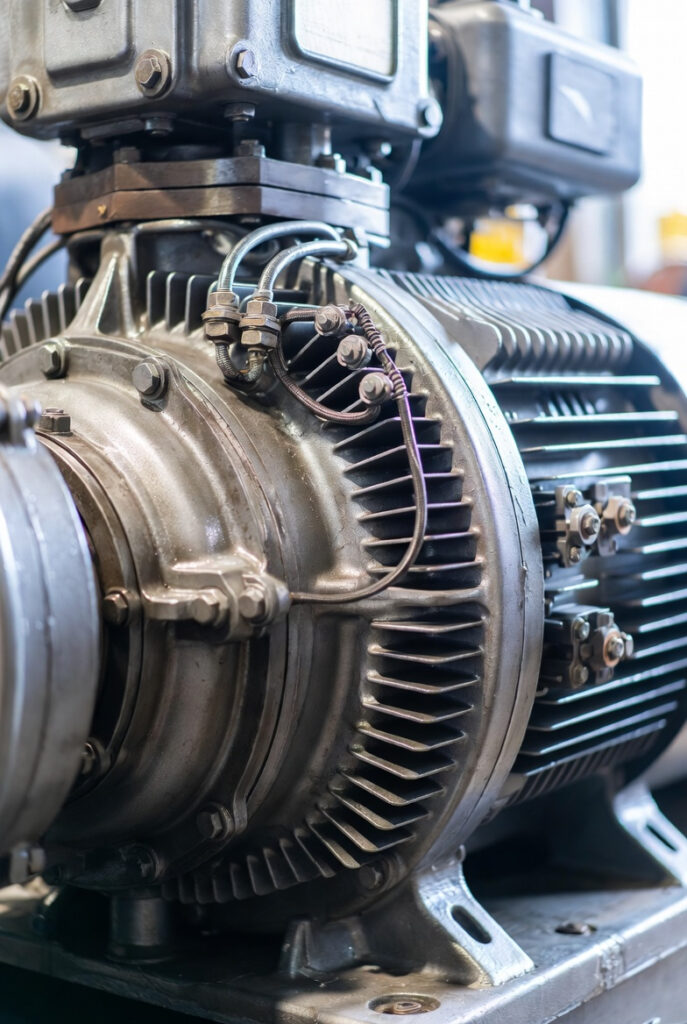
Every time your well pump kicks on in a Rockwood cabin your inverter takes a punch. Not a metaphor a physical electromagnetic punch to the transformer windings. The compressor motor tries to start from a dead stop all that rotational inertia demands enormous current the Locked Rotor Amps event. Your Victron MultiPlus-II handles it this time. And the next time. And the 10,000th time. Until one day it doesn’t. A soft starter inverter solution is not about whether your system survives today’s surge it is about whether it survives 10,000 surges over the next 10 years. Before sizing your inverter understand how much solar power you actually need the motor loads in your system determine whether a soft starter is required.
Soft Starter Inverter: Why Locked Rotor Amps Are the Hidden System Killer
What Locked Rotor Amps are: Every AC motor has two current ratings visible on its nameplate the Full Load Amps (FLA) the current it draws while running at rated load and the Locked Rotor Amps (LRA) the current it demands during startup when the rotor is stationary and the motor is drawing maximum current to overcome inertia. The LRA event typically lasts 0.3-3 seconds the time from zero RPM to operating speed. During this window the motor draws 3-8× its running current from the inverter’s AC output.
The LRA-to-FLA ratio – the risk threshold: The soft starter inverter requirement threshold is a LRA-to-FLA ratio above 3×. At or below 3× ratio the inverter’s rated surge capacity typically handles the starting event without stress. Above 3× ratio the starting current approaches or exceeds the inverter’s surge rating the inverter’s output voltage drops during the surge, current limiting engages, and the motor may fail to start or the inverter trips on overload. For well pumps and air conditioning compressors the LRA-to-FLA ratio is commonly 5-7× far above the safe threshold.
The inverter transformer fatigue mechanism: Every LRA event delivers a physical force to the transformer in the inverter. The rapidly rising current creates a magnetic field in the transformer core the Lorentz force between the windings and the core physically pushes them apart during the current peak. At 5-7× running current this force is 25-49× the force during normal operation. The transformer windings vibrate. The laminated core vibrates. The varnish bonding the windings flexes. Over 10,000 start cycles this mechanical fatigue loosens the winding structure producing the transformer hum that indicates the beginning of the failure sequence.
I was doing a system audit on a Rockwood cabin last autumn the client was complaining that his MultiPlus-II had developed a noticeable hum during well pump starts. I looked at the pump nameplate. FLA: 12A. LRA: 68A. LRA-to-FLA ratio: 5.7×. Every pump start was subjecting the MultiPlus-II transformer to electromagnetic forces 32× above normal operation. The hum was the transformer windings vibrating at their new, slightly loosened, resonant frequency. Not terminal yet. But heading there at every pump start. As covered in our Cold Start Surge guide Ontario winters amplify this at -20°C the motor starting torque requirement increases and the LRA event is longer and harder on the transformer.
The Soft Starter Technology – How It Works
What a soft starter does: A soft starter interposes between the inverter AC output and the motor. Instead of connecting the motor directly to the AC supply voltage at startup which creates the full LRA event immediately the soft starter applies a controlled ramped voltage to the motor over 1-2 seconds. The motor torque increases gradually as the voltage ramps. The current rises slowly rather than spiking. By the time the motor reaches operating speed the current has never exceeded 1.5-2× running current compared to the 5-7× event without the soft starter inverter solution.
The Micro-Air EasyStart adaptive learning: The Micro-Air EasyStart uses a microprocessor-based adaptive learning algorithm on the first startup after installation it measures the motor’s electrical characteristics: impedance, power factor, starting torque requirement, and resonant frequency response. It stores these measurements and calculates the optimal voltage ramp profile for that specific motor. The ramp profile is different for every motor a 15,000 BTU compressor has a different optimal start profile than a 1/2 HP well pump. The EasyStart learns the motor and applies the correct ramp. The result: starting current reduced by up to 75% from the unmanaged LRA.
The 75% reduction in practice: A well pump with a 68A LRA reduced by 75%: managed starting current = 68A × 0.25 = 17A. A 15,000 BTU AC compressor with a 72A LRA reduced by 75%: managed starting current = 72A × 0.25 = 18A. At 18A the Victron MultiPlus-II handles the start with zero surge stress no overload alarm, no voltage droop, no transformer fatigue event.
I installed a Micro-Air EasyStart on a client’s 15,000 BTU window AC last summer and measured the starting current before and after with a clamp meter on the AC output. Before: 68A spike for 1.8 seconds the MultiPlus-II output voltage dropped to 108V during the spike and the overload LED flickered. After EasyStart installation: 22A ramp over 1.4 seconds output voltage held at 118V throughout overload LED never moved. The client watched the clamp meter. He asked if the AC was actually starting. It was it had just stopped announcing itself like a freight train.
The Well Pump Application — SoftStartUSA Standard
Why well pumps are the hardest motor load in off-grid systems: A well pump starts against the full static head of the water column above it in a Rockwood property with a 200-foot well the pump starts against approximately 87 PSI of static pressure. At this load the motor torque requirement is maximum at zero RPM the LRA event is both high-current and long-duration compared to an unloaded motor start. The well pump is the motor load that most commonly trips off-grid inverters and the motor load that most benefits from soft starter inverter management.
The SoftStartUSA well pump soft starter specification: The SoftStartUSA soft starter is specifically designed for single-phase well pump applications in residential off-grid installations. It installs in the well pump control box between the pressure switch and the pump motor no rewiring of the inverter AC output required. The adaptive ramp algorithm is pre-configured for well pump starting characteristics static head, motor impedance, and pressure switch bounce. For a system where the well pump is the primary inverter overload trigger the SoftStartUSA is the correct specification.
When soft starter is required vs optional:
- Required: LRA-to-FLA ratio above 3× on any motor load
- Required: LRA approaches or exceeds 60% of inverter surge rating
- Required: Repeated overload trips on motor start system already showing the symptom
- Required: Running a smaller inverter than the motor specification suggests 15,000 BTU AC on a 3000VA inverter
- Optional: LRA-to-FLA ratio below 3× motor well within inverter surge rating
NEC 440 and CEC Section 28 – The Code Considerations
NEC 440 – Hermetic refrigerant motor-compressors: National Electrical Code Article 440 governs the installation of air conditioning and refrigeration equipment including the hermetic motor-compressors in AC units. NEC 440.52 addresses motor starting duty recognizing that high starting currents create voltage drop on branch circuits. While NEC 440 does not mandate soft starters it establishes the framework under which a soft starter inverter solution satisfies the voltage drop and circuit protection requirements of the article the soft starter manages the starting current to within the branch circuit’s voltage drop tolerance.
CEC Section 28 – Canada: The Canadian Electrical Code Section 28 governs air conditioning and refrigeration installations with requirements equivalent to NEC 440. The CEC equipment durability requirement that electrical equipment be installed and operated within its design limits is directly relevant to the soft starter inverter application. Repeated LRA events that stress the inverter beyond its sustained surge design specification violate the spirit of the CEC equipment durability standard. The soft starter inverter solution keeps the inverter within its design limits at every motor start.
The voltage drop practical impact: Without a soft starter inverter solution a well pump starting on a long battery cable run produces a voltage drop event at the inverter AC output. The voltage drop during the LRA may cause other sensitive electronics Cerbo GX, router, lights to reset or flicker. With a soft starter the current ramp is controlled and the voltage drop is eliminated. As covered in our System Voltage guide 48V system voltage provides significantly more headroom for motor starting than 12V the soft starter further extends this advantage.
The LRA Identification Checklist
How to determine if your system needs a soft starter:
- Find the motor nameplate yellow energy label on AC units, data plate on well pump control box
- Record Full Load Amps (FLA) the running current at rated load
- Record Locked Rotor Amps (LRA) listed as LRA or RLA on the nameplate
- Calculate ratio: LRA ÷ FLA
- If ratio exceeds 3.0 soft starter required
- If LRA exceeds 60% of inverter surge rating soft starter required regardless of ratio
- If inverter shows overload alarm on motor start soft starter required immediately
The MultiPlus-II surge rating reference:
- MultiPlus-II 3000VA: surge rating 6000VA = 50A at 120V any motor with LRA above 30A needs a soft starter
- MultiPlus-II 5000VA: surge rating 10000VA = 83A at 120V any motor with LRA above 50A needs a soft starter
Quick Reference – Soft Starter Inverter Selection
| Application | Typical LRA | Soft Starter Required | Recommended Product |
|---|---|---|---|
| 15,000 BTU AC compressor | 60-80A | Yes – exceeds 3× FLA | Micro-Air EasyStart Flex |
| Well pump 1/2 HP | 40-50A | Yes – exceeds 3× FLA | SoftStartUSA |
| Well pump 1 HP | 55-70A | Yes – exceeds 3× FLA | SoftStartUSA |
| Refrigerator compressor | 15-25A | Optional – check ratio | EasyStart if needed |
| Small fan motor | 5-10A | No – within inverter surge | None required |
Pro Tip: After installing any soft starter record the before and after starting current with a clamp meter one probe on the AC output hot wire, measuring during startup. The before reading is your baseline LRA. The after reading confirms the soft starter is functioning correctly and achieving the rated reduction. Store both measurements in the system commissioning log as covered in our Off-Grid Solar Maintenance guide. If the after reading is less than 25% reduction from the LRA the soft starter ramp profile needs adjustment. A soft starter that is installed but not achieving rated reduction is providing false confidence the transformer fatigue events continue at only slightly reduced amplitude.
The Verdict
A soft starter inverter solution is not about whether your system survives today’s motor start. It is about whether it survives the 10,000th one.
Three steps to determine if you need a soft starter today:
- Find the motor nameplate record FLA and LRA
- Calculate the ratio if LRA ÷ FLA exceeds 3.0 install a soft starter before the next season
- Run the before/after clamp meter test after installation confirm below 25% of original LRA
The engine that never cold-starts without oil pressure protection wears faster. The inverter that takes 10,000 unmanaged LRA events fails sooner. The soft starter is the block heater for your AC motors.
Disclosure: This article contains affiliate links. If you buy through them, GridFree Guide earns a small commission at no extra cost to you.
Questions? Drop them below.
About the Author
Robert Bertrand spent 20 years as a service advisor in the automotive industry (Lexus and Nissan), where precision diagnostics, wiring integrity, and documentation standards were non-negotiable. He brings that same technical discipline to GridFree Guide, where he researches, tests, and documents off-grid solar systems for Ontario conditions. Based in Rockwood, Ontario, every article is built on verified specifications, manufacturer data, and the real-world climate constraints of Canadian off-grid living.
As an Amazon Associate I earn from qualifying purchases. This site also contains affiliate links to other products and services. GridFree Guide earns a small commission at no extra cost to you.