
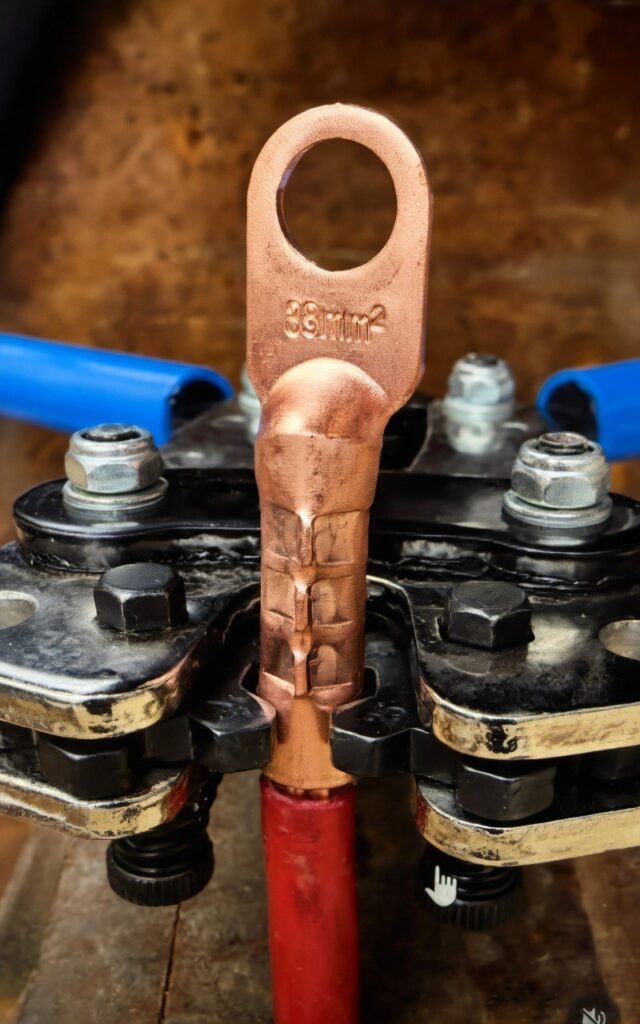
In the service bay you would never let a car leave with a loose battery terminal. Loose terminal means resistance. Resistance means heat. Heat means failure. In a 48V off-grid system battery cable crimping is the most common point of failure and unlike a loose terminal you cannot tighten it after the fact. Battery cable crimping done wrong is a permanent decision. Before specifying your cable understand how much solar power you actually need the system current determines the cable size and therefore the crimping force required.
Battery Cable Crimping: Why Micro-Gaps Kill Connections
The physics of a correct crimp: A hydraulic hex crimp done correctly produces a cold weld where the copper strands and the lug barrel are deformed under sufficient pressure to flow together at a molecular level. The contact resistance is essentially zero indistinguishable from the cable’s own resistance. As covered in our Cold Weld Crimping guide this is the only connection method that achieves the 25-year standard.
The physics of a poor crimp: A poor battery cable crimping leaves micro-gaps between wire strands and the lug barrel. These gaps are not visible with the naked eye but are measurable with a resistance meter. The copper strands in the micro-gap zones make intermittent contact sufficient to carry current under light load but creating elevated resistance under the full system current.
The P=I²R heat calculation: A crimp resistance of 0.001Ω above nominal at 200A continuous: P = 200² × 0.001 = 40 watts of heat generated at a single connection point. At 300A the same milliohm resistance generates 90 watts. This heat has nowhere to go except into the lug and cable insulation. As covered in our Tinned Copper guide the lug entry point is the most vulnerable location for moisture ingress and oxidation a hot lug accelerates this failure mode.
The thermal runaway cascade: Heat from a poor battery cable crimping softens the cable insulation at the lug entry point. Softened insulation compresses under the cable tie or heat shrink creating tighter mechanical constraints that prevent the lug from radiating heat. The temperature rises further accelerating copper oxidation inside the crimp increasing resistance generating more heat. The cascade is self-reinforcing. It ends with a melted lug or a fire.
I tested this directly in the workshop last year a connection that passed visual inspection showed 0.8 milliohms above nominal wire resistance on the meter. At 250A that single connection was generating 50 watts of heat continuously. The cable insulation at the lug entry had already begun to discolor the thermal cascade had started. We re-crimped with the correct tool and matched lug. Resistance dropped to 0.07 milliohms. The heat was gone.
The Tool Standard – Why Tonnage Matters
Why hydraulic hex crimping is the only acceptable method: Hydraulic hex crimping applies force simultaneously from six sides ensuring uniform compression around the wire bundle. Plier crimpers and ratchet crimpers apply force from two sides producing an oval compression that leaves void space at 90 degrees to the crimping axis. No matter how hard you squeeze a two-sided crimper you cannot achieve the void elimination of a six-sided hex die under hydraulic pressure.
The tonnage requirement: For a 4/0 AWG lug with a barrel diameter of approximately 19mm you need approximately 8-12 tons of hydraulic force to achieve cold weld compression. An 8-ton tool may fall short on worn dies or at the upper end of the lug size range. A 12-ton tool provides margin for die wear over time.
The WBHome 12-ton hydraulic crimper standard: The WBHome 12-ton hydraulic crimper is the correct specification for battery cable crimping from 10 AWG through 4/0 AWG. The 12-ton rating provides compression margin above the minimum required for 4/0 AWG. The hex die geometry ensures six-sided uniform compression. The additional tonnage above the minimum provides consistent results as dies wear over time.
The NEC 110.14 matched components rule: National Electrical Code Section 110.14 requires that electrical connections be made with devices listed and marked for the conductor material and type. For battery cable crimping this means:
- Fine-stranded welding cable (SGX/SGT) requires a lug barrel sized for fine stranding
- Standard THHN wire uses different lug geometry
- Installing a THHN lug on fine-stranded cable leaves voids violating NEC 110.14 and creating the micro-gap resistance failure mode
The Penny Test and Pull Test – Verifying Crimp Quality
The penny test: After hydraulic hex battery cable crimping the end of the lug barrel should look like a solid copper penny uniform surface, no visible individual strand outlines, no air gaps between strands. The cold weld compression should have eliminated all void space between strands. If individual strands are visible at the barrel end the compression was insufficient the die was wrong, the tonnage was inadequate, or the lug was not fully seated before crimping. Recrimp.
The pull test: Apply firm hand tension to the crimped cable pulling directly away from the lug with approximately 10-15 kg of force. A correctly crimped connection shows zero movement. Zero. The cold weld bond between strands and barrel is stronger than the cable jacket.
I found a failed pull test on a system inspection last year. The lug came off in my hand under less than 5 kg of force no mechanical bond whatsoever. The installer had used a ratchet crimper at the correct die size. The visual appearance was adequate the pull test revealed zero cold weld had been achieved. The entire battery cable run required replacement. A 30-second pull test at commissioning would have caught this before the system was sealed and energized.
The resistance test: A digital multimeter in milliohm mode across the crimped connection measures actual contact resistance. A cold weld should measure less than 0.1 milliohms above nominal wire resistance. Any measurement above 0.5 milliohms indicates incomplete compression recrimp before sealing. This test requires a quality milliohm-capable meter a standard continuity test beep is not sufficient resolution to detect the resistance levels that cause thermal failure at high current.
The Matched Lug Standard – Why Cable Type Matters
Fine stranding vs standard stranding: WindyNation 4/0 AWG battery cable has a strand count of approximately 1,232 individual copper strands in a 4/0 AWG bundle each strand approximately 0.25mm in diameter. Standard 4/0 AWG THHN has approximately 19 strands at 1.6mm diameter. The total copper cross-section is the same. The void geometry is completely different.
Why the geometry matters: A lug barrel designed for standard THHN stranding has an interior geometry sized for large-diameter strands. When fine-stranded welding cable is inserted it packs differently leaving more void volume between strands and the barrel wall. Even with full 12-ton hydraulic compression a THHN lug on fine-stranded cable produces higher residual resistance than a correctly matched fine-stranded lug. The barrel geometry does not match the wire geometry complete void elimination is not achievable regardless of crimping force.
The correct lug specification: Tinned copper lugs marked “fine stranding” or “welding cable” are the correct specification for SGX/SGT battery cable. These lugs have tighter barrel bores designed for the void-fill geometry of fine stranding. They meet the ABYC E-11 standard for marine DC wiring the same standard that parallels off-grid Ontario installations as covered in our Tinned Copper guide.
The Heat Shrink Seal – Protecting the Cold Weld
Why sealing is required: A correctly executed cold weld has zero contact resistance at commissioning. Without sealing the lug entry point where the cable jacket ends and the bare copper strands enter the lug barrel moisture, condensation, and oxygen access the copper directly. Over Ontario humidity cycles this produces the copper oxidation failure mode covered in our Tinned Copper guide the cold weld that was perfect at year 1 shows elevated resistance at year 5.
The adhesive-lined dual-wall specification: As covered in our Heat Shrink guide adhesive-lined dual-wall heat shrink tubing provides both mechanical strain relief and a waterproof adhesive seal that prevents moisture ingress at the lug entry point. The adhesive flows into the cable strands under heat creating a sealed interface between the cable jacket and the lug barrel.
Quick Reference – Battery Cable Crimping Standards
| Standard | Requirement | Failure Mode if Violated |
|---|---|---|
| Tool tonnage | 10-ton minimum 12-ton recommended for 4/0 AWG | Micro-gaps and resistance heat |
| Die geometry | Hexagonal hex dies not ratchet or pliers | Incomplete compression |
| Lug type | Fine-stranded lug for SGX/SGT cable | Void geometry and higher resistance |
| Penny test | Solid copper face no visible strands | Insufficient compression |
| Pull test | Zero movement at 10-15 kg | No cold weld bond |
| Resistance test | Below 0.5 milliohms above nominal | Thermal failure at high current |
| Heat shrink | Adhesive-lined dual-wall | Moisture ingress and oxidation |
Pro Tip: Stagger the heat shrink application apply a short piece of adhesive-lined heat shrink over the lug barrel first, then a longer piece that overlaps both the lug barrel and the cable jacket. This two-layer application provides double adhesive seal at the critical lug entry point. The first layer seals the barrel-to-strand interface. The second layer seals the barrel-to-jacket interface and provides mechanical strain relief across the transition. As covered in our Busbar Torque Spec guide the lug-to-busbar connection must also be torqued correctly the perfect crimp is wasted if the lug bolt is finger tight.
The Verdict
Battery cable crimping is either a cold weld or a fire hazard. There is no acceptable middle ground.
Three tests before sealing any crimp with heat shrink:
- Penny test – solid copper face, no visible strands
- Pull test – zero movement under firm hand force, 10-15 kg minimum
- Resistance test – below 0.5 milliohms above nominal wire resistance
If any test fails cut the lug, strip fresh cable, and recrimp with the correct tool and matched lug.
Disclosure: This article contains affiliate links. If you buy through them, GridFree Guide earns a small commission at no extra cost to you.
Questions? Drop them below.
About the Author
Robert Bertrand spent 20 years as a service advisor in the automotive industry (Lexus and Nissan), where precision diagnostics, wiring integrity, and documentation standards were non-negotiable. He brings that same technical discipline to GridFree Guide, where he researches, tests, and documents off-grid solar systems for Ontario conditions. Based in Rockwood, Ontario, every article is built on verified specifications, manufacturer data, and the real-world climate constraints of Canadian off-grid living.
As an Amazon Associate I earn from qualifying purchases. This site also contains affiliate links to other products and services. GridFree Guide earns a small commission at no extra cost to you.