
A sealed battery cabinet in July is an oven. The batteries are generating heat during every bulk charge cycle. The hot air has nowhere to go. The temperature climbs. By mid-afternoon the internal cabinet temperature is 55-60°C. The Victron MultiPlus-II starts derating it sees the ambient temperature and reduces output to protect itself. The owner thinks the inverter is failing. The inverter is fine. Battery room ventilation is failing. Before building your thermal management system understand how much solar power you actually need the charge current determines how much heat your battery bank generates.
Battery Room Ventilation: The 25°C Sweet Spot
Why LiFePO4 cells have a thermal comfort zone: LiFePO4 battery cells operate optimally in the 20-25°C temperature range. Below this range as covered in our Battery Heating Pad guide the BMS charge lockout becomes a risk. Above this range a different degradation mechanism activates. At cell temperatures above 45°C the electrolyte the lithium salt solution between the electrodes begins to undergo accelerated oxidation reactions. These reactions are irreversible. They reduce the electrolyte’s ionic conductivity. They increase the cell’s internal resistance. They cause permanent capacity loss.
The 45°C threshold – what actually happens:
- Internal resistance increases by approximately 15-25% above the 25°C baseline
- Charge acceptance rate decreases the BMS may throttle charge current to limit further temperature rise
- Electrolyte decomposition rate approximately doubles for every 10°C above 25°C per the Arrhenius equation
- Cycle life projection decreases the battery rated for 3,000 cycles at 25°C may achieve only 1,500-2,000 cycles if regularly operated at 45°C+
The stagnant air problem: A battery bank during a bulk charge cycle at 50A generates approximately 100-150 watts of heat. In a sealed enclosure that heat has nowhere to go. The air temperature rises rapidly. The batteries cook in their own heat output. Battery room ventilation is not a comfort feature it is the thermal management system that keeps the electrolyte intact for 25 years.
What Happens Without Battery Room Ventilation
The inverter derating cascade: The Victron MultiPlus-II monitors ambient temperature at its installation location. Above approximately 40°C ambient the MultiPlus-II begins reducing output power derating to protect its internal components from thermal damage. In a poorly ventilated battery room the ambient temperature around the inverter rises with the battery enclosure temperature. The MultiPlus-II at 60°C ambient may derate to 40-50% of rated output. The system appears to be failing. The inverter is working correctly it is protecting itself from the thermal environment that battery room ventilation failure has created.
I diagnosed exactly this on a $40,000 off-grid install last July. The owner had built a beautiful custom oak cabinet for his battery bank no vents, no fan, sealed on all six sides. By mid-afternoon the cabinet internal temperature was 62°C measured with an IR thermometer through a small gap at the back. The MultiPlus-II was derating to 45% output. He had been troubleshooting the “inverter failure” for two weeks. We cut two 100mm vent holes one low, one high mounted a brushless fan at the top, and ran a test charge cycle. Cabinet temperature stabilized at 28°C. MultiPlus-II output returned to 100%. Total hardware cost: $85. Two weeks of misdiagnosis eliminated.
The LiFePO4 advantage and its limits: LiFePO4 is significantly more thermally stable than NMC or LCO lithium chemistries it does not enter thermal runaway at the temperatures commonly seen in poorly ventilated battery rooms. But thermal stability is not thermal immunity. The electrolyte degradation at sustained 45°C+ temperatures is real and cumulative. A LiFePO4 battery bank that spends every summer at 55°C will show measurable capacity loss by year 3 that would not occur if battery room ventilation had maintained 25°C.
The Active Exhaust Fan Standard
Why passive vents are not adequate for enclosed cabinets: Passive ventilation holes in the enclosure top and bottom relies on natural convection. In a typical battery enclosure the natural convection flow rate through passive vents is approximately 5-10 CFM adequate for modest heat loads but insufficient during a high-current bulk charge event generating 100-150 watts. An active fan is required for any enclosed battery cabinet that undergoes regular high-current charging.
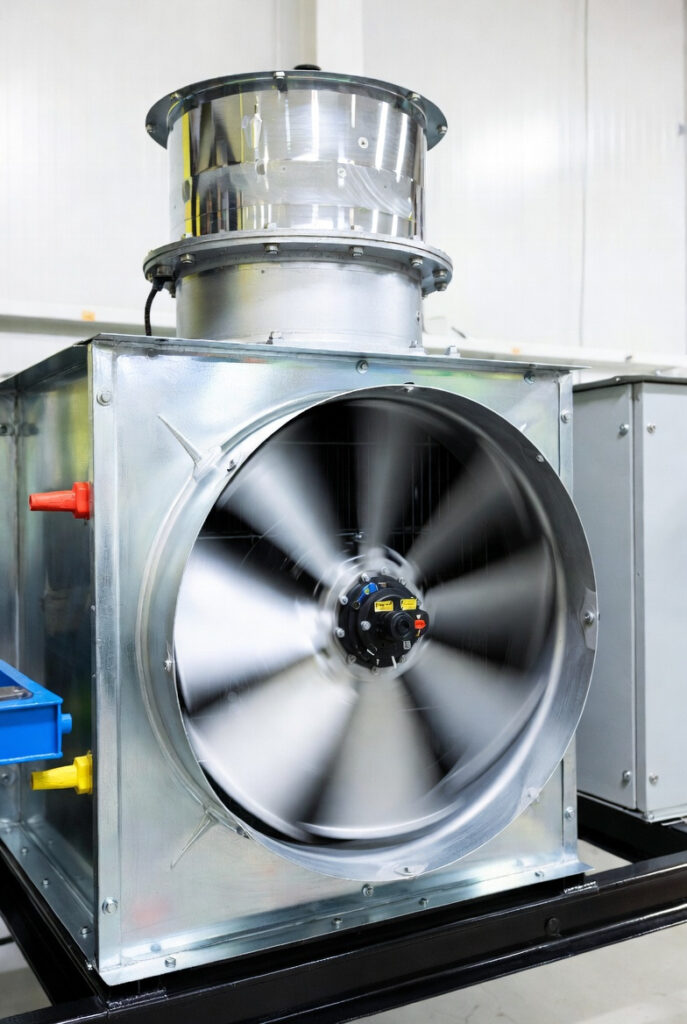
The active exhaust fan specification: A brushless DC fan AC Infinity AXIAL series, Noctua NF-A series, or equivalent mounted at the highest point of the battery enclosure provides forced air extraction. Target airflow: 20-40 CFM for a standard 200Ah battery bank enclosure. A single 80mm or 120mm brushless fan at this airflow rating draws approximately 0.5-2.5 watts negligible parasitic load.
Brushless vs brushed fans: Brushless DC fans are the correct specification for battery room ventilation. Brushed motors produce sparks at the brush-commutator interface during normal operation in a battery enclosure where trace amounts of off-gas may be present during fault conditions this spark is an ignition source. Brushless motors have no brush-commutator interface zero sparks. This is the same ignition protection logic that governs switch selection as covered in our DC Disconnect Selection guide.
When active ventilation is required vs when it is not: A small 100Ah battery bank on open shelving in a naturally ventilated cool basement may not need an active exhaust fan the natural airflow is adequate for the heat load. Active battery room ventilation is required for: enclosed battery cabinets, battery rooms with limited natural circulation, and any installation where the battery bank regularly undergoes bulk charging at high current in a confined space. If in doubt install the fan. A $30 brushless fan costs less than one lost year of battery capacity.
The Cerbo GX Relay – Thermostatic Fan Control
Why thermostatic control matters: A fan running continuously in winter works against the heating pad covered in our Battery Heating Pad guide removing the heat the pad just generated. Thermostatic control activates the fan only when the battery temperature requires it typically above 30°C in summer, never in winter when temperatures are below the activation threshold.
The Victron Cerbo GX relay configuration: Configure Relay 1 via the Cerbo GX menu or VictronConnect:
- Relay function: Temperature
- Temperature sensor: Battery temperature sensor (via SmartShunt or Smart Battery Sense)
- Activate relay above: 30°C
- Deactivate relay below: 25°C
- Fan wired to Relay 1 output 12V or 24V brushless fan powered through the relay
The VRM temperature graph: After installation the VRM portal logs battery temperature continuously the relay activation events appear as temperature plateaus in the graph. Charge events that would previously have driven the temperature to 45°C+ now show a temperature rise to 30°C, relay activation, temperature stabilization at 28-32°C, relay deactivation. Thermal management working as designed visible in data.
I set up this relay configuration on a Rockwood client system last summer and pulled up the VRM temperature graph with the client present. We watched the first bulk charge cycle complete the temperature climbed to 30°C, the relay clicked, the fan started, the temperature held at 29-31°C for the entire absorption phase, and dropped to 25°C as the charge completed. The client had never seen what their batteries were experiencing thermally. He asked why nobody had shown him this before. I told him: now it is in the log. It stays there for 25 years.
Intake Filtration – The Dust-as-Carbon Problem
Why dust matters in a battery room: Dust settling on high-current busbars and connection points is not an aesthetic problem it is a conductivity problem. Workshop dust sawdust, drywall dust, carbon black contains conductive particles. Conductive dust bridging across busbar gaps or accumulating on connection surfaces increases leakage current, reduces surface insulation resistance, and in sufficient accumulation can initiate arc tracking a sustained electrical discharge across a contaminated surface.
The MERV filter specification: The intake vent of the battery enclosure should be covered with a MERV 8 or MERV 11 rated filter pad. MERV 8 captures particles above 3 microns adequate for most cabin environments. MERV 11 captures particles above 1 micron correct for workshop environments with fine dust. The filter pad is cut to size and secured over the intake opening — the fan draws air through the filter, capturing particles before they enter the enclosure.
The filter maintenance schedule: Inspect and replace the intake filter every 6 months at the spring and fall system inspection as covered in our Off-Grid Solar Maintenance guide. A clogged filter restricts airflow the fan cannot move adequate air through a blocked intake and thermal management effectiveness decreases.
NEC and CEC Requirements
NEC 480.10 – USA: National Electrical Code Article 480.10 governs the installation of storage batteries including lithium systems. Section 480.10(A) requires that battery installations have adequate ventilation to prevent the accumulation of flammable gases and to maintain safe operating temperatures. For LiFePO4 the ventilation requirement focuses on thermal management the code treats battery locations with a conservative standard that covers worst-case chemistry scenarios.
CEC 64-802 – Canada: The Canadian Electrical Code Rule 64-802 requires that battery installations in photovoltaic systems be located in spaces with adequate ventilation sufficient to maintain battery temperatures within the manufacturer’s specified operating range. For LiFePO4 batteries this is typically 0-45°C the battery room ventilation must prevent sustained exceedance of 45°C internal temperature.
Battery Room Ventilation Checklist
- Active exhaust fan mounted at highest point of battery enclosure brushless DC 20-40 CFM
- Low intake vent minimum 50% of fan exhaust area with MERV 8 or MERV 11 filter
- Cerbo GX Relay 1 configured activate at 30°C, deactivate at 25°C
- Battery temperature sensor connected SmartShunt temperature sensor or Smart Battery Sense
- VRM temperature logging confirmed battery temperature visible in VRM portal
- Fan wiring fused at 1-2A protecting fan circuit from overload
- Filter inspection scheduled every 6 months in maintenance log
- Summer commissioning test confirmed bulk charge cycle with temperature monitoring peak temperature below 35°C with fan active
Quick Reference – Battery Room Ventilation Specifications
| Component | Specification | Notes |
|---|---|---|
| Exhaust fan type | Brushless DC – no sparks | AC Infinity AXIAL or Noctua NF-A series |
| Fan airflow | 20-40 CFM | 80mm or 120mm fan adequate |
| Fan activation temp | 30°C battery temperature | Cerbo GX Relay 1 |
| Fan deactivation temp | 25°C battery temperature | Cerbo GX Relay 1 |
| Intake filter | MERV 8 minimum – MERV 11 for workshop | Replace every 6 months |
| Critical threshold | 45°C maximum cell temperature | Above this electrolyte degradation begins |
| NEC reference | NEC 480.10 | Battery location ventilation requirement |
| CEC reference | CEC 64-802 | PV battery location temperature range |
Pro Tip: Test your battery room ventilation before the first summer not during it. In May set the Cerbo GX relay activation threshold temporarily to 20°C and run a full bulk charge cycle. Watch the VRM temperature graph in real time. Confirm the relay activates, the fan starts, and the battery temperature stabilizes rather than continuing to climb. Confirm the intake filter is not restricting airflow the fan should run quietly without straining. Reset the activation threshold to 30°C for normal summer operation. A ventilation system that has never been tested before summer arrives is a ventilation system you cannot trust on the hottest day of the year.
The Verdict
Battery room ventilation is the summer equivalent of the battery heating pad. The heating pad keeps the cells above 0°C in January. The exhaust fan keeps the cells below 45°C in July.
Three ventilation criteria before the first summer:
- Active brushless exhaust fan installed at highest point 20-40 CFM
- Cerbo GX relay configured – activate at 30°C, deactivate at 25°C
- MERV filter on intake vent – inspected and replaced every 6 months
The battery bank that survives 10 Ontario summers at 25°C delivers its rated 3,000 cycles. The bank that spends those summers at 55°C delivers 1,500. The fan costs $30. The decision costs nothing.
Disclosure: This article contains affiliate links. If you buy through them, GridFree Guide earns a small commission at no extra cost to you.
Questions? Drop them below.
About the Author
Robert Bertrand spent 20 years as a service advisor in the automotive industry (Lexus and Nissan), where precision diagnostics, wiring integrity, and documentation standards were non-negotiable. He brings that same technical discipline to GridFree Guide, where he researches, tests, and documents off-grid solar systems for Ontario conditions. Based in Rockwood, Ontario, every article is built on verified specifications, manufacturer data, and the real-world climate constraints of Canadian off-grid living.
As an Amazon Associate I earn from qualifying purchases. This site also contains affiliate links to other products and services. GridFree Guide earns a small commission at no extra cost to you.