
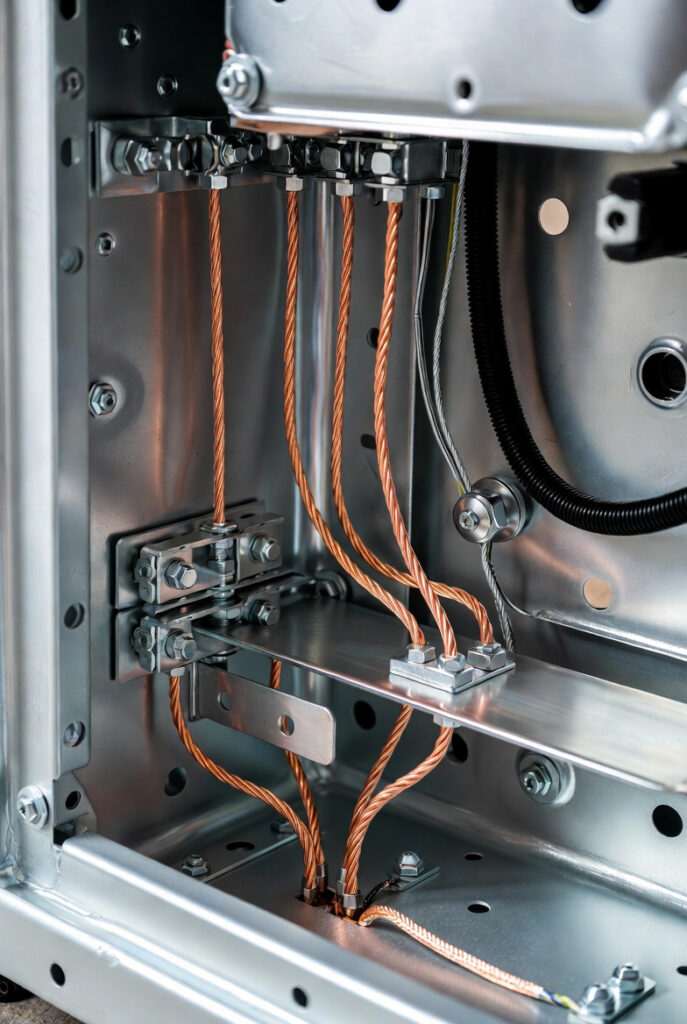
In the service bay bonding is why you don’t get a shock when you touch a car door during a short circuit. The fault current finds the low-resistance bonded path back to the source blows the fuse and the chassis stays at zero volts. In a 48V off-grid cabin without equipment bonding solar a wiring fault can leave your inverter chassis energized at battery voltage 52V just sitting there waiting for the next person who touches it to complete the circuit. Equipment bonding solar is not optional — it is the proactive safety system that forces the system to fail safe. Before building your bonding system understand how much solar power you actually need the system size determines the bonding requirements.
Equipment Bonding Solar: What It Is and Why It Matters
The definition that matters: As covered in our Grounding Electrode guide grounding connects the system to the earth for lightning and external surges. Equipment bonding solar connects all the metal parts of the system to each other ensuring they stay at the same voltage potential relative to each other and relative to the system ground.
The fault current path: When a live conductor contacts a metal enclosure the fault current needs a low-resistance path back to the source to cause the overcurrent protection to open. In a properly bonded system: fault current flows from the energized enclosure through the Equipment Grounding Conductor (EGC) back to the source the inverter or battery and the Class T fuse or DC breaker sees the fault current and opens within milliseconds. In an unbonded system: fault current has no path back to the source the enclosure sits energized at battery voltage the fuse never blows the hazard is invisible.
The electrolysis failure mode: An unbonded fault that does not arc does not disappear. If a battery negative cable contacts a metal enclosure and there is no bonding path to complete the circuit and blow the fuse the connection just sits there. At 48V DC the electrochemical potential drives slow electrolysis the contact point slowly dissolves the metal. Months later the cabin owner notices corrosion at an unexpected location and cannot trace the cause. Proper equipment bonding solar forces the fault to declare itself immediately fuse blows, system shuts down, fault is found and repaired. As covered in our Battery Fortress guide the enclosure provides physical protection bonding provides electrical protection for the same hardware.
The Equipment Grounding Conductor Sizing for 48V
What the EGC is: The Equipment Grounding Conductor is the dedicated safety wire that connects every metal enclosure, chassis, and structural component in the system to the main ground busbar and through the main ground busbar to the grounding electrode system. The EGC is not a current-carrying conductor during normal operation it carries current only during a fault event.
NEC 250.102 sizing – USA: National Electrical Code Section 250.102 sizes the main bonding conductor based on the largest ungrounded service entrance conductor or the rating of the overcurrent protection. For a 48V system with 4/0 AWG main battery cables and a 400A Class T fuse:
- From NEC Table 250.102(C)(1): 400A overcurrent protection → minimum 3 AWG copper EGC
- Professional standard: 6 AWG copper for most residential off-grid builds provides safety margin above code minimum while remaining manageable for chassis connections
CEC 10-600 sizing – Canada: Canadian Electrical Code Rule 10-600 sizes the equipment bonding conductor based on the ampacity of the circuit conductors. For 4/0 AWG conductors:
- Minimum bonding conductor: 6 AWG copper
- The bonding conductor must be continuous no splices between chassis connections
The daisy chain vs star topology: Equipment bonding solar connections can be made in a daisy chain inverter chassis → MPPT chassis → battery enclosure chassis → main ground busbar or in a star topology where each chassis connects individually to the ground busbar. The star topology is preferable for systems with Victron communication buses it minimizes the potential for common-mode interference from shared bonding conductors.
The Star Washer Law – Why Paint Is an Open Circuit
What factory powder coat does to a bond: Every Victron component MultiPlus-II, SmartSolar MPPT, Cerbo GX enclosure ships with factory powder coat finish. Powder coat is a dielectric an electrical insulator. A 6 AWG bonding conductor terminated with a lug and screwed directly onto a powder-coated chassis surface creates zero electrical contact between the lug and the metal chassis beneath. The bond is an open circuit.
The star washer solution: A star washer a washer with sharp serrated teeth on both faces bites through the powder coat under the clamping force of the mounting screw creating metal-to-metal contact between the bonding lug and the chassis metal beneath. One star washer between the lug and the chassis surface on the component side one star washer between the mounting screw head and the lug on the fastener side. The serrations cut through paint and anodizing to reach bare metal.
The test that reveals the failure: A multimeter set to resistance across a bonding lug installed on powder coat without star washers measuring from the lug barrel to an unpainted area of the same chassis will show open circuit or multi-megaohm resistance. The same measurement after installation with star washers shows less than 1 ohm. This is the difference between a bond and an illusion of a bond.
I found exactly this on a client system inspection last year. The installer had run 6 AWG bonding wire to every component neat, organized, professionally routed. I checked the resistance from the Victron MultiPlus-II chassis lug to the ground busbar. Over 2 megaohms. The lug was sitting on factory powder coat with no star washer beautiful looking installation, zero actual bond. We installed star washers at every chassis connection. Resistance dropped to 0.3 ohms at every point. Equipment bonding solar requires metal-to-metal contact not lug-to-paint contact.
Solar Rail Bonding – The Roof Is a Fault Waiting to Happen
Why solar rails need bonding: A solar panel with a ground fault internal insulation failure between a cell and the aluminium frame can energize the panel frame and the mounting rails at battery voltage. If the rails are not bonded to the system ground busbar the entire roof-mounted aluminium structure sits energized at an undefined potential. Any person touching a rail during maintenance, during snow clearing contacts this voltage. The energy available from a solar array is more than sufficient to cause electrocution.
The WEEB lug standard: WEEB – Washer, Electrical Equipment Bond lugs are specifically designed for bonding anodized aluminium solar mounting rails. Anodized aluminium has the same problem as powder coat the anodizing layer is an insulator. WEEB lugs have serrated contact surfaces that pierce the anodizing layer under the clamping force of the rail bolt providing metal-to-metal contact between the lug and the bare aluminium beneath.
The rail bonding procedure: Install one WEEB lug at each rail section junction where rails connect end-to-end and one at each end of the array. Run 6 AWG bare copper from the WEEB lug array connection to the main ground busbar. The solar rails, panel frames, and mounting hardware are now at the same potential as the system ground a panel fault energizes the fault current path to the busbar and blows the appropriate string fuse.
The Neutral-to-Ground Bond – The One-Location Rule
What the neutral-to-ground bond is: In an off-grid inverter system the AC neutral conductor and the equipment ground conductor must be bonded at one location and only one location. This single point where neutral and ground connect is called the neutral-to-ground bond or the system bonding jumper. In an off-grid system the correct location for this bond is at the inverter the source of the AC power.
Why only one location: If the neutral-to-ground bond exists at more than one point in the system a ground loop is created. A ground loop is a circuit formed by multiple paths between neutral and ground. Any difference in potential between the multiple bond points drives current through this loop. The circulating current in the ground loop induces electromagnetic interference commonly manifesting as Cerbo GX communication errors and random resets, Starlink connectivity drops during high AC load events, and interference on VE.Direct and VE.Bus communication cables.
I diagnosed a ground loop on a Rockwood cabin system that had been causing Cerbo GX random resets for three months. The client had two neutral-to-ground bonds one at the Victron MultiPlus-II internal bond (correct) and one at a sub-panel where a previous electrician had bonded neutral to ground bar (incorrect in an off-grid source circuit). Removing the sub-panel bond eliminated the ground loop. The Cerbo GX has not reset unexpectedly since. The Victron SmartShunt 500A readings stabilized the circulating current had been adding measurement noise to the shunt. One bond. One location. At the inverter.
The MultiPlus-II internal bond: The Victron MultiPlus-II has an internal neutral-to-ground bond relay that activates when the inverter is in inverter mode no external AC source present. When shore power or generator is connected the internal bond opens and the external source’s neutral-to-ground bond takes precedence. This is the correct behavior the bond follows the source. No external neutral-to-ground bond is required or permitted in the AC distribution downstream of the MultiPlus-II.
The Equipment Bonding Solar Checklist
- All Victron component chassis bonded with 6 AWG copper and star washers resistance confirmed below 1 ohm per connection
- Blue Sea Systems HD 600A Disconnect chassis bonded to main ground busbar
- Battery enclosure chassis bonded to main ground busbar
- Solar mounting rails bonded with WEEB lugs 6 AWG to main ground busbar
- All bonding conductors converge at single main ground busbar no direct chassis-to-chassis bonding that bypasses the busbar
- Main ground busbar connected to grounding electrode via GEC as covered in our Grounding Electrode guide
- Neutral-to-ground bond exists at inverter only confirmed absent at all downstream distribution points
- Star washer installation verified at every chassis bonding lug resistance test below 1 ohm at every point
- All EGC connections torqued to specification as covered in our Busbar Torque Spec guide
- Bonding documented in system commissioning log as covered in our Off-Grid Solar Maintenance guide
Quick Reference – Equipment Bonding Solar Specifications
| Component | Bond Required | Method | Wire Size |
|---|---|---|---|
| Inverter chassis | Yes | Star washer + lug | 6 AWG copper |
| MPPT charge controller | Yes | Star washer + lug | 6 AWG copper |
| Battery enclosure | Yes | Lug to chassis stud | 6 AWG copper |
| DC disconnect chassis | Yes | Lug to chassis stud | 6 AWG copper |
| Solar mounting rails | Yes | WEEB lug | 6 AWG bare copper |
| Panel frames | Via rail bond | WEEB at rail junction | 6 AWG bare copper |
| Neutral-to-ground bond | At inverter only | Internal MultiPlus-II relay | N/A internal |
Pro Tip: After completing all bonding connections perform a continuity test across every component in the system multimeter set to resistance, one probe on the main ground busbar, other probe on each chassis in sequence. Every measurement should be below 1 ohm. Any measurement above 1 ohm indicates either a star washer missing, a loose lug, or a paint-to-lug contact instead of metal-to-metal. Document all measurements in the commissioning log. This 15-minute test is the only way to verify that the equipment bonding solar installation is actually functional and not just visually complete.
The Verdict
Equipment bonding solar is the proactive safety system that forces every fault to declare itself. An energized chassis without bonding is invisible it waits. A bonded system cannot wait the fault blows the fuse in milliseconds.
Star washers at every chassis. WEEB lugs on every rail. One neutral-to-ground bond at the inverter. Continuity test below 1 ohm at every connection.
The system that fails safe is the system built to last 25 years.
Disclosure: This article contains affiliate links. If you buy through them, GridFree Guide earns a small commission at no extra cost to you.
Questions? Drop them below.
About the Author
Robert Bertrand spent 20 years as a service advisor in the automotive industry (Lexus and Nissan), where precision diagnostics, wiring integrity, and documentation standards were non-negotiable. He brings that same technical discipline to GridFree Guide, where he researches, tests, and documents off-grid solar systems for Ontario conditions. Based in Rockwood, Ontario, every article is built on verified specifications, manufacturer data, and the real-world climate constraints of Canadian off-grid living.
As an Amazon Associate I earn from qualifying purchases. This site also contains affiliate links to other products and services. GridFree Guide earns a small commission at no extra cost to you.