
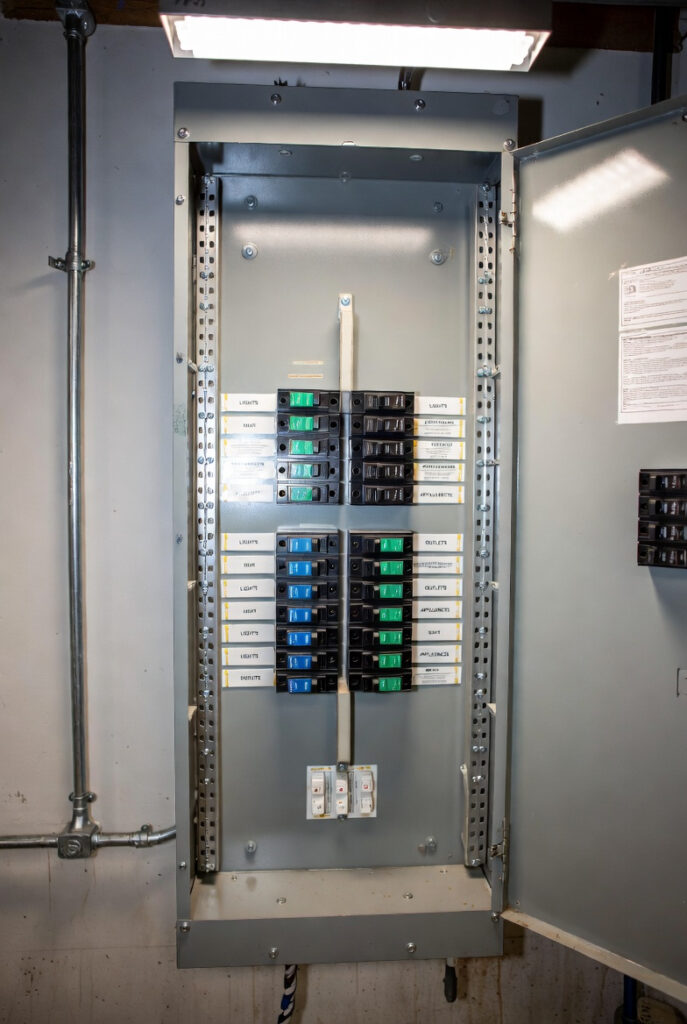
Three hours. That is how long it takes to trace a wiring harness when a shade-tree mechanic used all black wire with no tags. In the service bay I did this job more times than I can count. A 48V off-grid system at 2am during a January power outage not a professional technician with a wiring diagram but a spouse, a neighbour, or you five years from now when you have forgotten which of the six Lynx Distributor outputs feeds the inverter. Solar system labeling is not a finishing touch. It is a safety requirement with a code behind it. Before building your system understand how much solar power you actually need the complexity of your system determines how many labels it requires.
Solar System Labeling: Why the Code Requires Permanent Labels
What NEC 690.31 requires: National Electrical Code Section 690.31(G) requires permanent labels on all PV system conductors labels that identify the circuit as a solar circuit, the voltage level, and the polarity. The key word is permanent. The NEC defines permanent as capable of withstanding the environmental conditions of the installation for the life of the system not a Sharpie on white electrical tape that will be illegible in 18 months. In a jurisdiction requiring a NEC-compliant solar installation unlabeled conductors fail inspection. Period.
What CEC Section 64-200 requires: The Canadian Electrical Code Section 64-200 requires that every solar photovoltaic circuit be identified with a warning label at each point where the circuit could be accessed every disconnect, every combiner, every junction box. The label must identify the voltage present, the current-carrying conductors, and the location of the nearest disconnect. For a 48V LiFePO4 system these labels are not optional they are the means by which a first responder, an inspector, or a family member can safely identify and de-energize the system without prior knowledge of the installation.
Why Sharpie fails: A permanent marker on white electrical tape has a service life of approximately 12-18 months in a Rockwood cabin equipment room. Humidity cycling causes the tape adhesive to fail. Temperature cycling causes the ink to fade. UV exposure even indirect accelerates ink degradation. At year 3 the label that said “INVERTER OUTPUT – 240V AC – DO NOT TOUCH” is an unreadable smear. This is not a standard. It is a liability.
I got a 2am call in January from a client power out, fuse blown on the Victron Lynx Distributor. No labels on any of the output positions. Twenty minutes on the phone talking him through identifying which LED indicator was dark trying to figure out if the tripped circuit was the inverter, the MPPT, or the DC-DC converter with a flashlight in a -15°C equipment room. A label maker and 10 minutes at commissioning would have made that a 2-minute fix. That call is why solar system labeling is on the commissioning checklist of every build I do. As covered in our Lynx Distributor guide the LED diagnostic is only useful if you know which LED corresponds to which circuit.
The Label Material Standard – Why P-Touch TZe-S Is the Specification
What makes a label permanent: Brother P-Touch TZe-S series laminated tape consists of a printed polyester label layer laminated under a clear protective polyester overlay. The result is a label where the ink is permanently sealed between two plastic layers impervious to moisture, UV exposure, chemicals, and temperature cycling. The industrial-strength adhesive is rated for curved surfaces, textured surfaces, and sustained adhesion through Ontario temperature cycles.
The specification comparison:
- Standard Sharpie on white electrical tape: 12-18 month readability in unconditioned spaces
- Standard P-Touch tape (non-laminated): 3-5 year readability adequate for conditioned interiors only
- Brother P-Touch TZe-S laminated tape: 25+ year readability in outdoor and industrial applications the correct specification for solar system labeling in unconditioned Ontario equipment rooms
The practical tool: A Brother P-Touch label maker with TZe-S cartridges costs approximately $50-80. It prints labels in multiple sizes 6mm for wire identification, 12mm for fuse position labels, 18mm for disconnect switch labels, 24mm for warning labels on enclosures. One tool. One commissioning session. Every label in the system printed to the 25-year standard.
The “Which Fuse?” Emergency Standard
Why the Lynx Distributor needs labels: The Victron Lynx Distributor provides individual LED indicators for each fused output the LED goes dark when that fuse has blown. This is an excellent diagnostic tool. It is useless at 2am if the outputs are not labeled and you cannot identify which dark LED corresponds to which circuit. Every Lynx Distributor output position must be labeled before the system is commissioned: INVERTER, MPPT CHARGE CTRL, DC-DC CONVERTER, CERBO GX, SPARE. One label per position. Applied to the enclosure adjacent to the fuse position. Readable with a flashlight at arm’s length.
The cable end labeling standard: Every high-current DC cable must be labeled at both ends at the source terminal and at the load terminal. A 4/0 AWG cable running from the battery positive terminal to the Lynx Power-In carries no markings that distinguish it from a cable running from the Lynx to the inverter. Label both ends: BATTERY POSITIVE → LYNX POWER-IN. Label the opposite end: BATTERY POSITIVE ← LYNX POWER-IN. Direction of current flow indicated. Circuit identified. The Next Guy knows what this cable does without tracing it.
The Victron SmartShunt 500A label: The SmartShunt sits in the battery negative return path every amp of system current flows through it. Label it: BATTERY NEGATIVE RETURN – DO NOT BYPASS – SHUNT MONITOR. A technician who has never seen this system before now knows what this component is, what it does, and what not to do to it.
The Code-Compliant Label Checklist
Outdoor / Roof labels:
- Solar array source circuit labels on every combiner box output: SOLAR CIRCUIT [VOLTAGE]V DC [CURRENT]A MAX
- MC4 connector polarity labels at every field junction: POSITIVE / NEGATIVE
Equipment room labels:
- Main DC disconnect: MAIN DC DISCONNECT – EMERGENCY SHUTOFF – [VOLTAGE]V DC
- Lynx Distributor: Label every fused output position with circuit name and fuse rating
- Battery bank enclosure exterior: LITHIUM BATTERY BANK – [VOLTAGE]V DC -[AH] AH -HIGH VOLTAGE QUALIFIED PERSONNEL ONLY
- Inverter AC output: AC OUTPUT – [VOLTAGE]V AC – BACK-FED FROM BATTERY – ISOLATE BEFORE SERVICING
- All DC cable ends: Circuit name , direction of flow and voltage
Warning labels (bright yellow/red – NEC 690 and CEC 64 required):
- Dual power source warning: DUAL POWER SOURCE – SOLAR AND BATTERY – SYSTEM MAY BE ENERGIZED EVEN WHEN UTILITY IS DISCONNECTED
- High voltage DC warning on battery enclosure
- Arc flash warning on battery terminals
The Blue Sea Systems HD 600A Disconnect label: The main disconnect must have a label identifying it as the main shutoff and specifying the voltage it interrupts applied directly to the switch housing, not on the wall beside it. On the switch. Readable at arm’s length. In the dark. With a flashlight. As covered in our DC Disconnect guide the main disconnect is the emergency brake the label tells the Next Guy where it is and what it does.
What a Labeled System Looks Like
The commissioning standard: A professionally labeled off-grid system allows a person with no prior knowledge of the installation to:
- Identify the main emergency disconnect in under 5 seconds
- Identify which fuse position corresponds to which circuit in under 10 seconds
- Identify the voltage present at any point in the system without tracing a wire
- Identify all current-carrying conductors by circuit name and direction at both cable ends
- Identify all warning labels for high voltage, dual power source, and arc flash hazards
The Stranger Test: If a stranger a professional electrician, an emergency responder, your spouse walks into your equipment room and cannot identify the main emergency shutoff in 5 seconds your solar system labeling does not meet the standard. This is the intent of NEC 690.31(G) and CEC Section 64-200 stated in plain language.
I finished a Rockwood Fortress build last autumn with a Brother P-Touch label maker. Every fuse position labeled. Every cable end labeled. Every disconnect labeled. Every warning label applied. The client walked in and said it looked like a data center. I told him that is exactly what it is. A data center does not have unlabeled circuits. Neither does a system protecting $30,000 worth of equipment and keeping a family warm in January. As covered in our Battery Fortress guide the enclosure provides physical protection the labels provide informational protection for everyone who comes after you.
Quick Reference – Solar System Labeling Checklist
| Location | Label Content | Code Requirement |
|---|---|---|
| Main DC disconnect | MAIN DC DISCONNECT, EMERGENCY SHUTOFF , [V]V DC | NEC 690.13 / CEC 64-200 |
| Lynx Distributor outputs | Circuit name, fuse rating | NEC 690.31 / CEC 64-200 |
| Battery enclosure | LITHIUM BATTERY , [V]V DC , HIGH VOLTAGE QUALIFIED PERSONNEL | NEC 690.31 / CEC 64-200 |
| Inverter AC output | AC OUTPUT BACK-FED ISOLATE BEFORE SERVICING | NEC 690.31 |
| All DC cable ends | Circuit name , direction of voltage | NEC 690.31(G) |
| Dual power source warning | DUAL POWER SOURCE MAY BE ENERGIZED | NEC 690.53 / CEC 64-200 |
| Solar combiner outputs | SOLAR CIRCUIT, [V]V DC – [A]A MAX | NEC 690.31 / CEC 64-200 |
Pro Tip: Photograph every labeled component in the system at commissioning every Lynx Distributor label, every cable end label, every warning label and store the photos in a Google Drive folder labeled GRIDFREE [CABIN NAME] COMMISSIONING PHOTOS. Include a photo of the wiring diagram if one exists. Five years from now when you or a technician need to trace a circuit the commissioning photos are the reference document. This takes 15 minutes at commissioning and saves hours of diagnostic time at every future service event. The Next Guy will thank you.
The Verdict
Solar system labeling is not a finishing touch. It is a safety requirement with a code reference, a material specification, and a performance standard.
Before a system is commissioned every item on this checklist must be complete:
- Every fuse position labeled by circuit name
- Every cable end labeled by circuit name, direction, and voltage
- Every disconnect labeled with voltage and emergency shutoff identification
- Every warning label applied to battery enclosure, AC output, and dual power source points
- Commissioning photos stored off-site in Google Drive
If a stranger can identify the main kill switch in 5 seconds you have built a professional system. If they have to trace a wire to find it you have built a hazard.
Disclosure: This article contains affiliate links. If you buy through them, GridFree Guide earns a small commission at no extra cost to you.
Questions? Drop them below.
About the Author
Robert Bertrand spent 20 years as a service advisor in the automotive industry (Lexus and Nissan), where precision diagnostics, wiring integrity, and documentation standards were non-negotiable. He brings that same technical discipline to GridFree Guide, where he researches, tests, and documents off-grid solar systems for Ontario conditions. Based in Rockwood, Ontario, every article is built on verified specifications, manufacturer data, and the real-world climate constraints of Canadian off-grid living.
As an Amazon Associate I earn from qualifying purchases. This site also contains affiliate links to other products and services. GridFree Guide earns a small commission at no extra cost to you.