
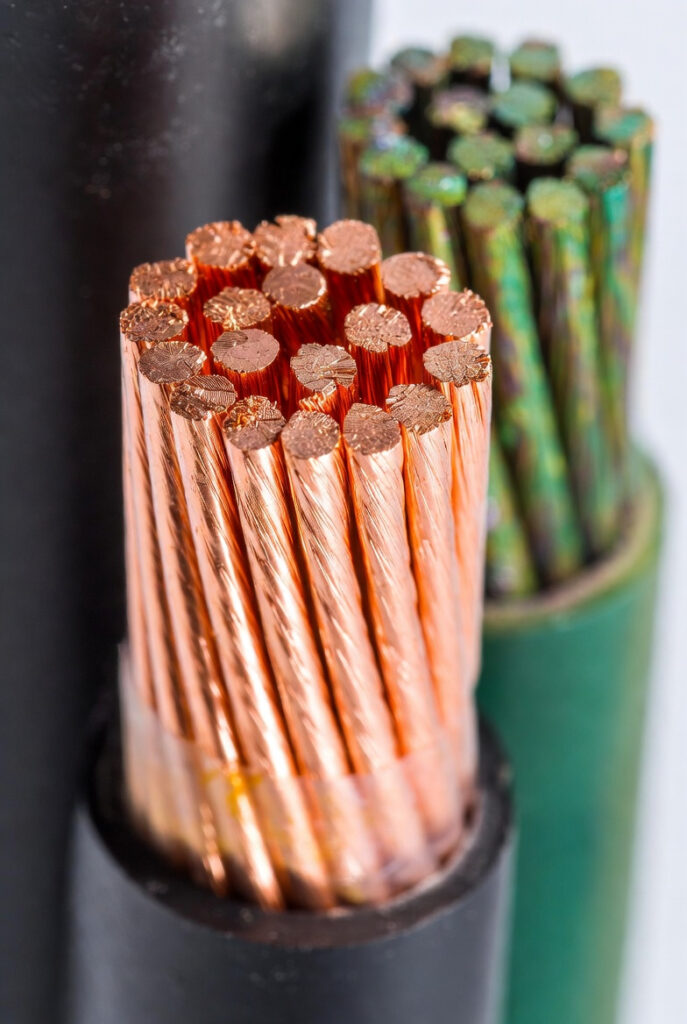
A battery cable pulled from a Rockwood cabin in year 3. The outside jacket looks fine. Cut it open the copper strands are green. Not a little green. Uniformly green. Every strand coated in copper oxide from moisture that wicked in through a micro-crack in the jacket at the lug entry point. The resistance of that cable has increased by a measurable amount. The tinned copper wire that costs $0.50 more per foot would still look like new copper at year 3. At year 10. At year 25. Before specifying your cable understand how much solar power you actually need the current your cables carry determines how critical long-term resistance stability becomes.
Tinned Copper Wire: Why Bare Copper Fails in Ontario Cabins
What copper oxidation is: Copper reacts with oxygen and moisture to form copper oxide specifically cupric oxide (CuO) and cuprous oxide (Cu₂O). These compounds form as a thin surface layer on exposed copper the green patina visible on old copper pipes, roofing, and the Statue of Liberty. The patina looks harmless. Electrically it is not. Pure copper has an electrical resistivity of approximately 1.68 × 10⁻⁸ Ω·m one of the best electrical conductors available. Cupric oxide (CuO) has a resistivity of approximately 1 × 10⁻¹ to 1 × 10⁻³ Ω·m between 5 million and 500 million times higher than pure copper. A thin layer of copper oxide does not make the wire non-conductive but it dramatically increases contact resistance at every interface between oxidized strand surfaces.
The P=I²R oxidation tax: At 300A through a battery cable bundle where 20% of the strand cross-sectional area has been reduced by copper oxide formation the effective resistance increases by approximately 25% above nominal. In a 4/0 AWG cable with nominal resistance of 0.003Ω per foot at 300A: P = 300² × 0.00375Ω = 337.5 watts of heat per foot vs the nominal 270 watts. The difference 67.5 additional watts per foot is the oxidation tax. Across a 6-foot battery cable run: 405 additional watts of heat generated in the cable alone. This is not theoretical. This is what a green battery cable is doing inside its jacket.
The Ontario humidity engine: A Rockwood cabin occupied in summer and closed in winter experiences dramatic humidity swings. Summer: 70-80% relative humidity in July and August. Winter: the cabin cools to near-outdoor temperatures moisture condenses on surfaces as the temperature drops through the dew point. Freeze-thaw cycling opens microscopic gaps at cable jacket terminations. Every gap is a moisture infiltration point. Over 3-5 Ontario winters a bare copper cable in an unconditioned equipment room is progressively oxidizing from the inside invisibly until the resistance is high enough to show measurable heat on an IR thermometer.
I pulled a bare copper 2/0 AWG cable from a Rockwood cabin system at year 4 during an upgrade. Green strands throughout the lug barrel the crimp had been mechanically sound but the copper had oxidized inside the sealed barrel over 4 Ontario winters. Resistance measurement at the lug: 0.008Ω vs the expected 0.001Ω 8× higher than specified. At 200A: P = 200² × 0.008 = 320 watts at that single lug. The lug was running hot. The cable was replaced with tinned copper. Resistance at the new lug: 0.001Ω. The heat was gone. As covered in our Wire Gauge guide proper cable sizing assumes nominal resistance an oxidized cable is a different cable entirely.
What Tinning Is and How It Works
The electroplating process: Tinned copper wire is manufactured by passing drawn copper wire through a molten tin bath or an electroplating solution depositing a thin uniform layer of tin on the copper strand surfaces before the wire is assembled into a cable. The tin layer is typically 1-3 microns thick thin enough to add negligible resistance or weight but thick enough to provide continuous barrier protection between the copper and the atmosphere.
Why tin does not oxidize at the same rate as copper: Tin oxidizes to form stannic oxide (SnO₂) a much more stable and adherent compound than copper oxide. The tin oxide layer that forms is thin, stable, and self-limiting it forms quickly and then stops growing. Tin oxide has significantly lower electrical resistance than copper oxide the contact resistance of a tin oxide surface is acceptable for electrical connections in a way that a copper oxide surface is not. The tin acts as a sacrificial layer it oxidizes preferentially, protecting the underlying copper, and the tin oxide that forms does not significantly impair electrical conductivity.
The 25-year protection: At 1-3 microns of tin plating the wire strand surfaces remain protected from copper oxidation for the design lifetime of the system. At year 10 a tinned copper wire strand in an Ontario cabin equipment room still has its tin protective layer intact. At year 25 if the mechanical seal at the lug is sound the copper underneath has never been exposed to oxygen or moisture.
I did a 5-year inspection on a Rockwood Fortress build last autumn a system I had commissioned with tinned copper cable and tinned copper lugs throughout. The client expected to find some deterioration. We pulled one lug from each cable run and inspected the strands. Bright orange-pink copper. Not a trace of green. Not a trace of brown. The resistance at every lug was within 5% of the commissioning measurement. His face said everything. The tinned copper wire that cost him an extra $40 on the original build had just saved him a cable replacement job. That is the 25-year standard in practice.
The Solder Compatibility Advantage
Why tinning improves solder flow: As covered in our Cold Weld Crimping guide hydraulic hex crimping is the preferred connection method for battery cables. But for small gauge signal wiring, sensor connections, and control circuit wiring where soldering is appropriate tinned copper wire provides a significant advantage. Solder adheres more readily to a tin surface than to a bare copper surface the tin and solder are compatible alloys that wet uniformly.
The flux residue problem: Standard rosin flux leaves a non-corrosive residue that is electrically inert. Activated flux used on more heavily oxidized surfaces leaves a residue that is mildly corrosive and hygroscopic. On tinned copper wire solder flows without activated flux the tin surface is clean and solderable without aggressive flux chemistry. The resulting joint has no corrosive residue, wets uniformly, and maintains low resistance. And every connection sealed with adhesive-lined heat shrink as covered in our Heat Shrink guide the tinning and the seal together are the complete moisture protection system.
The ABYC and CEC Standards
ABYC E-11 – The Marine Authority: The American Boat and Yacht Council Standard E-11 essentially mandates tinned copper for marine DC wiring due to documented failures of bare copper in salt air and humidity environments. A Rockwood cabin equipment room in January humidity condensing on every surface as the temperature drops is chemically equivalent to a marine environment for the purposes of copper oxidation. The ABYC E-11 tinned copper requirement applies to off-grid Ontario installations by analogy even if not by strict jurisdiction.
CEC Section 64 – Canada: The Canadian Electrical Code Section 64 requires that electrical connections and wiring in photovoltaic systems maintain their “permanent integrity” under all environmental conditions of the installation. For an unconditioned Ontario cabin experiencing -30°C to +35°C temperature swings, 30-85% relative humidity swings, and freeze-thaw condensation cycling tinned copper wire is the only specification that satisfies the “permanent integrity” requirement over the design lifetime of the system.
The NEC parallel: NEC Article 310 specifies conductor types and their appropriate environments. Type USE-2 Underground Service Entrance cable rated for wet locations is the correct specification for outdoor and unconditioned-space solar wiring. USE-2 cables are manufactured with tinned copper conductors as standard the NEC effectively requires tinned copper for wet location wiring by specifying the cable type.
The Cable and Lug Selection Standard
What to look for in tinned copper battery cable:
- Tinned copper stranding – specified on product listing or packaging not assumed
- USE-2 or SGX/SGT rating – indicates wet location suitability
- UL Listed – independent verification of conductor specification
- Fine stranding – SGX/SGT fine stranded wire is more flexible and has greater strand surface area for crimping
The WindyNation 4/0 AWG battery cable meets the tinned copper specification for battery cable applications flexible fine stranding, wet location rated, appropriate for the main battery cable runs in a Rockwood Fortress build.
The lug standard: Every tinned copper cable connection terminates in a tinned copper lug the tin-to-tin interface at the crimp provides long-term oxidation resistance at the critical connection point. A tinned copper cable terminated in a bare copper lug loses half its oxidation protection at the most important point in the circuit. The WBHome hydraulic crimper with the correct tinned copper lug and die produces the cold-welded tin-to-tin connection that defines the 25-year standard.
The monitoring connection: The Victron SmartShunt 500A battery negative connection carries the full system current 200-500A on a typical 48V system. Any increase in contact resistance at this connection directly affects the accuracy of the current measurement. Tinned copper lugs on the SmartShunt terminals ensure zero-drift contact resistance at the most current-sensitive connection in the monitoring system. As covered in our Battery Fortress guide the enclosure protects the physical connections the tinning protects them electrochemically.
Quick Reference – Tinned vs Bare Copper
| Property | Bare Copper | Tinned Copper |
|---|---|---|
| Oxidation resistance | Poor in humid environments | Excellent – 25+ year protection |
| Contact resistance over time | Increases as oxide forms | Stable – tin oxide is conductive |
| Solder compatibility | Requires activated flux | Wets with rosin flux – no residue |
| Ontario cabin suitability | Acceptable – conditioned only | Required – unconditioned spaces |
| ABYC E-11 compliance | No | Yes |
| CEC Section 64 permanent integrity | Marginal in unconditioned spaces | Yes |
| Cost premium | Baseline | Approximately 10-20% higher |
Pro Tip: At every annual system inspection October before the first frost pull the insulation back 5mm at one battery cable lug entry point on each cable run and inspect the copper strand color with a flashlight. Pure copper is bright orange-pink. Oxidized copper is dull brown. Green copper oxide is the failure indicator. If you see green at a lug entry point the moisture seal has been breached that lug and cable section must be replaced before winter. This 5-minute inspection catches the invisible oxidation failure mode before it becomes a 320-watt heat source inside your battery enclosure.
The Verdict
Two questions before buying any lug or battery cable:
- Is it tinned copper specified on the product listing, not assumed?
- Is it UL Listed for the application wet location, high current DC?
If the answer to either question is no it does not go in a Rockwood cabin battery enclosure.
The tinned copper wire that costs $0.50 more per foot today is the wire that looks like new copper at year 25. The bare copper cable that saved $20 is the green cable you are replacing at year 4.
Buy the tinned copper. One time. For 25 years.
Disclosure: This article contains affiliate links. If you buy through them, GridFree Guide earns a small commission at no extra cost to you.
Questions? Drop them below.
About the Author
Robert Bertrand spent 20 years as a service advisor in the automotive industry (Lexus and Nissan), where precision diagnostics, wiring integrity, and documentation standards were non-negotiable. He brings that same technical discipline to GridFree Guide, where he researches, tests, and documents off-grid solar systems for Ontario conditions. Based in Rockwood, Ontario, every article is built on verified specifications, manufacturer data, and the real-world climate constraints of Canadian off-grid living.
As an Amazon Associate I earn from qualifying purchases. This site also contains affiliate links to other products and services. GridFree Guide earns a small commission at no extra cost to you.