
In 20 years of automotive service I have seen what happens when a battery terminal vibrates loose. In a car the engine will not start. In a 48V off-grid system pulling 300 amps a loose nut is not an inconvenience it is a heating element. A busbar torque spec is not a suggestion from the manufacturer. It is the difference between a solid copper-to-copper connection and a resistive junction generating 90 watts of heat at the point where your most expensive equipment connects to your battery bank. Before torquing your busbars understand how much solar power you actually need the current your system pulls determines how critical every connection specification becomes.
Busbar Torque Spec: Why Finger Tight Is Not a Specification
The resistance reality: The P = I²R formula is not theoretical it is the temperature reading on your IR thermometer six months after commissioning. At 300A through a connection with 0.001Ω of additional resistance from a loose bolt: P = 300² × 0.001 = 90 watts of heat generated continuously at that single bolt. 90 watts. A small incandescent light bulb worth of heat being produced at the interface between your busbar and your cable lug inside a plastic fuse holder next to your battery bank. Finger tight is not a spec. It is a recipe for a very expensive failure.
Why loose connections increase resistance: A properly torqued connection brings metal surfaces into full intimate contact the microscopic surface irregularities of both metal surfaces are crushed flat under the specified clamping force. The actual metal-to-metal contact area is maximized. Resistance at the interface approaches zero. A finger-tight bolt produces surface contact only at the highest points of the metal surface irregularities tiny islands of contact that concentrate current and generate disproportionate heat per the P = I²R relationship.
The vibration progression: A finger-tight bolt in an off-grid system does not stay finger-tight. Vibration from the inverter cooling fan, thermal expansion and contraction cycles, and Ontario freeze-thaw cycling all work to loosen the bolt progressively over 6-12 months. What starts as finger-tight becomes loose. What was generating 90W of heat is now generating more. The connection deteriorates until it produces enough heat to damage surrounding insulation or arc.
I diagnosed a hot busbar connection on a client system 14 months after commissioning. The IR thermometer showed the connection running 18°C above ambient. When I removed the bolt the copper lug surface showed the characteristic circular discoloration of sustained heat a dark ring where contact had been concentrated. The bolt had backed off to approximately 6 Nm well below the specified 14 Nm for an M8 connection. The surrounding plastic fuse holder had begun to deform. A torque wrench at installation and a paint pen mark would have caught this at the first annual inspection before any damage occurred.
The Victron Torque Specifications
The Victron Lynx Distributor – M8 bolts: The Victron Lynx Distributor uses M8 bolts for all cable lug connections. Victron’s specified busbar torque spec for M8 connections in the Lynx Distributor is 14 Nm (approximately 124 lb-in). This specification applies to every cable lug connection on every fused output position and the main busbar input terminals. Every single one. Not the ones that were hard to reach. All of them.
The Victron Lynx Power-In M10 bolts: The Victron Lynx Power-In uses M10 bolts for the main battery cable connections. Victron’s specified torque for M10 connections is 25 Nm (approximately 221 lb-in). The M10 connection carries the full battery bank current up to 1,000A on a large 48V system making this the most critical single busbar torque spec in the entire system. If there is one bolt in the build that gets a calibrated torque wrench it is this one.
General busbar torque reference:
- M6 bolts: 8-10 Nm (71-89 lb-in) – small busbar accessories
- M8 bolts: 14 Nm (124 lb-in) – Lynx Distributor, most fuse holders
- M10 bolts: 25 Nm (221 lb-in) – Lynx Power-In, main battery cables
- M12 bolts: 35-40 Nm (310-354 lb-in) – large format busbars, main disconnects
The Victron SmartShunt 500A terminal torque: The SmartShunt battery negative connection uses M10 terminals 25 Nm busbar torque spec. Every amp of battery current flows through the SmartShunt for measurement. A loose SmartShunt connection adds resistance directly into the main current path generating heat and introducing measurement error simultaneously. As covered in our Lynx Distributor guide every component in the DC distribution chain requires its specified torque not an approximation.
The Code Standards – NEC and CEC
NEC 110.14(D) – The Hammer: National Electrical Code Section 110.14(D) added in the 2017 edition requires that where manufacturer’s installation instructions specify a torque value for a connection a calibrated torque tool must be used to achieve that torque. This is not a recommendation. It is a code requirement. Victron publishes torque specifications for every Lynx component connection. Therefore under NEC 110.14(D) a calibrated torque wrench is mandatory for every Lynx Distributor and Lynx Power-In connection in a US jurisdiction. A system installed without a torque wrench where manufacturer torque specs are indicated is technically non-compliant with NEC 110.14(D). Most installers do not know this subsection exists. Now you do.
CEC Section 12 – Canada: The Canadian Electrical Code Section 12 requires that all connections be made “securely and permanently” maintaining their specified electrical and mechanical properties under all operating conditions including temperature extremes. In Ontario this explicitly includes the freeze-thaw cycling and -30°C minimum temperatures that affect busbar torque spec retention throughout the system life.
The Ontario cold-shrink phenomenon: Metal contracts when cold. An M8 bolt torqued to 14 Nm in September at 20°C will produce less clamping force at -20°C in January the differential thermal contraction between the steel bolt and the copper busbar reduces the clamping force. If the initial torque was already marginal finger-tight plus a quarter turn rather than a calibrated tool the January cold-shrink can back the connection to the point where it begins generating heat. This is a uniquely Ontario failure mode that CEC Section 12 addresses directly. The solution: hit the specified torque at installation, mark with a paint pen, and inspect every October before the first hard frost.
The Torque Wrench Standard
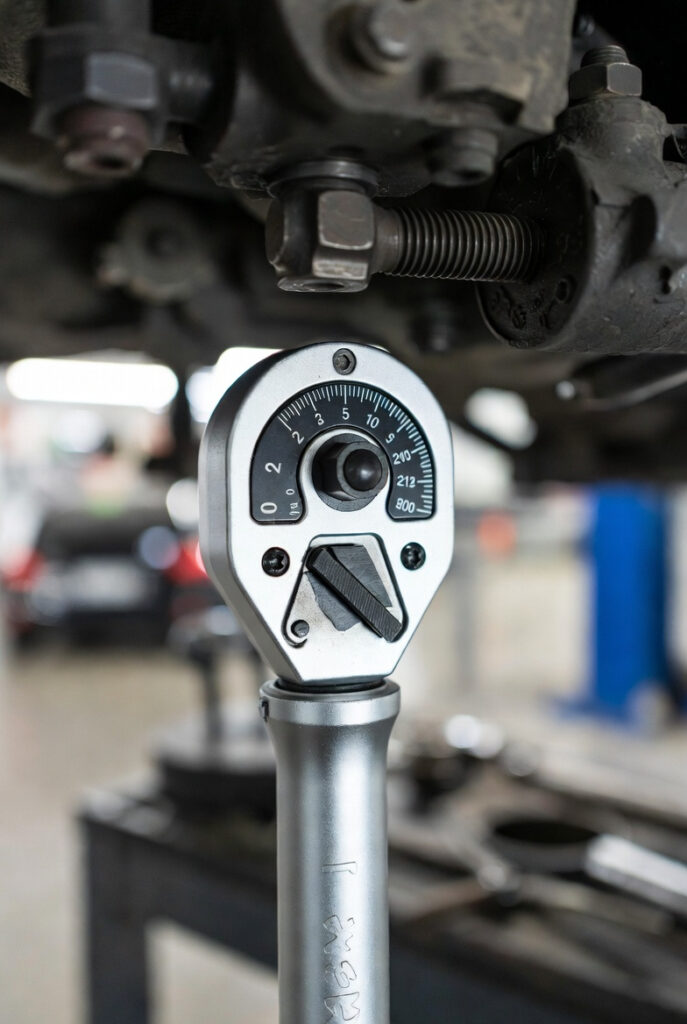
What tool is required: A 1/4-inch drive click-type torque wrench covering the 5-25 Nm range is the correct tool for Victron Lynx busbar connections. A click-type wrench provides an audible and tactile signal when the specified torque is reached removing operator judgment from the equation. Cost: $40-70 for a quality unit. This is the single cheapest insurance policy in an off-grid electrical system. As covered in our Cold Weld Crimping guide the same precision mindset that produces a cold-welded crimp produces a correctly torqued busbar connection.
The calibration requirement: NEC 110.14(D) specifies a “calibrated torque tool” not just any wrench. A quality click-type torque wrench maintains calibration for normal use when stored properly. Drop it on a concrete floor and it needs recalibration. Store it at the midpoint of its range not at maximum to preserve the spring mechanism. Many tool rental centers offer torque wrench calibration verification.
The procedure:
- Clean all contact surfaces – no oxidation, no debris, no anti-seize on the contact faces
- Install the cable lug flat against the busbar surface – no washers between lug and busbar unless specified
- Thread the bolt finger tight – the lug should be fully seated and not rotating
- Apply torque wrench – smooth steady increase in torque until click
- Apply paint pen mark across bolt head and adjacent surface immediately
- Document torque spec and date in the system commissioning log
I was installing a Lynx Distributor on a Rockwood Fortress build last autumn. My client watched the torque wrench procedure for the first time and asked why I was using a paint pen. I explained if the mark shifts the bolt has moved. Simple as that. He picked up the paint pen and marked every remaining bolt himself under my guidance. Six months later at the first inspection every mark was aligned. The system was exactly where it had been at commissioning. He understood what the paint pen was for the moment he saw the unbroken lines.
The Paint Pen Marking Standard
Why marking matters: A paint pen mark applied across the bolt head and adjacent busbar surface immediately after torqueing creates a permanent visual inspection record. At every subsequent inspection annual or after any significant system event a visual check of every paint pen mark confirms that no bolts have moved. A shifted mark identifies a loosened connection before it generates heat. A missing mark identifies a connection that was never torqued to spec. As covered in our Battery Fortress guide the busbar torque spec inspection is part of the annual maintenance standard for the entire system.
What to mark: Every M6, M8, M10, and M12 bolt on every busbar connection the Lynx Distributor all output fuse positions and input terminals, the Lynx Power-In both main battery cable terminals, the SmartShunt both main current terminals, and the battery terminals themselves. One continuous line from bolt head across the adjacent surface. Straight. Unambiguous. Bright color yellow or orange on silver hardware.
Quick Reference – Busbar Torque Specifications
| Bolt Size | Torque (Nm) | Torque (lb-in) | Application |
|---|---|---|---|
| M6 | 8-10 Nm | 71-89 lb-in | Small busbar accessories |
| M8 | 14 Nm | 124 lb-in | Lynx Distributor – all outputs |
| M10 | 25 Nm | 221 lb-in | Lynx Power-In battery cables |
| M12 | 35-40 Nm | 310-354 lb-in | Large format busbars |
| SmartShunt M10 | 25 Nm | 221 lb-in | Battery negative main connection |
Pro Tip: Add a busbar torque spec inspection to your annual system maintenance checklist every October before the first hard frost. Check every paint pen mark for alignment. Retorque any connection where the mark has shifted. Do this before the heating season begins not after the first -20°C night when the cold-shrink has already done its work. A 30-minute annual inspection of every busbar connection is the difference between a system that performs at year 10 the same as it did at commissioning and one that is quietly building resistance at every cold junction all winter.
The Verdict
A busbar torque spec is not a suggestion. It is the boundary between a solid copper-to-copper connection and a resistive junction generating 90 watts of heat at your most critical electrical interface.
14 Nm on M8. 25 Nm on M10. Paint pen mark on every bolt. Annual inspection before the first frost.
A $50 torque wrench is the cheapest insurance policy in your off-grid system. Use it on every bolt. Every single one.
Disclosure: This article contains affiliate links. If you buy through them, GridFree Guide earns a small commission at no extra cost to you.
Questions? Drop them below.
About the Author
Robert Bertrand spent 20 years as a service advisor in the automotive industry (Lexus and Nissan), where precision diagnostics, wiring integrity, and documentation standards were non-negotiable. He brings that same technical discipline to GridFree Guide, where he researches, tests, and documents off-grid solar systems for Ontario conditions. Based in Rockwood, Ontario, every article is built on verified specifications, manufacturer data, and the real-world climate constraints of Canadian off-grid living.
As an Amazon Associate I earn from qualifying purchases. This site also contains affiliate links to other products and services. GridFree Guide earns a small commission at no extra cost to you.