
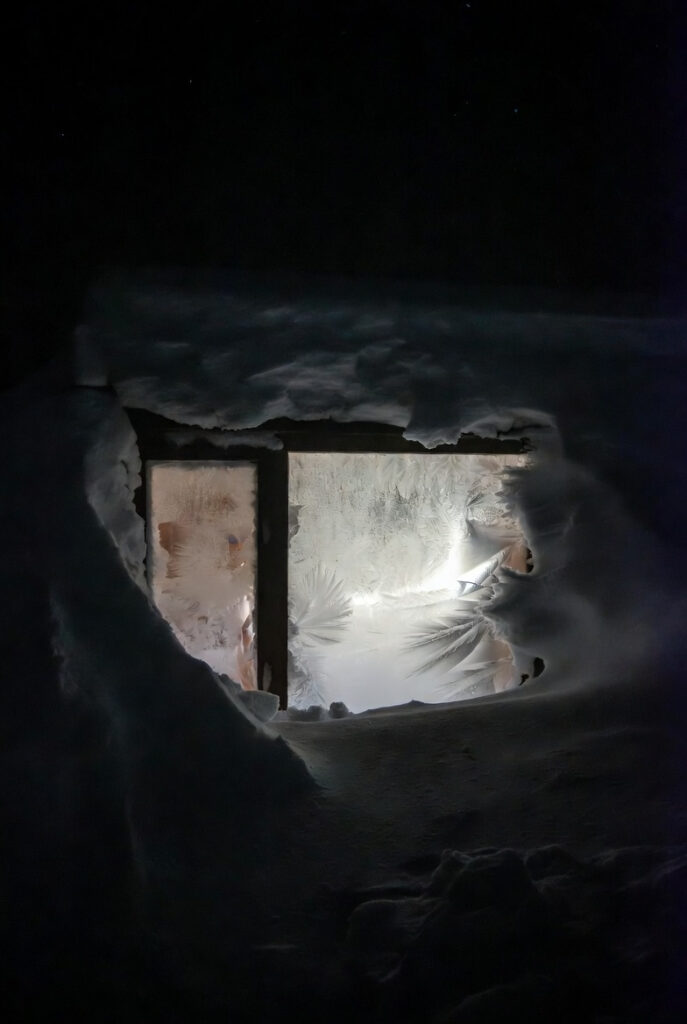
3:00 AM. January. Rockwood. The furnace blower kicks on. The inverter sees the surge. The battery voltage sags. The system hits Low Voltage Cutoff. The cabin goes dark and cold in the same second. Inverter sizing for off-grid is not a summer calculation it is a winter survival calculation. The inverter that handled everything fine in August may fail this test in January. Cold air. Dense air. A motor that needs three times its rated current to move it. Before sizing your inverter understand how much solar power you actually need the loads you run in January determine your inverter specification.
Inverter Sizing for Off-Grid: Why Winter Changes Everything
The cold air density problem: Air density increases as temperature decreases. At -20°C air is approximately 15% denser than at +20°C. A furnace blower motor a centrifugal fan designed to move a specific volume of air must work harder to move denser air. Working harder means drawing more current. The nameplate current rating on a motor is measured at standard conditions typically 20-25°C. At -20°C the same motor moving through denser air draws 10-15% more continuous current than its nameplate rating before accounting for the cold-temperature inrush multiplier.
The inrush current multiplier: Induction motors the type used in furnace blowers, well pumps, and refrigerator compressors draw 3-7× their rated running current during startup. This inrush event lasts 1-3 seconds while the motor accelerates to operating speed. A furnace blower with a 5A nameplate rating draws 15-35A for 2 seconds on startup in summer at 20°C. In January at -20°C with denser air and a cold motor winding with higher resistance the inrush multiplier can reach 7-8× the cold-temperature running current. A motor drawing 5.75A continuously at -20°C may draw 40-46A for 2 seconds on startup.
Why this matters for inverter sizing for off-grid: An inverter’s surge rating is its peak output capacity typically 2-3× its continuous rating for 1-5 seconds. A 3,000W continuous inverter typically has a 6,000W surge rating. At 48V 6,000W = 125A peak from the battery. A furnace blower motor pulling 46A inrush at 48V = 2,208W of surge demand. The 3,000W inverter handles this easily in summer. In winter the same inverter must also overcome the battery voltage sag that occurs simultaneously with the motor surge. If the voltage sag drops below the inverter’s Low Voltage Cutoff threshold the inverter shuts off at the moment of peak demand. 3am. January. Cabin goes dark.
I had a client near Guelph with a 3,000W inverter running a propane furnace with an electric blower in his Rockwood-area cabin. Called me in January. System went dark at 3am during a -25°C night. Furnace blower started, inverter hit LVC, shut down. Cabin dropped to 4°C before he woke up. I diagnosed it the next morning the battery voltage under surge load was dropping to 43.8V the inverter’s LVC threshold was 44V. He was 0.2V below cutoff under the combined load of the blower surge and the battery sag at -20°C. In August the same system ran fine. Voltage never sagged below 46V. Winter changed the math entirely.
The Battery Voltage Sag Problem
What internal resistance does at -20°C: LiFePO4 battery internal resistance increases significantly at low temperatures — even with heating pads maintaining the cells above 0°C as covered in our Battery Heating Pad guide. A battery bank with internal resistance of 0.5 milliohms at 20°C may have internal resistance of 1.5-2.0 milliohms at -5°C. The heating pad maintains the BMS charge threshold it does not restore room-temperature internal resistance.
The voltage sag calculation: Voltage sag under load = I × R_internal. A 200A surge current through a battery bank with 1.5 milliohms internal resistance: V_sag = 200A × 0.0015Ω = 0.3V. On a 48V battery at 50% SoC showing 51V resting voltage: surge voltage = 50.7V. Manageable. The same surge through a bank at 30% SoC showing 48V resting voltage: surge voltage = 47.7V. Add 0.3V of cable voltage drop now 47.4V. A 44V LVC inverter still runs. A 48V LVC inverter shuts down.
The compounding factors in January: Three factors compound simultaneously at 3am on a -25°C January night: higher motor inrush current from cold dense air, higher battery internal resistance from cold cell temperature, and lower battery SoC if the heating pads have been running all night consuming capacity. Each factor alone is manageable. All three together at the moment the furnace blower starts is the failure scenario.
The NEC and CEC Temperature Correction Factors
NEC 690.8 – USA: National Electrical Code Section 690.8 requires that conductor and equipment ampacity be corrected for operating temperature below 30°C. At -20°C the NEC temperature correction factor is approximately 1.29 meaning equipment must be sized to 129% of its rated capacity to maintain safe operation. Applied to inverter sizing for off-grid: if your calculated surge requirement is 6,000W at 20°C the NEC 690.8-corrected requirement at -20°C is 6,000W × 1.29 = 7,740W.
CEC Section 64 – Canada: The Canadian Electrical Code Section 64 governs photovoltaic systems and requires equipment rated for the ambient temperature of the installation. For Ontario installations experiencing -30°C minimum ambient temperature the CEC requires equipment rated for this temperature range. The practical implication for inverter sizing for off-grid in Ontario: the inverter surge capacity must accommodate motor inrush current corrected for the minimum expected ambient temperature not the standard test condition temperature.
The True Surge Calculation – step by step:
- Identify your largest motor load furnace blower, well pump, refrigerator compressor
- Find the nameplate running current (amps) from the motor data plate
- Apply cold temperature running current multiplier multiply by 1.15 for -20°C conditions
- Apply inrush multiplier multiply by 6 conservatively (up to 8 for worst case)
- Convert to watts multiply by system voltage (48V)
- Apply NEC 690.8 / CEC Section 64 temperature correction multiply by 1.29
- This is your minimum inverter surge requirement for Ontario winter conditions
Example calculation – furnace blower:
- Nameplate: 5A running current at 120V AC = 600W
- Cold temperature running: 5A × 1.15 = 5.75A
- Inrush: 5.75A × 6 = 34.5A at 120V AC = 4,140W AC surge
- At 48V DC the inverter must supply: 4,140W / 0.9 efficiency = 4,600W DC surge
- CEC temperature correction: 4,600W × 1.29 = 5,934W minimum surge capacity
The Soft Starter Solution
What a soft starter does: A soft starter like the Micro-Air EasyStart Flex reduces motor inrush current by ramping voltage to the motor gradually rather than applying full voltage instantaneously. Instead of a 6-8× inrush spike the motor draws 2-3× running current during startup. The same furnace blower that draws 34.5A at startup with direct-on-line starting draws 11.5A with a soft starter installed. The inverter sizing for off-grid requirement drops from 5,934W to approximately 2,300W a 3,000W inverter now has full comfortable margin. As covered in our EasyStart Flex guide soft starters are the most cost-effective way to reduce surge requirements on any motor load.
When the soft starter is the right answer: A correctly sized larger inverter costs $1,000-3,000 more than an undersized unit. A Micro-Air EasyStart Flex costs approximately $300-400. For a system where the inverter is already installed and undersized for winter surge conditions the soft starter is the economical fix. For a new system design calculate the true surge requirement first then decide whether to meet it with inverter sizing or soft starter technology.
Inverter Selection for Ontario Winter
The Victron MultiPlus-II 5000VA at 48V: 10,000W surge rating. 5,000W continuous. At 48V this represents 208A continuous and 416A surge from the battery well above the corrected surge requirement for a furnace blower at -20°C. The 5000VA is the correct specification for any Ontario cabin running a furnace blower, well pump, or refrigerator compressor as part of the winter load profile. As covered in our MultiPlus-II vs Quattro guide this unit is the professional standard for full-cabin Ontario off-grid systems.
The Victron MultiPlus-II 3000VA: 6,000W surge rating. 3,000W continuous. For small cabins with no motor loads or with soft starters on all motors this unit handles Ontario winter conditions adequately. Without soft starters on motor loads the 3,000VA is marginal for combined furnace blower and well pump surge in January conditions. The idle consumption advantage covered in our Inverter Idle Consumption guide makes the 3,000VA the correct choice when loads allow it just not for motor-heavy winter systems without soft starters.
I showed a client the true surge calculation for the first time last October. He had purchased a 3,000W inverter for a cabin with a furnace blower and a well pump. When we ran the numbers 5,934W minimum surge for the blower alone, before the well pump his face changed. He had been one cold January night away from the system going dark at 3am. The inverter was replaced with the 5000VA unit before the first frost. He has never hit LVC since.
Quick Reference – Ontario Winter Inverter Sizing
| Load | Summer Surge | Winter Corrected Surge | Recommended Inverter |
|---|---|---|---|
| Furnace blower 5A | 4,140W | 5,934W | 5,000VA minimum |
| Well pump 10A | 8,280W | 10,681W | 5,000VA + soft starter |
| Refrigerator compressor 3A | 2,484W | 3,204W | 3,000VA minimum |
| Lighting and small loads only | No surge concern | No surge concern | 3,000VA adequate |
Pro Tip: Test your inverter surge capacity before January not during it. In October connect your largest motor load furnace blower, well pump and watch the battery voltage on the Cerbo GX during startup. Note the minimum voltage reached during the surge event. If the minimum voltage is within 2V of your inverter’s LVC threshold you have a margin problem. Fix it in October with a soft starter or a larger inverter not at 3am in January when the cabin is at 4°C and the options are limited.
The Verdict
Inverter sizing for off-grid in Ontario is a winter calculation. Not a summer calculation. Not a nameplate calculation. A January 3am calculation when the furnace blower starts, the battery voltage sags, and the only question is whether your inverter stays on or shuts down.
Calculate the true surge. Apply the temperature correction. Size for where you are not where the spec sheet was written.
The cabin stays warm because you did the math in October.
Disclosure: This article contains affiliate links. If you buy through them, GridFree Guide earns a small commission at no extra cost to you.
Questions? Drop them below.
About the Author
Robert Bertrand spent 20 years as a service advisor in the automotive industry (Lexus and Nissan), where precision diagnostics, wiring integrity, and documentation standards were non-negotiable. He brings that same technical discipline to GridFree Guide, where he researches, tests, and documents off-grid solar systems for Ontario conditions. Based in Rockwood, Ontario, every article is built on verified specifications, manufacturer data, and the real-world climate constraints of Canadian off-grid living.
As an Amazon Associate I earn from qualifying purchases. This site also contains affiliate links to other products and services. GridFree Guide earns a small commission at no extra cost to you.