
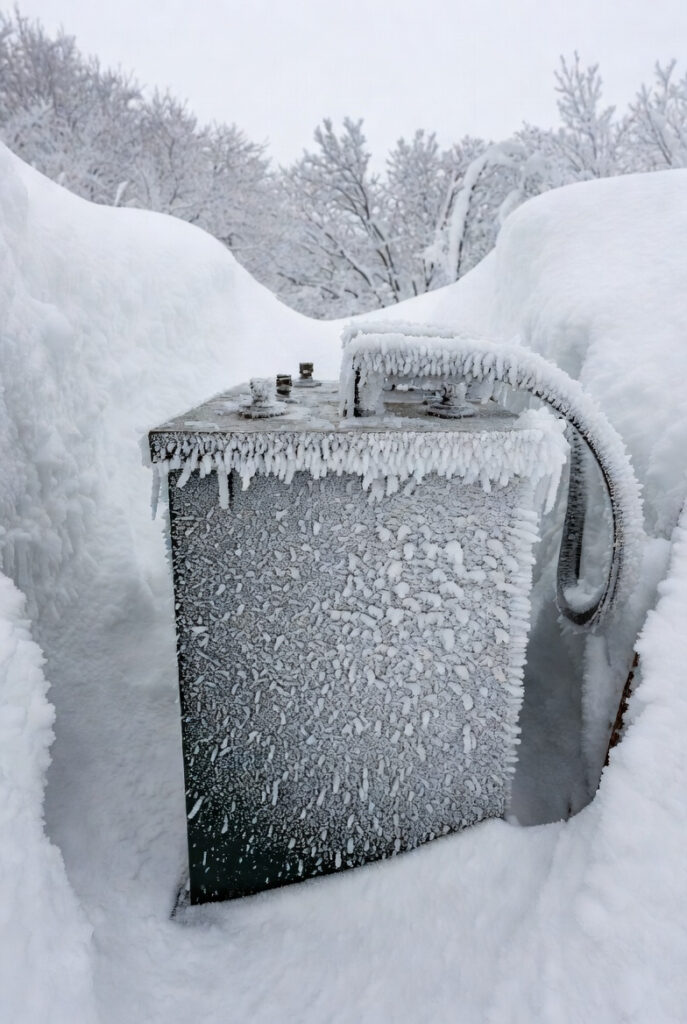
“Charging Disabled: Low Temp.” January. Clear sky. 1,200W array producing nothing. $5,000 battery bank. 40% SoC. A lifepo4 battery heating pad is the $50 device that determines whether that clear January day charges your batteries or wastes them entirely. Before building your battery system understand how much solar power you actually need because none of it matters if your batteries cannot accept the charge.
LiFePO4 Battery Heating Pad: Why the BMS Hard Floor Exists
The lithium plating problem: LiFePO4 batteries cannot safely accept charge below 0°C because of lithium plating. When lithium ions move from cathode to anode during charging at sub-zero temperatures the graphite anode cannot absorb the ions fast enough they plate onto the anode surface as metallic lithium dendrites instead of intercalating into the graphite structure. Lithium dendrites are permanent capacity loss. They are also the initiating mechanism for internal short circuits and thermal runaway. The BMS 0°C charge lockout is not a conservative setting it is preventing irreversible physical damage to the cells.
What the BMS lockout actually does: When any cell drops below 0°C the BMS opens the charge FETs and blocks all incoming charge current. This is an absolute hard cutoff. It does not matter how many Renogy panels are on your roof or how bright the January sun is if the cells are below threshold the energy goes nowhere. The battery can still discharge and power your inverter. It simply will not accept any charge until the cells warm up.
The concrete floor problem: Here is the detail that almost no solar blog mentions. Concrete has a thermal conductivity of approximately 1.0 W/(m·K) dramatically higher than still air at 0.025 W/(m·K). A battery sitting on a concrete floor loses heat by conduction at a rate that has nothing to do with the air temperature in the room. A battery that would stabilize at 2°C sitting on a wooden shelf may reach -8°C sitting on a concrete floor at the exact same ambient temperature. The concrete is an active heat sink.
I had a client near Guelph call me on a clear blue January morning the kind of day that should have been pinning the MPPT needle. His Victron app said “Charging Disabled: Low Temp.” His 200Ah LiFePO4 bank was at 40% SoC and -4°C. His array was producing 1,200W and his batteries could not accept a single watt. They were sitting directly on an uninsulated concrete equipment room floor. We installed two 25W silicone heating pads connected to a thermostat relay set to trigger at 2°C that weekend. Three winters later zero lockouts. Including three weeks of -20°C in February.
The Self-Heating Battery Trap
What internal heaters actually do: Many modern LiFePO4 batteries advertise built-in self-heating capability. The marketing implies the battery can protect itself in cold conditions. The technical reality has two significant failure modes that manufacturers rarely explain clearly.
The chicken-and-egg problem: Most internal battery heaters are powered by the battery itself. If the BMS has locked out charging due to low temperature the battery is simultaneously trying to warm itself using stored energy while unable to accept new charge to replace what the heater is consuming. On a cold enough night a self-heating battery can discharge itself significantly attempting to maintain temperature leaving you with a warmer but flatter battery by morning.
The wake-up threshold failure: Some internal heaters only activate when an external charge source is detected. If the battery is too cold the BMS will not wake up enough to detect the charge source so the heater never starts. The panels are producing. The BMS is locked. The internal heater that would fix the situation never receives the signal to activate. I have seen this exact scenario on a client’s premium battery with built-in heating the system failed repeatedly until we bypassed the internal heater entirely and installed external pads. External silicone heating pads operate independently of the BMS state. They run off a separate circuit. The BMS lockout is irrelevant to their operation.
Sizing and Installing the External Silicone Heating Pad
What silicone heating pads are: Silicone heating pads are flexible resistance heaters a resistance wire element encapsulated in a silicone rubber sheet that distributes heat evenly across the pad surface. Available in 12V or 24V and wattages from 10W to 200W. The silicone construction remains flexible at -40°C appropriate for Ontario equipment room conditions.
Sizing for your battery bank: For a typical 100-200Ah LiFePO4 battery bank in an insulated enclosure a 25-50W pad provides adequate heating. The goal is maintenance not rapid warming. The math is straightforward: a 25W pad at 20% duty cycle averages 5W of continuous draw 120Wh per day. Even in December that is manageable and does not meaningfully impact your energy budget.
Pad placement: Mount the silicone pad on the bottom face of the battery between the battery and the mounting surface. Heat rises. A bottom-mounted pad distributes heat through the entire cell stack more effectively than a side-mounted pad. Secure with high-temperature adhesive or stainless steel cable ties around the pad perimeter not through the pad.
The honest budget alternative: A Victron BMV-712 with its programmable relay offers precise automated control. But a basic 12V thermostat relay from Amazon approximately $15 works fine if you do not have the budget for a full Victron monitor. Set it to close at 3°C and open at 8°C. Connect the heating pad. Done. This is the honest alternative most solar blogs never mention because it does not generate affiliate revenue. It works.
The Relay Logic – Automating the Heater
Why manual control fails: A heating pad left on continuously at 25W draws 600Wh per day an unnecessary 4% parasitic load for the 8 months of the year when batteries are above ambient temperature. Automated relay control eliminates this waste entirely.
The BMV-712 programmable relay: The Victron BMV-712 programmable relay closes when battery temperature drops below a configurable threshold typically 3°C and opens when temperature rises above 8°C. The BMV-712 monitors temperature via the optional temperature sensor the same sensor that corrects SoC calculations for cold-weather capacity reduction. One sensor does two jobs. As covered in our SmartShunt vs BMV-712 guide this relay is one of the key advantages of the BMV-712 over the SmartShunt.
The Victron Smart Battery Sense: The Victron Smart Battery Sense provides wireless temperature and voltage monitoring via VE.Smart Networking transmitting battery temperature data to all connected MPPT controllers simultaneously. Combined with relay-controlled heating pads it creates a complete closed-loop cold weather management system: temperature drops → relay closes → pad heats → temperature rises → relay opens → pad deactivates. The Cerbo GX covered in our Cerbo GX guide logs every relay event in VRM. From Miami in January you can confirm your Rockwood cabin batteries are staying warm.
The Insulation Box – The Force Multiplier
Why insulation changes everything: A 25W heating pad fighting -25°C in an uninsulated metal equipment room runs at near-constant duty cycle consuming 550-600Wh per day. The same pad in an insulated enclosure maintains temperature at 20% duty cycle consuming 120Wh per day. Insulation does not generate heat. It slows the rate at which heat escapes. Every R-value point reduces the pad duty cycle and reduces the parasitic energy cost.
The practical insulation options:
- 2-inch XPS rigid foam board R-10 lining all interior surfaces of a wooden battery box
- Heavy-duty insulated cooler pre-built effective for small battery banks up to 100Ah
- Spray foam seal every cable penetration into the insulated enclosure every gap is a cold air infiltration point
The wooden pallet standard: Every battery in an Ontario off-grid installation sits on a wooden pallet or 2-inch foam pad never on concrete. I saw one system in Rockwood where proper insulation and a pallet elevation alone eliminated heating pad activation on all but the six coldest nights of the year. The owner had expected to need the pad constantly. He used it six times all winter.
The Heater Wire Connections – Don’t Skip This
A silicone heating pad operates in the most demanding connection environment in the system continuous temperature cycling from summer heat to winter cold with condensation forming during every transition. Any bare or poorly protected heater wire connection will corrode. Increased resistance at a corroded connection generates heat at the connection rather than at the pad surface the same failure mode as a generic MC4 connector or an unprotected lug.
Seal every heater wire connection with adhesive-lined heat shrink as covered in our Heat Shrink guide. This is not optional. It is the same standard applied to every other electrical connection in the system.
Quick Reference – Battery Heating System Specifications
| Component | Specification | Purpose |
|---|---|---|
| Silicone heating pad | 25-50W – 12V or 24V | Maintains battery above 0°C |
| Relay controller | BMV-712 or basic $15 thermostat | Activates pad below 3°C – off at 8°C |
| Temperature sensor | Victron temp sensor or Smart Battery Sense | Provides temperature data to relay |
| Insulation | 2-inch XPS foam all surfaces | Reduces pad duty cycle and energy cost |
| Battery elevation | Wood pallet or foam pad | Prevents concrete conduction heat loss |
| Connection sealing | Adhesive-lined heat shrink | Prevents corrosion at heater connections |
Pro Tip: Test your heating system in October not January. Set the relay threshold temporarily to 15°C and confirm the relay closes, the pad heats, the temperature rises, and the relay opens at the upper threshold. Then reset to 3°C for winter operation. A heating system that has never been tested before it is needed is a heating system you cannot trust when the forecast shows -25°C for five consecutive days. Test in autumn. Sleep in January.
The Verdict
The BMS lockout is absolute. The panels are producing. The sun is there. The question is whether your batteries can accept what the sky is offering.
A 25W silicone pad. A relay set to 3°C. A wooden pallet. An insulated box. Under $150. 100% of January solar production recovered.
Install the lifepo4 battery heating pad before the first frost. Not after.
Disclosure: This article contains affiliate links. If you buy through them, GridFree Guide earns a small commission at no extra cost to you.
Questions? Drop them below.
About the Author
Robert Bertrand spent 20 years as a service advisor in the automotive industry (Lexus and Nissan), where precision diagnostics, wiring integrity, and documentation standards were non-negotiable. He brings that same technical discipline to GridFree Guide, where he researches, tests, and documents off-grid solar systems for Ontario conditions. Based in Rockwood, Ontario, every article is built on verified specifications, manufacturer data, and the real-world climate constraints of Canadian off-grid living.
As an Amazon Associate I earn from qualifying purchases. This site also contains affiliate links to other products and services. GridFree Guide earns a small commission at no extra cost to you.