
A customer brings in a dead inverter. You check the 4/0 cable connection the lug pulls off in your hand. The customer says he soldered it so it would be extra strong. Solder is for circuit boards not for 250A battery cables. Under continuous high-current load a poor connection heats up. If it gets hot enough to soften the solder the cable pulls out of the lug. A live 4/0 cable carrying 250A loose in a battery enclosure is not something you recover from cleanly. Crimping battery lugs with a hydraulic tool is the only professional standard for high-current DC connections. Before terminating cables understand how much solar power you actually need so you know what current your lugs need to handle continuously.
I pulled a lug off a cable in a Rockwood van build last fall. The previous installer had soldered it. Looked clean from the outside. Inside the lug the solder had wicked 4 centimetres up the cable stiffening the strands into a solid copper rod. Six months of cabin vibration had cracked five of the seven strand groups right at the lug barrel edge. The connection had maybe 40% of its rated ampacity. We recrimped every lug in the van that afternoon with a hydraulic tool. The owner had no idea he was running a system held together by 40% of the copper he thought he had.
Crimping Battery Lugs: Why the Cold Weld Beats Solder Every Time
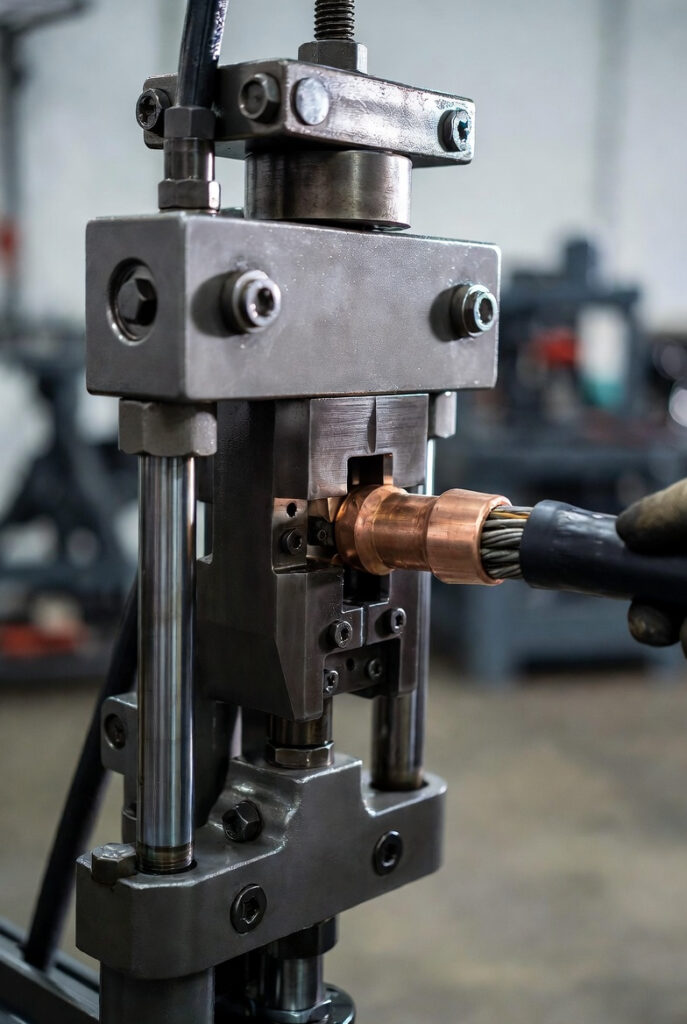
What a hydraulic crimp actually creates: A 10-ton hydraulic crimper deforms the copper lug barrel around the cable strands with approximately 20,000 pounds of pressure applied evenly around the circumference of the barrel. This pressure cold-welds the copper strands and the lug barrel into a single continuous piece of metal. No oxygen inside the joint. No voids. No interfaces between strand and barrel. One piece of copper from cable to lug.
Why no oxygen means no corrosion: Copper corrosion requires oxygen and moisture. Inside a properly crimped joint there is no oxygen. The cold-welded copper-to-copper interface cannot oxidize. A correctly crimped lug connection made today will have the same resistance in 25 years as it does the day it is crimped. A soldered joint has flux residue, voids between strands, and air pockets all sites for eventual oxidation.
The solder wicking problem: Solder is a liquid when applied it flows by capillary action into the spaces between the fine copper strands of Class K welding cable covered in our Wire Gauge guide. It does not stay in the lug barrel. It wicks 2-5 centimetres up the cable filling the gaps between strands and fusing them into a solid copper and solder composite rod. That rod is no longer flexible cable. It is a brittle composite that fractures under repeated bending or vibration at exactly one point the edge of the lug barrel where the wicking stops and the flexible strands begin.
The fracture point: The lug barrel edge is a stress concentration point even on correctly crimped connections it is where the cable transitions from constrained to free. On a soldered connection the brittle solder-impregnated section extends 2-5cm beyond the barrel edge. The first vibration cycle flexes the cable at this point. The brittle section cannot flex it cracks. Over hundreds of vibration cycles the strand groups fracture one by one. From the outside the connection looks perfect. Inside it is failing.
The Gravel Road Test – Vibration Is the Enemy
Why vibration matters for off-grid systems: As covered in our Busbar guide vibration is present in every off-grid installation gravel roads near Rockwood, generator operation, HVAC cycling, road vibration in van builds. Vibration is not a one-time event. It is thousands of micro-cycles per hour every hour the system operates.
Mechanical vs chemical connection: A hydraulic crimp is a mechanical connection cold-welded metal-to-metal with no adhesive, bonding agent, or intermediate material. Mechanical connections are not affected by vibration as long as they are correctly torqued to the busbar stud. A soldered connection is a chemical connection the bond relies on the integrity of the solder material. Solder fatigues under vibration the crystalline structure work-hardens and eventually cracks. Mechanical beats chemical in every vibration environment.
The high-current heat cycle problem: Every time the inverter draws 250A the cable heats slightly. Every time the load stops the cable cools. These thermal cycles stress the connection at the lug barrel. A cold-welded crimped joint expands and contracts as one piece of metal no differential movement between barrel and strand. A soldered joint has different thermal expansion coefficients between the solder and the copper creating micro-movement at every thermal cycle that progressively loosens the bond.
The Hydraulic Crimp Tool – What You Actually Need
The professional standard: A 10-12 ton hydraulic lug crimper with matched dies is the professional standard for crimping battery lugs up to 4/0 AWG. The WBHome 12-ton hydraulic lug crimper handles 8 AWG through 4/0 AWG with the correct die set the exact range needed for off-grid battery wiring. Cost approximately $60-80.
Why hammer crimpers are not acceptable: A hammer crimper does not apply consistent pressure around the barrel circumference. One side compresses more than the other. Voids remain between strands and barrel on the under-compressed side future corrosion sites. Hammer crimpers are adequate for small gauge connections. They are not acceptable for 1/0 AWG and larger.
Why ratcheting hand crimpers fail at large gauge: Ratcheting hand crimpers for large gauge cable do not generate enough force to fully cold-weld 4/0 AWG. A human hand generates approximately 200-400 pounds of force through a ratcheting mechanism. Cold-welding 4/0 AWG requires 10 tons 20,000 pounds. The math makes the argument.
Die matching – the critical detail: The die set must match the lug barrel size exactly. An undersized die crushes the barrel wall and extrudes copper past the die faces. An oversized die leaves the barrel incompletely compressed with voids between strands. Match the die size to the lug barrel specification stamped on the lug. Every quality lug has the wire gauge stamped on the barrel. Use the matching die.
The Correct Lug Specification
Lug barrel size: The lug barrel inside diameter must match the cable outside diameter exactly. 4/0 AWG welding cable has a slightly larger outside diameter than 4/0 THHN due to fine strand construction verify the lug is specified for welding cable not house wire if using Class K cable.
Lug material: Tin-plated copper lugs not bare copper, not aluminium. Tin-plated for the same reason busbars should be tin-plated corrosion resistance at the connection surface. The lug mates with a busbar stud or terminal at the far end. That connection surface is exposed. Tin-plating protects it.
Stud hole size: Match the stud hole in the lug to the busbar stud diameter. Most busbar studs for off-grid systems are M8 5/16 inch hole in the lug. Verify before ordering 25 lugs that do not fit your busbar.
The Heat Shrink Seal – Completing the Connection
Crimping battery lugs correctly is step one. Sealing the crimp is step two. An unsealed lug barrel allows moisture to enter the space between the cable jacket and the lug barrel exactly the environment that causes copper oxide corrosion even inside a cold-welded joint.
Adhesive-lined heat shrink: Slide a piece of adhesive-lined heat shrink over the cable before crimping it cannot go on after the lug is installed. Size to cover the lug barrel plus 3cm of cable jacket on either side. Apply heat from the middle outward. The adhesive liner melts and flows when adhesive appears from both ends of the heat shrink the seal is complete.
Why standard heat shrink is not enough: Standard heat shrink shrinks but does not seal. Moisture enters from the barrel ends. Use adhesive-lined sometimes called dual-wall heat shrink only. The Ontario freeze-thaw cycle creates condensation inside any unsealed connection every spring and fall. Adhesive-lined heat shrink over every crimped lug is the 25-year standard.
Crimping Battery Lugs – The Step by Step
- Slide adhesive-lined heat shrink onto cable before installing lug
- Strip cable jacket to match lug barrel depth no more, no less
- Insert cable fully into lug barrel strands visible at inspection hole if present
- Select correct die for lug barrel size stamped on lug
- Position die at centre of lug barrel
- Apply full hydraulic pressure until ratchet releases or gauge reads full
- Apply second crimp adjacent to first if lug barrel is longer than die width
- Slide heat shrink over lug barrel minimum 3cm onto cable jacket each side
- Apply heat from centre outward adhesive flows from both ends confirming seal
- Inspect lug barrel should show uniform compression with no cracking
Pro Tip: Make a pull test on every crimp before the system goes live. Grip the cable with both hands within 15cm of the lug and apply firm pulling force straight pull, not twisting. A correctly crimped 4/0 lug will not move. If the lug shifts or the cable pulls even 1mm out of the barrel the crimp is incomplete recrimp before energizing. This 10-second test replaces 30 minutes of fault diagnosis after the system is running. Pull every lug. Every time.
The Verdict
Crimping battery lugs with a hydraulic tool is not the difficult way. It is the only way that works at 250A in a vibrating off-grid environment. Solder wicks. Solder fatigues. Solder fails. Cold-welded copper does not.
WBHome 12-ton hydraulic lug crimper. Matched dies. Tin-plated lugs. Adhesive-lined heat shrink. Pull test every crimp.
That is the standard. Build it once. Build it right.
Disclosure: This article contains affiliate links. If you buy through them, GridFree Guide earns a small commission at no extra cost to you.
Questions? Drop them below.
About the Author
Robert Bertrand spent 20 years as a service advisor in the automotive industry (Lexus and Nissan), where precision diagnostics, wiring integrity, and documentation standards were non-negotiable. He brings that same technical discipline to GridFree Guide, where he researches, tests, and documents off-grid solar systems for Ontario conditions. Based in Rockwood, Ontario, every article is built on verified specifications, manufacturer data, and the real-world climate constraints of Canadian off-grid living.
As an Amazon Associate I earn from qualifying purchases. This site also contains affiliate links to other products and services. GridFree Guide earns a small commission at no extra cost to you.