
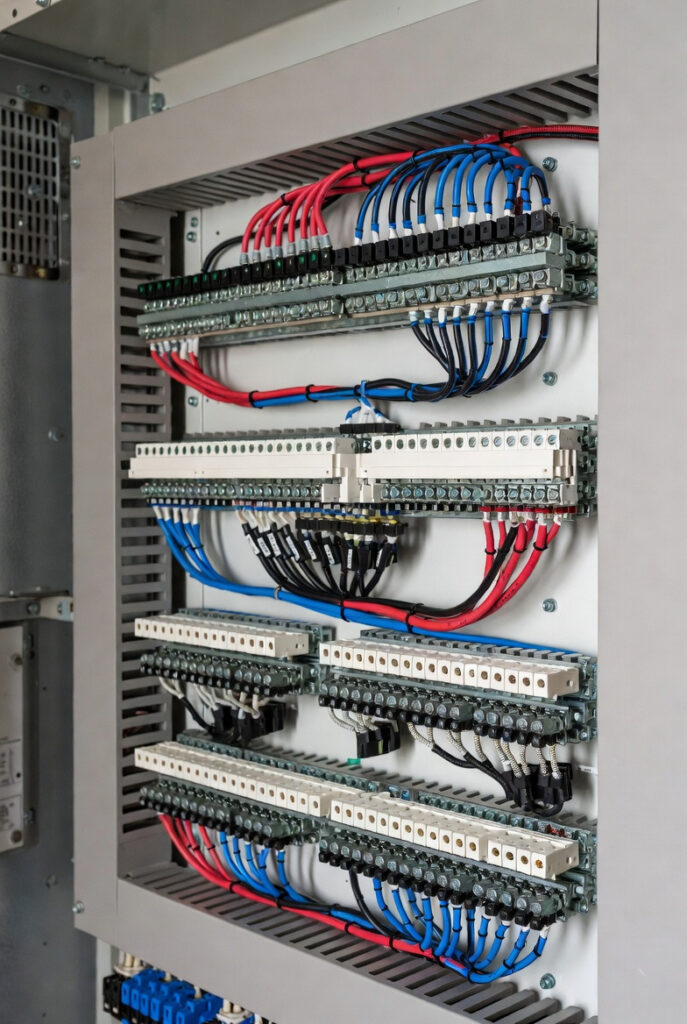
Eight wires bolted to a single battery positive terminal ring terminals stacked four deep stripped bolt one wire barely making contact. That is not a wiring system. That is a fire waiting for the right vibration to complete the circuit. The victron lynx distributor is the device that ends this a modular DC bus bar system that replaces the entire pile of ring terminals, fuse blocks, and bare conductors with one clean enclosed professional assembly. Before sizing your distribution system understand how much solar power you actually need so you know what current your bus bars and fuses need to handle.
I walked into a DIY off-grid build in Rockwood last spring eight wires stacked on a battery positive terminal, bolt stripped, one wire barely making contact. A Lynx Power-In and victron lynx distributor would have replaced that entire mess for about $200 total. The homeowner had spent more than that on wire and connectors trying to solve a problem that was never going to be solved with more wire.
Victron Lynx Distributor: What the Lynx System Actually Is
The modular concept: The Victron Lynx system is a modular DC distribution platform individual modules that snap together mechanically and share a common positive and negative bus bar running through the assembly. Each module connects to the next. The whole assembly mounts on a DIN rail or panel. One positive rail. One negative rail. Everything organized. Everything enclosed. Fused and labelled in ten minutes.
The two main modules:
Lynx Power-In: The battery input module. Connects the battery bank positive and negative to the Lynx bus. Houses the main Class T or Mega fuse between battery and bus. M8 or M10 bolt connections for heavy cable. No LED indicators. No fuse monitoring. Cost approximately $160. See our DC Fuse Sizing guide for correct fuse sizing at the Power-In.
Victron Lynx Distributor: The output module. Four fused DC output connections each with its own Mega fuse slot and optional LED blown-fuse indicator. Connects inverters, charge controllers, and loads to the bus. Cost approximately $260. The Victron Lynx Distributor replaces a separate fuse block, separate bus bars, and multiple connection points with one clean module.
What the Lynx system replaces:
- Separate positive bus bar
- Separate negative bus bar
- Separate fuse block with individual fuse holders
- Multiple stacked ring terminal connections
- Exposed live bus bar conductors
All of it – two modular units, ten minutes, done.
The $100 Difference – What You Actually Get
What the Lynx Power-In gives you: Battery positive and negative connection point. Main fuse holder. M8 or M10 bolt terminals for heavy cable. That is it. Simple. Solid. Essential for any Lynx build.
What the victron lynx distributor adds:
- Four individual fused output terminals each with its own Mega fuse holder
- LED blown-fuse indicators one LED per fuse position showing fuse status at a glance
- Negative return terminals for each output circuit keeping positive and negative organized per circuit
- Fuse monitoring integration when connected to a Lynx Shunt the GX device alerts you via VRM when a fuse blows
The honest question: Wiring one inverter to the battery use a Class T fuse holder and the Victron Lynx Power-In. Simple. Clean. Adequate. Wiring an inverter, a charge controller, a DC loads panel, and a battery heater each needing its own fused connection the victron lynx distributor is the right tool. Four clean fused outputs. Four LED indicators. One module.
The Master Tech Hack – Fusing the Power-In
What the hack is: The Lynx Power-In accepts Mega fuses via M8 bolt connections. By adding Mega fuses and appropriate washers to the Power-In output terminals you can create fused outputs on the Power-In giving you a fused battery busbar at the Power-In price point.
When this makes sense:
- You have only 2-3 outputs to fuse
- You do not need the LED blown-fuse indicators
- You do not have a Lynx Shunt so LED monitoring does not work anyway
- Budget is a consideration
The LED indicator caveat: The blown-fuse LEDs on the victron lynx distributor only work when connected to a Lynx Shunt via the RJ10 port. If you are using a SmartShunt covered in our SmartShunt vs BMV-712 guide those LEDs stay dark unless you wire a 5V power supply to the RJ10 port as a workaround. The monitoring function requires the full Lynx ecosystem.
The honest recommendation: Have a Lynx Shunt or planning to add one buy the Lynx Distributor. The LED monitoring and VRM fuse alerts are genuinely useful. Using a SmartShunt with no Lynx Shunt the Power-In hack delivers fused outputs at lower cost with no functional loss.
The 1000A Rating – Why It Matters in Ontario January
What 1000A means in practice: Both the Lynx Power-In and the victron lynx distributor are rated for 1000A continuous. A 3,000W inverter on a 12V system draws 250A at full load. A 5,000W inverter draws 417A. Even the largest residential off-grid systems running multiple simultaneous loads are unlikely to exceed 600-700A peak. The 1000A rating is genuine headroom.
Why headroom matters at -25°C: Ontario January. Space heater on the inverter. Coffee maker starting. Well pump kicking on. Three simultaneous high-current loads 400-500A peak for 2-3 seconds. A bus bar running at its rated limit generates heat. A bus bar running at 50% of its rated limit stays cool. The Lynx system’s 1000A rating ensures Ontario winter peak loads produce negligible heating at the distribution point.
The enclosed housing safety factor: Both modules use polycarbonate housing rated for high-voltage DC environments. The enclosed design prevents accidental contact with live bus bars a real hazard in a dark equipment room at 3am in a blizzard. A DIY bus bar built from copper strip and ring terminals does not provide this protection.
Lynx Power-In vs Lynx Distributor – Which One Do You Need
| Feature | Lynx Power-In | Lynx Distributor |
|---|---|---|
| Battery connection | Yes – main input | Via Power-In module |
| Fused outputs | Main fuse only | 4 individual fused outputs |
| LED fuse indicators | No | Yes – requires Lynx Shunt |
| VRM fuse monitoring | No | Yes – requires Lynx Shunt + GX |
| Bolt size | M8 or M10 | M8 |
| Max current | 1000A | 1000A |
| Cost | ~$160 | ~$260 |
| Best for | Battery input, main fuse | Multiple fused outputs |
The typical Rockwood cabin build:
- 1 × Lynx Power-In: battery positive and negative connect here main Class T fuse here
- 1 × Victron Lynx Distributor: inverter output -MPPT output – DC loads panel output – battery heater output
- Total: ~$420 for a complete modular distribution system that can be diagnosed, expanded, and trusted
Pro Tip: Mount the Lynx assembly horizontally with fuse access covers facing up not vertically. Mega fuses in vertical installations can fall out of their holders if the fuse body is slightly loose after a vibration event. Horizontal mounting with covers facing up keeps gravity working in your favour. Label each output circuit on the victron lynx distributor face with a label maker “Inverter”, “MPPT”, “DC Panel”, “Heater” before you close the equipment room. You will thank yourself at 2am in January when you need to pull a fuse fast.
The Verdict
The victron lynx distributor is not the cheapest way to distribute DC power. It is the most professional way. Clean enclosed housing. Four fused outputs. LED fuse monitoring. Modular expansion. 1000A headroom. A system that can be diagnosed and expanded without rewiring.
Eight ring terminals stacked on a battery post is a fire waiting for the right moment. A Lynx Power-In and Lynx Distributor is a system built to last 25 Ontario winters.
Buy the right components once.
Disclosure: This article contains affiliate links. If you buy through them, GridFree Guide earns a small commission at no extra cost to you.
Questions? Drop them below.
About the Author
Robert Bertrand spent 20 years as a service advisor in the automotive industry (Lexus and Nissan), where precision diagnostics, wiring integrity, and documentation standards were non-negotiable. He brings that same technical discipline to GridFree Guide, where he researches, tests, and documents off-grid solar systems for Ontario conditions. Based in Rockwood, Ontario, every article is built on verified specifications, manufacturer data, and the real-world climate constraints of Canadian off-grid living.
As an Amazon Associate I earn from qualifying purchases. This site also contains affiliate links to other products and services. GridFree Guide earns a small commission at no extra cost to you.