
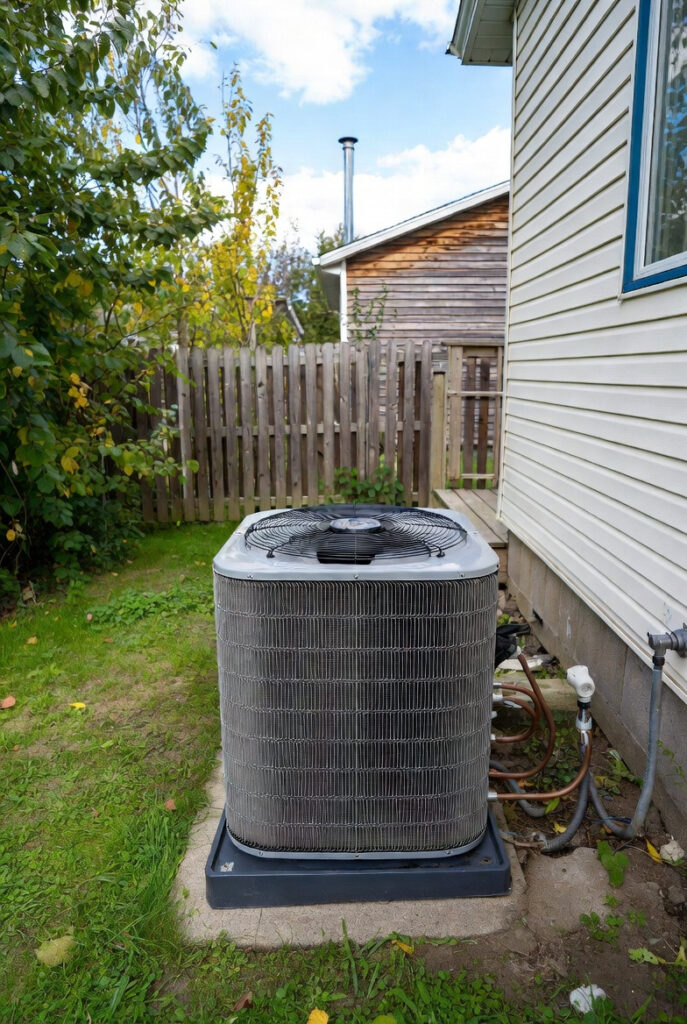
Ontario July is a test of endurance32°C with 85% humidity. Your off-grid solar system is producing its best numbers of the year. You flip on the central A/C. The inverter screams overload and the system shuts down. The micro-air easystart flex is the $300 device that solves this permanently turning an inverter that cannot start your compressor into one that starts it every single time. Before sizing your system for A/C understand how much solar power you actually need so your array and battery bank can actually sustain the cooling load.
I had a client in Rockwood with a 3-ton central A/C and a 5,000W Victron MultiPlus. July afternoon. Humid. He flipped on the A/C. The MultiPlus screamed overload LRA of 87 amps at 240V equals a 20,880W startup spike. Nearly four times his surge rating. We installed the micro-air easystart flex. Five learning cycles later his peak inrush was 26 amps. The MultiPlus starts it without a flinch every single time.
The A/C Compressor LRA Problem – Why Your Inverter Hates Cooling
What LRA is for A/C compressors: LRA stands for Locked Rotor Amps the massive current an A/C compressor draws before it starts spinning. A compressor at rest is electrically equivalent to a short circuit it has almost no resistance until the rotor begins turning and builds back-EMF.
The compressor is a brute: Unlike a fan or a light an A/C compressor is a refrigerant piston starting from a complete stop against full refrigerant line pressure. A 3-ton central A/C might draw 12-15A running at 240V about 2,880-3,600W. That same compressor has an LRA of 60-100A at 240V a startup spike of 14,400-24,000W lasting 200-500 milliseconds.
The inverter math: A 5,000W continuous inverter typically surges to 8,000-10,000W for 1-2 seconds. A 3-ton A/C compressor startup demands 14,000-24,000W in that same window. The inverter trips on overcurrent protection. The compressor never starts. The overload alarm sounds. The system resets. This repeats every time the thermostat calls for cooling.
The critical point most guides miss: Most people look at the running watts on the A/C specification label and think their inverter can handle it. The running load is irrelevant to whether the system starts. The startup surge is what determines whether your inverter can start the compressor. As covered in our Inductive Loads guide every motor-driven compressor has this characteristic the same principle that makes well pumps trip inverters as covered in our Well Pump Soft Starter guide.
Micro-Air EasyStart Flex: How the Learning Technology Works
What the EasyStart Flex is: The Micro-Air EasyStart Flex is a soft starter designed specifically for single-phase A/C compressors up to 6 tons (72,000 BTU). It installs inside the condenser unit’s electrical compartment between the contactor and the compressor ramping voltage through a 4-stage sequence over 1-2 seconds instead of applying full voltage instantly.
The adaptive learning – the killer feature: The micro-air easystart flex learns your specific compressor’s motor signature over the first 5 startup cycles. Each cycle the unit measures the compressor’s response torque characteristics, spin-up time, refrigerant back-pressure and optimizes the ramp profile for the next start.
Real learning cycle data from a 3-ton unit:
- Cycle 1 (conservative): 47A peak inrush
- Cycle 2: 42A peak
- Cycle 3: 34A peak
- Cycle 4: 33.5A peak
- Cycle 5 (optimized): 26-28A peak 70%+ reduction from original 87A
Critical – refrigerant equalization between cycles: Allow 5 minutes of off-time between training cycles for refrigerant pressure to equalize. If you cycle the compressor too quickly the high-side pressure is still elevated the compressor starts against extra resistance and the learning data is inaccurate. Do the training on utility grid power if available inverter voltage sag during startup can affect training accuracy.
The Inverter Sizing Math – Before and After EasyStart
Without Micro-Air EasyStart Flex: 3-ton A/C with 87A LRA at 240V requires: 87A × 240V = 20,880W surge minimum Recommended inverter: 7,500W+ continuous with 15,000W+ surge Victron Quattro or equivalent cost $3,000-5,000+
With Micro-Air EasyStart Flex: Same 3-ton A/C after 5 learning cycles 26A peak at 240V: 26A × 240V = 6,240W surge requirement Recommended inverter: 3,000-5,000W continuous with 8,000-10,000W surge Victron MultiPlus-II cost $1,500-2,500
The $300 math: The EasyStart Flex costs approximately $300. The inverter savings from downsizing is $1,500-2,500. The EasyStart pays for itself before the first Ontario July afternoon.
A/C sizing reference by tonnage:
- 1-ton (12,000 BTU): LRA typically 30-45A – most 3,000W inverters handle with EasyStart
- 2-ton (24,000 BTU): LRA typically 45-65A – 5,000W inverter handles with EasyStart
- 3-ton (36,000 BTU): LRA typically 65-90A – 5,000W inverter handles with EasyStart
- 4-ton (48,000 BTU): LRA typically 85-120A – requires 7,500W inverter even with EasyStart
The Ontario July Context – Why This Matters More Than You Think
The humidity factor: Ontario July is not Arizona July. In Rockwood on a humid July afternoon 32°C and 85% humidity the A/C is not a comfort item. It is a health necessity. Older off-grid homeowners, young children, and anyone with respiratory conditions cannot safely manage Ontario July humidity without cooling. The inability to run A/C off-grid is a health risk not an inconvenience.
The irony of peak solar production: Ontario July is when your solar system produces its absolute best numbers 6-8 peak sun hours, maximum panel output, batteries charging fast. The day your system is most capable of powering your home is the same day you most need the A/C. Without the micro-air easystart flex your system cannot deliver on what the panels are producing.
The refrigerant pressure angle: A/C compressors starting after a short off-cycle face elevated refrigerant head pressure the high side has not fully equalized. On hot Ontario July days when the A/C cycles frequently this elevated head pressure is a constant factor. The EasyStart Flex’s short-cycle delay timer manages this enforcing minimum off-time between starts for adequate pressure equalization.
Installation Overview – What the Job Actually Involves
Where it installs: The micro-air easystart flex installs inside the condenser unit’s electrical compartment the small metal box on the side of the outdoor unit. It mounts with a self-adhesive strip or two screws. No new conduit runs required.
The 4-wire connection:
- L1 – Line 1 incoming 240V power
- L2 – Line 2 incoming 240V power
- C – Common terminal on the compressor
- R – Run terminal on the compressor
The EasyStart documentation includes brand-specific wiring diagrams for all major A/C manufacturers. The Bluetooth app guides you through training after installation.
Installation time: 45-90 minutes for a first-time installer. Brand-specific wiring guidance available at microair.net.
Note on inverter compressor mini-splits: Modern mini-splits with variable-speed inverter compressors have built-in soft start they do not need an EasyStart Flex. Check your mini-split specifications before purchasing. If your unit says “inverter compressor” or “variable speed” the EasyStart is not required.
The Short-Cycle Protection – The Feature Nobody Talks About
What short-cycling does to compressors: When a thermostat cycles a compressor on and off too rapidly the compressor starts against elevated head pressure every time. Over a summer of short-cycling compressor lifespan drops significantly.
How the EasyStart Flex handles it: The micro-air easystart flex includes an intelligent short-cycle delay timer. When the compressor shuts off the EasyStart enforces a minimum off-time before allowing the next start giving refrigerant pressure time to equalize. Off-grid systems experience more voltage fluctuation than grid power which can cause more frequent cycling. The short-cycle protection prevents compressor damage from these fluctuation-driven short cycles.
Should I Buy the Micro-Air EasyStart Flex? The Checklist
You need a micro-air easystart flex if:
- ☐ You have a central A/C or heat pump on an off-grid or generator-backed system
- ☐ Your inverter trips or struggles when the A/C compressor starts
- ☐ Your inverter is under 7,500W continuous
- ☐ You are in Ontario, Minnesota, or Montana where July heat and humidity make A/C a health necessity
- ☐ You want to run A/C on a smaller inverter without replacing it
- ☐ Your A/C is a single-phase unit up to 6 tons (72,000 BTU)
You may not need one if:
- Your inverter is 10,000W+ with genuine 20,000W+ surge capacity
- Your mini-split uses variable-speed inverter compressor technology with built-in soft start
- Your A/C is a three-phase unit EasyStart Flex is single-phase only
Pro Tip: Do the 5 EasyStart training cycles on utility grid power not on your inverter if you have any grid access during commissioning. Inverter voltage sag during compressor startup affects the learning data and produces a sub-optimal ramp profile. If grid power is unavailable ensure your battery bank is at 90%+ SoC before running training cycles to minimize voltage sag. The EasyStart learns your compressor’s motor characteristics stable voltage during learning produces the most accurate and effective ramp profile.
The Verdict
Ontario July is not optional. The A/C is not a luxury it is a health necessity for the young, the elderly, and anyone with respiratory conditions in Ontario summers. A $300 micro-air easystart flex is the difference between an off-grid system that can cool your home and one that cannot.
Real users have documented 17,000+ starts without failure. A 3-ton compressor that was demanding 87A inrush now demands 26A and the Victron MultiPlus starts it without a complaint.
That is the solution. Install it before July.
Disclosure: This article contains affiliate links. If you buy through them, GridFree Guide earns a small commission at no extra cost to you.
About the Author
Robert Bertrand spent 20 years as a service advisor in the automotive industry (Lexus and Nissan), where precision diagnostics, wiring integrity, and documentation standards were non-negotiable. He brings that same technical discipline to GridFree Guide, where he researches, tests, and documents off-grid solar systems for Ontario conditions. Based in Rockwood, Ontario, every article is built on verified specifications, manufacturer data, and the real-world climate constraints of Canadian off-grid living.
As an Amazon Associate I earn from qualifying purchases. This site also contains affiliate links to other products and services. GridFree Guide earns a small commission at no extra cost to you.