
That $15,000 off-grid solar system sitting on a metal ground mount in an open field is connected to the sky by hundreds of meters of wire and most owners have no solar lightning protection whatsoever. A $45 surge protection device is the cheapest insurance you will ever buy for the most expensive equipment on your property. Before anything else make sure you understand how much solar power you actually need so you know exactly what you are protecting.
A customer in Rockwood called me last June. Single thunderstorm. Lightning hit a tree at the edge of the property not the array directly. The induced surge traveled down the DC wiring and fried the Starlink router, the Victron SmartShunt battery monitor, and the MPPT charge controller simultaneously. Total replacement cost: $1,847. He had skipped the $45 surge arrestor to save money. That is the most expensive $45 anyone in Rockwood spent last summer.
Solar Lightning Protection: Direct Hit vs Induced Surge
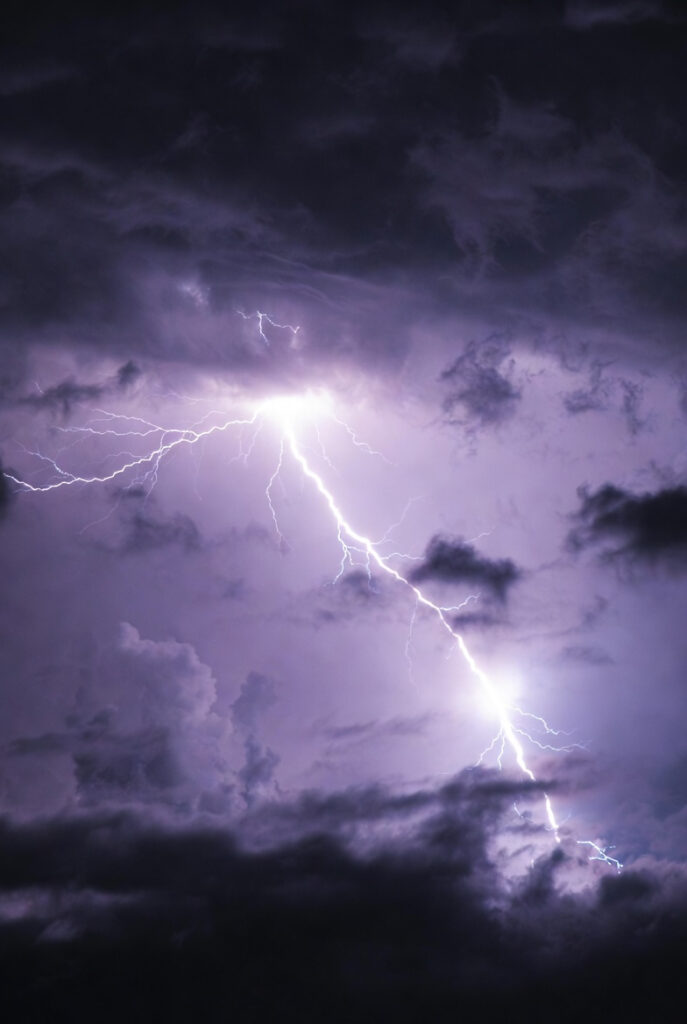
The two threat types: A direct lightning strike on your solar array is a total loss event. Panels shattered. Wiring vaporized. Mounting structure damaged. No surge protection device prevents this you need a full external lightning protection system with air terminals and down conductors for that level of protection. Direct hits are rare.
The threat that actually destroys equipment: An induced surge is what kills 90% of off-grid electronics. When lightning strikes within 500 meters of your array a tree, a fence post, the ground itself the electromagnetic pulse induces a voltage spike in every conductor in the vicinity. Your DC wiring from the panels to the controller acts as an antenna. The induced voltage can reach 10,000V or more. Your charge controller MOSFET transistors are rated for 150-600V. The math is straightforward.
The laptop analogy: You would not plug a $2,000 laptop into a wall outlet during a thunderstorm without a surge protector. Why would you leave a $15,000 solar system connected to an outdoor antenna array without one? The principle is identical. A solar lightning protection device costs $45 instead of $20 and what it protects is worth 750× more.
How a Solar Surge Protection Device Works
The pressure relief valve: A surge protection device works like a pressure relief valve in a hydraulic system. Under normal operating conditions it is invisible current passes through normally and the SPD does nothing. When a voltage spike arrives that exceeds the SPD’s clamping voltage threshold the internal metal oxide varistor (MOV) component switches from high resistance to near-zero resistance opening a low-resistance path directly to the ground bus.
What clamping voltage means: Clamping voltage is the maximum voltage the SPD allows to pass through to your equipment. A good DC solar SPD clamps at 300-600V depending on your system voltage. Your charge controller and inverter electronics are rated to handle their normal operating voltage plus a safety margin. The SPD ensures the transient never exceeds that safe level.
Why cheap power strip SPDs do not work: A household power strip surge protector is rated for 120/240V AC. Your solar DC wiring operates at a different voltage with different fault characteristics. An AC surge protector connected to a DC solar circuit will not provide the correct clamping response and may fail dangerously. Solar lightning protection devices are specifically rated for DC circuits.
The Grounding Triangle – Why SPD Alone Is Not Enough
A surge protection device is only one third of the protection equation. All three elements must be present for the SPD to work correctly.
Element 1 – The SPD itself: Installed at the combiner box or at the charge controller input between the array and the sensitive electronics. As covered in our Solar Combiner Box guide the combiner box is the ideal location because it is close to the array and the SPD serves all strings simultaneously.
Element 2 – A dedicated ground rod at the array: The SPD diverts surge energy to ground but ground means a physical earth ground rod not the DC negative bus and not the house electrical ground. A dedicated 8-foot copper ground rod driven at the base of the array mount connects to the SPD ground terminal. This rod provides the low-resistance path the surge energy travels through. Without this rod the SPD has nowhere to send the surge. It goes into your equipment instead.
Element 3 – The grounding conductor: A 6AWG or larger copper wire connects the SPD ground terminal to the dedicated ground rod. This conductor must be as short and straight as possible – loops and bends add inductance that slows surge diversion and reduces SPD effectiveness. The complete grounding picture including inverter chassis grounding is covered in our Solar Inverter Grounding guide.
The Frozen Ground Problem in Ontario Winters
This is the cold climate detail completely absent from every solar lightning protection guide.
Why ground resistance matters: The SPD’s ability to divert surge energy depends on the ground rod providing a genuinely low-resistance path to earth. The NEC recommends ground resistance of 25 ohms or less. Above 25 ohms the ground rod cannot effectively absorb surge current and the energy finds alternate paths through your equipment.
What freezing does to ground resistance: Soil electrical resistance increases dramatically as it freezes. Near-surface soil at -10°C may have 10-50× higher resistance than the same soil at +10°C. A ground rod that provides 5 ohms in August may provide 150+ ohms in January completely inadequate for surge protection.
The Ontario ground rod depth requirement: Southern Ontario frost line: 1.2–1.5 meters. A standard 8-foot (2.4 meter) ground rod driven vertically penetrates below the frost line in southern Ontario contacting consistently conductive soil year-round. This is the minimum for Ontario, Minnesota, and Montana off-grid installations. See our DC Fuse Sizing guide for the complete system protection picture.
What the SPD Protects – The Equipment Insurance Reality
What an induced surge can destroy in one millisecond:
- Charge controller: $150-400
- Battery monitor / SmartShunt: $150-250
- Inverter control board: $300-800 or full inverter replacement
- Starlink router and terminal: $500–700
- Any communication equipment connected to the system
- Total potential loss: $1,000-2,500 in a single event
A Midnite Solar MNSPD-300-DC costs approximately $45-65. It installs on a DIN rail inside the combiner box or a small enclosure at the array. Installation time: 15 minutes.
The insurance math: A $45 SPD protects $1,500-2,500 of sensitive electronics. That is a 33-55× return on investment if it absorbs one surge event in 25 years. Ontario averages 20-30 thunderstorm days per year. Over a 25-year system lifespan that is 500-750 thunderstorm events during which your array is connected and vulnerable.
One surge pays for the SPD 33 times over.
Should I Buy Solar Lightning Protection? The Checklist
You need solar lightning protection if:
- ☐ Your array is ground-mounted in an open field or rural property
- ☐ You are in Ontario, Minnesota, or Montana 20-30 thunderstorm days per year
- ☐ You have sensitive electronics Victron components, Starlink, battery monitors
- ☐ Your DC wiring runs more than 10 metres from panels to controller
- ☐ Your array is on a metal ground mount metal structures attract induced surges
- ☐ You have a LiFePO4 battery bank costing $1,500-5,000+
Minimum installation – every off-grid system:
- 1 × DC-rated surge protection device at the combiner box or controller input
- 1 × 8-foot copper ground rod at the array base
- 1 × 6AWG copper ground conductor SPD to ground rod as short and straight as possible
Pro Tip: Check your SPD status indicator after every significant thunderstorm not just annually. A single nearby strike can degrade or destroy the MOV component inside the SPD while the LED still shows green on some units. If you are in a high-lightning area of Ontario or Minnesota consider installing two SPDs one at the combiner box and one at the charge controller input. The combiner box SPD handles the first wave. The controller input SPD catches anything that gets through. Belt and suspenders. Your Victron MultiPlus is worth the second $45.
The Verdict
Solar lightning protection is the lowest-cost highest-return investment in any off-grid system. A $45 surge protection device on a dedicated ground rod protects $15,000 of equipment from the one event that most warranties explicitly exclude lightning and acts of God.
Your array is connected to the sky. Ontario gets 25 thunderstorm days a year. The ground mount is a metal structure in an open field.
Install the arrestor today. The day you need it you will not have time to order one.
Internal Links
- How Much Solar Power Do I Actually Need?
- Solar Combiner Box
- Solar Inverter Grounding
- DC Fuse Sizing
- Midnite Solar MNSPD
Disclosure: This article contains affiliate links. If you buy through them, GridFree Guide earns a small commission at no extra cost to you.
Questions? Drop them below.
About the Author
Robert Bertrand spent 20 years as a service advisor in the automotive industry (Lexus and Nissan), where precision diagnostics, wiring integrity, and documentation standards were non-negotiable. He brings that same technical discipline to GridFree Guide, where he researches, tests, and documents off-grid solar systems for Ontario conditions. Based in Rockwood, Ontario, every article is built on verified specifications, manufacturer data, and the real-world climate constraints of Canadian off-grid living.
As an Amazon Associate I earn from qualifying purchases. This site also contains affiliate links to other products and services. GridFree Guide earns a small commission at no extra cost to you.