
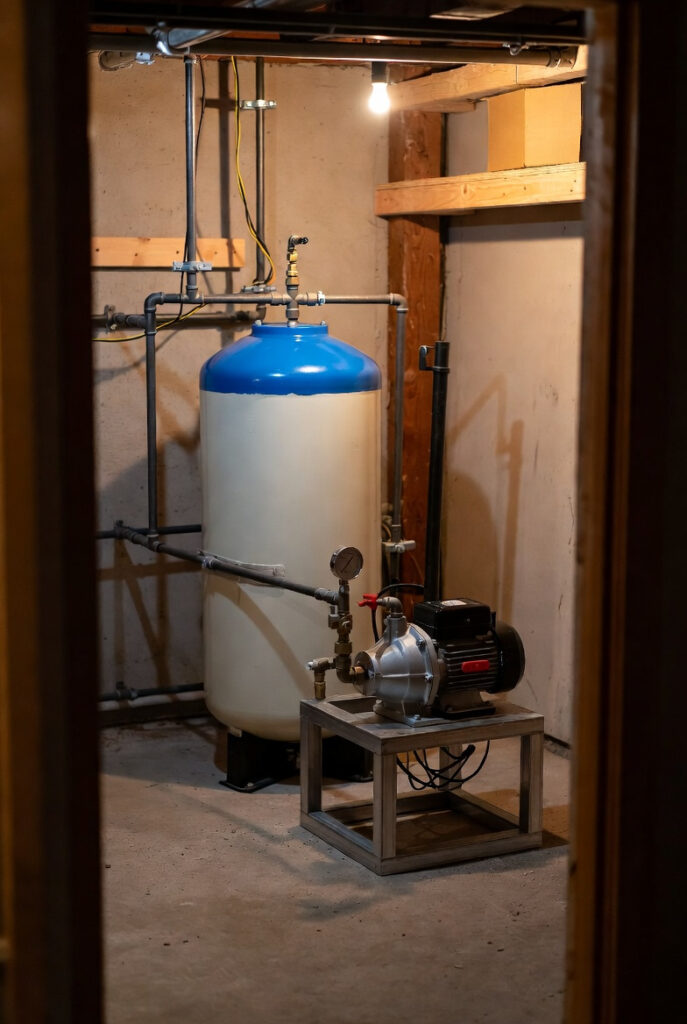
In Ontario, Minnesota, and Montana your well pump is not a convenience. It is survival infrastructure. When your inverter shuts down every time the pressure tank calls for water you do not have a power problem you have a soft starter for well pump problem. The fix costs $280 not $2,000. Start by understanding how much solar power you actually need before oversizing your inverter to compensate for a problem a $280 part solves.
I watched a 2000W inverter shut down three times in a row trying to start a 1/2 HP well pump in Rockwood last January. The homeowner had been living with it for two winters just cycling the pressure tank manually and waiting for the inverter to reset. A $280 soft starter fixed it permanently in 20 minutes.
Soft Starter for Well Pump: Understanding the LRA Problem
What LRA is: LRA stands for Locked Rotor Amps the massive current surge a motor draws before it starts spinning. A motor at rest is electrically equivalent to a short circuit it has almost no resistance until the rotor begins turning and builds back-EMF.
The well pump numbers: A typical 1/2 HP submersible well pump draws approximately 5–7A running at 120V about 600–840W. That same pump has an LRA of 30–50A at 120V a startup surge of 3,600–6,000W. In 1 HP pumps running at 240V the LRA can reach 40-60A a startup demand of 9,600–14,400W.
Why this destroys inverters: A 2000W inverter surges to 4,000W maximum. A 1/2 HP well pump starting at 120V demands 5,000W+ in that same window. The inverter trips on overcurrent protection. The pump never starts. The inverter resets. The cycle repeats every time the pressure tank calls for water.
As we covered in our Inductive Loads guide every motor with a compressor or impeller has this surge characteristic. Well pumps are among the worst offenders because deep well pumps face water column back pressure adding to the starting load.
The stalled car analogy: Pushing a stalled car from a dead stop takes enormous effort you lean in, build momentum slowly, get it rolling. You would never run at it full speed and hit it. A soft starter for well pump leans into the motor instead of hitting it with a sledgehammer of current all at once.
What a Soft Starter Actually Does
The mechanism: A soft starter sits in series between the inverter output and the pump. Instead of applying full voltage the instant the pressure switch closes the soft starter ramps voltage up gradually over 1-2 seconds using internal SCR components.
The numbers in practice:
- Without soft starter: 1/2 HP pump LRA 40A × 120V = 4,800W spike lasting 50–100ms inverter trips
- With soft starter: same pump draws 15–20A peak × 120V = 1,800–2,400W over 1–2 seconds inverter handles it
Peak startup current drops 40–75% depending on the unit. The inverter that was tripping on 4,800W now sees 2,400W maximum well within surge capacity.
What happens at the pump: The gradual voltage ramp is also gentler on motor windings and bearings. Instead of full voltage torque slamming the impeller from rest the motor builds speed gradually reducing mechanical wear and extending pump life in cold Ontario ground water where motor components run cold.
The Cold Water Reality – Why Ontario Winters Make This Worse
This is the cold climate detail completely absent from every soft starter for well pump guide.
Water viscosity at ground temperature: Ontario well water in January may be 4-6°C near freezing. Cold water is approximately 1.8× more viscous than at 25°C. A pump impeller spinning against cold viscous water experiences measurably more hydraulic resistance at startup than the same pump in summer conditions.
The combined cold start problem: Cold ground water increases hydraulic startup resistance. Cold motor windings have slightly higher resistance requiring more current to build the same magnetic field. Cold bearing grease is thicker increasing mechanical friction at startup. All three factors increase the effective LRA of a well pump in January by 15–25% above its nameplate specification which was measured at standard temperature conditions.
The practical result: A 1/2 HP pump that starts reliably in July may consistently trip a 2000W inverter in January not because anything has failed but because cold conditions increase effective startup demand. A soft starter for well pump eliminates this seasonal variability by controlling the ramp regardless of temperature conditions.
Soft Starter vs VFD – Which One Do You Need?
What a VFD is: A Variable Frequency Drive controls both voltage AND frequency to the motor allowing true variable speed operation. VFDs are used in industrial pump applications where precise flow control is needed. Cost: $300-600 for a 1 HP pump. Requires programming. Complex installation.
Why VFDs are overkill for residential well pumps: A residential submersible well pump runs at one speed full speed. You do not need variable speed control. You need the pump to start without tripping the inverter. A VFD costs 2–3× more than a soft starter and requires programming that most DIY installers are not equipped to do.
The soft starter sweet spot: A soft starter for well pump controls voltage ramp only no frequency control, no programming, 20-minute installation, $200-350 cost. For off-grid residential well pumps up to 2 HP a soft starter is the correct solution. VFDs are for industrial and commercial applications with variable flow requirements. For 99% of Ontario and Minnesota rural homesteads a soft starter is the right tool.
The SoftStartUSA Well Pump Solution
The SoftStartUSA Well Pump Soft Starter is purpose-built for submersible and deep well pumps not an AC compressor unit repurposed for pump use. It cuts inrush current by up to 40% and is engineered for 0.5-1.5 HP 120V pumps and 1-3.5 HP 240V pumps. ETL listed. Waterproof and fire-resistant enclosure. 20-minute installation beside the main service panel with no pump removal required.
The inverter sizing math with soft starter:
- Without soft starter: 600W running pump needs 3,000W+ surge-capable inverter minimum $800-1,200
- With soft starter: same pump needs only 1,200W surge capacity a Victron Phoenix 12/1200 handles it comfortably
The soft starter turns a $2,000 inverter problem into a $280 soft starter solution. One part. 20 minutes. Done.
The Critical Load Panel Connection
Your well pump should always be on a critical load sub-panel covered in our Critical Load Sub-Panel guide. The soft starter is the final piece that makes that circuit reliable.
The inverter sizing comparison:
- Without soft starter for well pump: inverter must surge to 5× pump running watts
- With soft starter: inverter must surge to 2× pump running watts
A 600W running pump without soft starter needs a 3,000W inverter. The same pump with soft starter needs a 1,200W inverter.
That is a $1,200-2,000 inverter upgrade eliminated by a $280 part. The math is not close.
Should You Buy a Soft Starter? The Checklist
Yes , install a soft starter for well pump if:
- ☐ Your well pump is 1/2 HP or larger
- ☐ Your inverter is under 5,000W continuous
- ☐ Your inverter trips or struggles when the pump starts
- ☐ You are in Ontario, Minnesota, or Montana where cold water increases startup drag
- ☐ Your well pump is on a critical load circuit that must work during grid outages
- ☐ You want to extend inverter capacitor life by eliminating repeated surge events
- ☐ You are sizing a new system and want to use a smaller inverter
You may not need one if:
- Your inverter is 5,000W or larger with genuine 10,000W+ surge capacity
- Your pump is 1/4 HP or smaller drawing under 400W running
- You are on grid power with a large service panel and no inverter
Pro Tip: Victron inverters log every overload event with timestamp and duration in VictronConnect. A pattern of 50-100ms overload events every time the pressure switch closes is the diagnostic signature of an LRA problem. Three overload events per shower. Every day. Over a year of daily use this stress accumulates in the inverter’s capacitors. A soft starter for well pump eliminates every one of those events permanently. Check your inverter event log before assuming you need a larger inverter.
The Verdict
A soft starter for well pump is the highest-value $280 you can spend on an off-grid solar system in Ontario, Minnesota, or Montana. It turns an inverter that cannot start your pump into one that starts it reliably every time without buying a larger inverter.
If you have a well pump on an off-grid system and you have not installed a soft starter you are stressing your inverter’s capacitors every time you take a shower. Every single startup. Every single day.
Fix it once. Fix it for $280. Keep your water running at -25°C.
Internal Links
- How Much Solar Power Do I Actually Need? ✅
- Inductive Loads ✅
- Critical Load Sub-Panel ✅
- Micro-Air EasyStart ✅
Disclosure: This article contains affiliate links. If you buy through them, GridFree Guide earns a small commission at no extra cost to you.
Questions? Drop them below.
About the Author
Robert Bertrand spent 20 years as a service advisor in the automotive industry (Lexus and Nissan), where precision diagnostics, wiring integrity, and documentation standards were non-negotiable. He brings that same technical discipline to GridFree Guide, where he researches, tests, and documents off-grid solar systems for Ontario conditions. Based in Rockwood, Ontario, every article is built on verified specifications, manufacturer data, and the real-world climate constraints of Canadian off-grid living.
As an Amazon Associate I earn from qualifying purchases. This site also contains affiliate links to other products and services. GridFree Guide earns a small commission at no extra cost to you.