
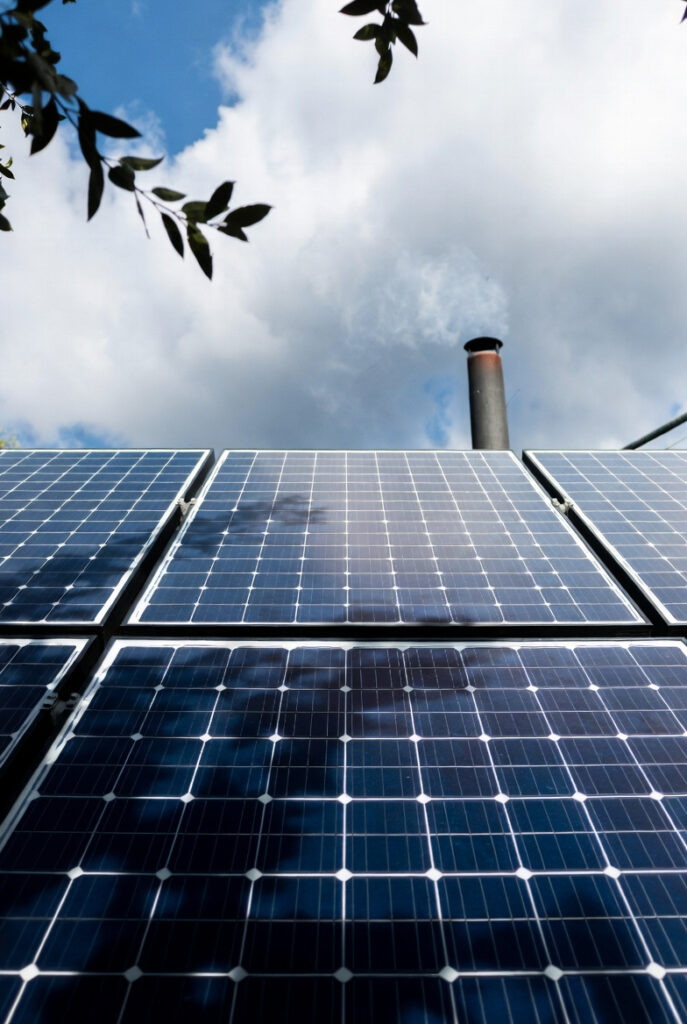
Your solar system is producing 30% of expected output on a perfectly clear January day in Rockwood. No clouds. Full sun. You have checked the charge controller, the battery connections, the fuse. Everything looks fine. The culprit is solar panel shading and it is not a tree. It is a single leafless branch casting a pencil-width shadow across the bottom row of cells.
I diagnosed a system in Rockwood last January that was producing 15% of expected output on a clear sunny day. Spent 20 minutes checking wiring and connections before I looked at the panels themselves. Bottom two inches of every panel had a solid crust of clear ice invisible from the ground because it was clear not snow. Cleared it in 10 minutes with a foam roof rake. Output jumped to 94% immediately.
Solar Panel Shading: The Christmas Light Effect
How series strings work: Panels wired in series pass current through each panel sequentially like old Christmas lights where one dead bulb killed the whole string. The current through a series string is limited by the weakest panel. If one panel produces 50% of its rated current due to solar panel shading the entire string drops to 50% not just that panel.
The math that surprises people: 6 panels in series. Panel 1 is 30% shaded. Output of Panel 1 drops to 70%. Output of the entire 6-panel string drops to 70% not 70% of one panel but 70% of the whole string. That is a 30% production loss across 6 panels from a shadow covering less than 5% of the total array area.
Why a thin shadow is disproportionately destructive: A branch shadow 25mm wide crossing a panel horizontally may shade only 3–4 cells. But if those cells are in the same sub-string the bypass diode activates taking out one third of that panel’s output. That reduction cascades through the entire series string.
The clogged fuel filter analogy: Think of it like a clogged fuel filter on a vehicle. The engine wants to run. The fuel pump is working. But the restriction at the filter limits everything downstream. One shaded panel is the restriction the rest of the string is the engine starving for current it cannot get.
What Bypass Diodes Actually Do
What they are: Bypass diodes are small semiconductor devices built into the junction box on the back of every quality solar panel. A standard panel has three bypass diodes one for each of three sub-strings of cells running vertically through the panel.
What they do: When a group of cells in one sub-string is shaded and its output drops below the current flowing through the string the bypass diode activates providing an alternate current path around that shaded sub-string. Current flows through the diode instead of through the shaded cells. This prevents hot spots and protects the panel from damage.
What they do NOT do: Bypass diodes do not recover the lost production from the bypassed sub-string. When a bypass diode activates that entire third of the panel produces zero output not reduced output. Zero.
The bypass diode math: One bypass diode activates for a shadow on 3-4 cells. That one third of the panel produces zero. The panel produces approximately 67% of rated output. In a 6-panel series string the entire string drops to 67%. Six panels producing at the output level of four panels from a shadow smaller than your hand.
The Ontario Winter Shadow Reality
This is the cold climate solar panel shading detail completely absent from every other guide.
Hard shadows vs soft shadows: In summer leafy trees cast dappled shadows soft, partial, distributed across many cells. In winter those same trees are bare. A leafless branch in December casts a hard-edged shadow a precise dark line across your panels. Hard shadows are more destructive than soft shadows because they shade entire cell rows completely rather than partially.
The winter sun angle makes it worse: With the sun at 20-25° elevation in Ontario winter the shadows are long. A chimney 3 meters tall casts a shadow over 6 meters long at solar noon in December. A roofline overhang that causes zero shading in July may shade half your array in January.
The ice strip problem: Solar panels are typically wired with cell sub-strings running vertically three columns of cells from top to bottom. A horizontal strip of ice or frozen debris across the bottom 50mm of a panel shades the bottom row of all three sub-strings simultaneously. All three bypass diodes may activate. The panel produces near zero output from an ice strip you cannot see from the ground because it is clear ice not snow.
The bird dropping reality: A single bird dropping 50mm in diameter landing on the wrong cell can activate a bypass diode and reduce panel output by 33%. A handful of droppings across the bottom edge in the right pattern can activate all three diodes. Output approaches zero. The system looks like a wiring fault from the charge controller display.
Global Maximum Power Point Tracking Why Your Controller Matters
The standard MPPT problem: A standard MPPT charge controller finds the maximum power point the voltage at which the panel array produces maximum power and locks onto it. Under uniform conditions this works perfectly. Under partial solar panel shading conditions the I-V curve develops multiple peaks a global maximum and one or more local maxima at lower power levels.
The stuck controller problem: A budget MPPT controller scanning for the power peak may find a local maximum and lock onto it. The controller believes it has found optimal operating voltage. It has not. The global maximum significantly higher power exists at a different voltage. The controller never finds it. Your system runs at 60–70% of available shaded output because the controller is locked on the wrong peak.
The Victron solution: The Victron SmartSolar MPPT 100/30 performs a full voltage sweep periodically scanning the entire I-V curve to find the global maximum power point rather than locking onto the first local peak. Under partial shading conditions this sweep recovers significant production that a standard controller misses.
The real world numbers: Under partial shading a standard MPPT controller may recover 60-70% of available shaded output. A global MPPT controller recovers 85–95% of available shaded output. On a cloudy Ontario winter day where production is already marginal that difference determines whether your battery bank holds charge or slowly depletes.
The honest recommendation: If you have unavoidable winter shading a chimney shadow, a roofline, bare tree branches a budget PWM controller is not adequate. You need a high-end MPPT that can scan for the global maximum. The Victron SmartSolar with its full curve sweep is the right tool for shaded Ontario winter conditions.
The Shade Audit Know Your Winter Shadow
Most solar panel shading problems are predictable. The shadow that kills your December production was there last December. You just were not watching for it.
The phone camera method: On the winter solstice December 21 or any clear day in December or January:
- At 10:00 AM take a photo of your panels from a fixed position noting shadow locations
- At 12:00 PM (solar noon) take the same photo from the same position
- At 2:00 PM take the same photo again
What to look for:
- Any shadow from chimneys, vents, rooflines, or neighbouring structures crossing panel rows
- Tree branch shadows even thin ones crossing panels horizontally
- Ice or debris accumulation at bottom panel edge
- Shadows absent in summer but present now due to low sun angle
The mapping result: Three photos give you a complete picture of your worst-case winter shading window. If your chimney shadow crosses your panels between 10:00 AM and 12:00 PM you are losing 2 hours of prime morning production every clear winter day. That is recoverable by repositioning panels, adjusting tilt, or trimming the obstruction.
The Ontario-specific check: Walk the perimeter of your property on a clear December day and look at every panel from ground level at 10:00 AM. Look specifically at the bottom 100mm of each panel for ice crust, frozen debris, or bird droppings. These are invisible from normal viewing angles but eliminate sub-string output completely.
Pro Tip: Use your battery monitor to detect solar panel shading loss without climbing on the roof. On a clear morning note your charge current at 10:00 AM. If it drops significantly between 10:00 AM and 11:00 AM on a cloudless day and recovers after noon that is a shadow pattern from a chimney or roofline moving across your array. The battery monitor timestamps your production curve. A shading event shows as a production notch at the same time every clear day. Find the notch and you find the shadow.
The Verdict
Solar panel shading is the most underdiagnosed production loss in off-grid systems. One thin branch. One ice strip. One bird dropping on the wrong cell. Any of these can cut your string output by 30-100% while the rest of the sky is perfectly clear.
Audit your winter shadows before December. Check the bottom edge of every panel for ice and debris after every freeze. If you have unavoidable winter shading invest in a global MPPT controller that can find real power peaks rather than locking onto false ones.
The tax is real. The audit takes 30 minutes. Do it once and you will never diagnose a mystery production drop the same way again.
Disclosure: This article contains affiliate links. If you buy through them, GridFree Guide earns a small commission at no extra cost to you.
About the Author
Robert Bertrand spent 20 years as a service advisor in the automotive industry (Lexus and Nissan), where precision diagnostics, wiring integrity, and documentation standards were non-negotiable. He brings that same technical discipline to GridFree Guide, where he researches, tests, and documents off-grid solar systems for Ontario conditions. Based in Rockwood, Ontario, every article is built on verified specifications, manufacturer data, and the real-world climate constraints of Canadian off-grid living.
As an Amazon Associate I earn from qualifying purchases. This site also contains affiliate links to other products and services. GridFree Guide earns a small commission at no extra cost to you.