
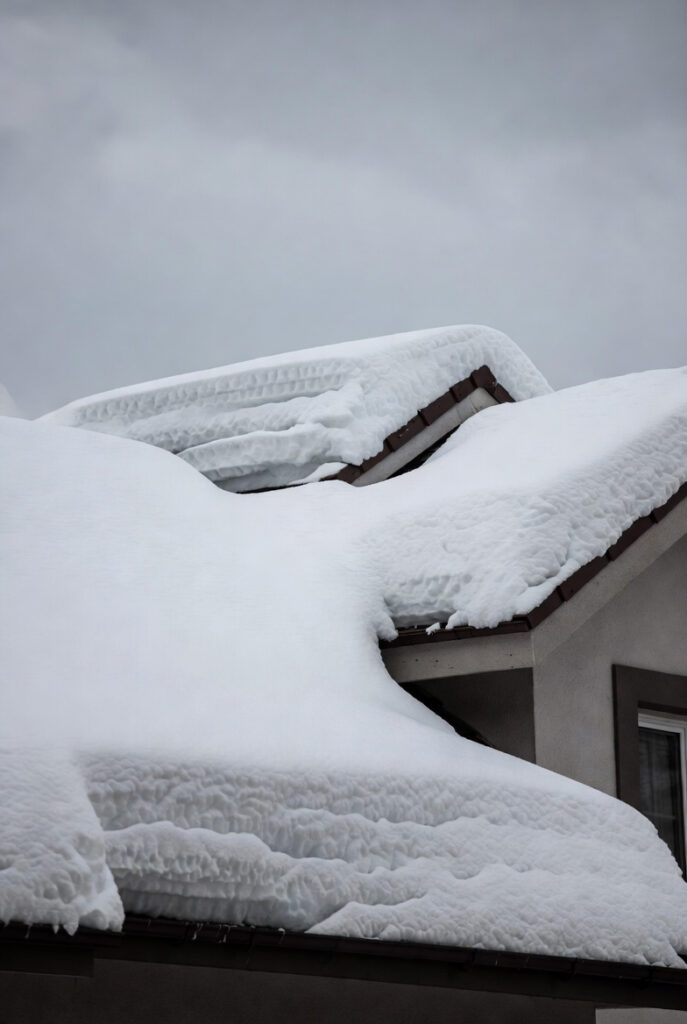
Most solar panel owners think about production. Almost none think about solar panel snow load until they hear a mounting rail crack in February. In Ontario, Minnesota, and Montana snow is not just a production problem. It is a structural problem. And the wrong mounting hardware in a heavy snow year is the difference between a working system and a collapsed array.
I cleared the Rockwood roof after a March ice storm last year what looked like 6 inches of fluffy snow was actually 4 inches of ice sitting on top of 2 inches of wet cement snow. I estimated over 400 pounds on a single panel section before I started clearing. That is when I understood why mounting hardware matters.
Solar Panel Snow Load: The Weight of the North
Not all snow is equal. Ontario and Minnesota installers deal with three distinct snow types with dramatically different weights.
Fluffy dry powder snow: New fallen snow at -10°C or colder. Density approximately 50-75 kg/m³. A 30cm accumulation on a 2m² panel section weighs approximately 3-4.5 kg manageable.
Wet heavy snow: Snow falling at temperatures near 0°C the classic Ontario late-autumn and early spring snow. Density 200–300 kg/m³. The same 30cm accumulation now weighs 12-18 kg 3-4× heavier than fluffy powder.
Ontario Cement: The late March or early April wet cycle where snow has partially melted and refrozen into a dense heavy mass. Density reaches 400-500 kg/m³ essentially half the density of water. A 30cm layer of Ontario Cement on a 2m² panel section weighs 24-30 kg. Add a layer of ice on top. That single panel section may be carrying 30–40 kg of frozen weight before the panel’s own mass.
The PSF calculation: Solar panel snow load in Canada is measured in pounds per square foot (psf) or kilopascals (kPa). Ontario’s NBC ground snow load for the Guelph/Rockwood area is approximately 1.4-1.6 kPa equivalent to 29–33 psf. Mounting hardware rated only for panel weight and basic live loads will fail under these conditions when snow accumulates and does not shed.
Static Load vs Dynamic Load The Perfect Storm
Static load – the weight sitting there: A typical panel weighs approximately 18-22 kg. Add 30cm of wet Ontario snow at 15 kg. Add a layer of ice at 5 kg. Total static load: approximately 40-45 kg on a mounting system rated for 20 kg. Already at 2× intended load.
Dynamic load – wind making it worse: A snow-covered panel presents significantly more surface area and wind resistance than a clean panel. In Ontario winter conditions with wind gusts of 60-80 km/h common during blizzards the dynamic wind load on a snow-covered panel can be 2-3× higher than on a clean panel.
The perfect storm: Static overload from accumulated snow AND dynamic wind uplift from a blizzard occurring simultaneously. Budget mounting hardware with undersized fasteners or non-stainless hardware fails at exactly this moment. The rafter connection is the most vulnerable point and if it fails the entire system follows.
Mounting Hardware That Survives Ontario Winters
The material failure mode: Budget mounting hardware uses zinc-plated or zinc-coated steel fasteners. In Ontario’s freeze-thaw cycle the zinc coating fails within 3–5 years. The underlying steel corrodes. The fastener section reduces. The load capacity drops often without any visible warning from outside.
The standard for cold climate installations: All fasteners lag bolts into rafters, rail splice bolts, panel clamp hardware must be 304 or 316 stainless steel for Ontario, Minnesota, and Montana installations. 316 stainless is preferred for coastal and high-humidity environments. 304 is acceptable for inland Ontario and Minnesota.
Rail rating requirements: Mounting rails must be rated for the combined dead load plus live load for the installation location. For Ontario the minimum combined load rating is 50 lbs/sq ft (2.4 kPa) accounting for the full NBC ground snow load plus wind. If your mounting rails do not have a published load rating with engineering documentation — that is a red flag.
4-point panel mounting: Each panel should be secured at four mounting points two on each rail rather than two-point mounting. Four-point distribution reduces the load on any single fastener by half and significantly improves resistance to wind uplift at panel corners.
The 100mm air gap – ice dam prevention: Panels mounted with less than 100mm (4 inches) of air gap between the panel back and the roof surface create ideal conditions for ice dam formation. Heat escaping through the roof melts snow at the bottom of the array. That water flows downward and refreezes at the cold eave forming an ice dam that traps meltwater and forces it under roof shingles.
Minimum air gap for Ontario roofs: 100mm (4 inches). No exceptions.
Common Mounting Failures in Cold Climates
Failure 1 – Undersized lag bolts into rafters: The most common catastrophic failure. Minimum for Ontario: 3/8″ lag bolts into solid rafter wood not OSB sheathing alone. No lag bolts into sheathing only.
Failure 2 – Missing mid-span rail support: Long rail spans between rafter penetrations allow the rail to flex under heavy load. Maximum recommended span between support points: 600-750mm for standard residential mounting rails.
Failure 3 – Corroded rail splice hardware: Budget zinc-coated splice hardware corrodes and loosens. A loose splice under load allows rail sections to separate destabilizing the entire row of panels above.
Failure 4 – Insufficient rafter engagement: Lag bolts that penetrate only 25-38mm into a rafter have minimal holding power. Minimum rafter engagement: 60mm (2.5 inches) into solid rafter wood beyond the roof sheathing and any insulation layer.
The Ground Mount Advantage in Ontario
Ground-mounted systems avoid the roof load transfer issue entirely the load path goes to concrete footings designed specifically for the system.
Footing depth – frost heave: Ground mount footings must extend below the frost line to avoid frost heave displacing the entire mounting structure. In southern Ontario the frost line is 1.2-1.5 meters. Footings shallower than this will shift seasonally potentially misaligning panels and stressing wiring connections.
The air gap advantage on ground mounts: Ground-mounted panels at 60° winter tilt have natural air circulation front and back. Snow sheds cleanly. Ice dams cannot form. The only snow load concern is whether drifted snow at the base of the array is blocking the lower panel edge preventing clean shedding.
Annual inspection for ground mounts: Every spring check all mounting hardware for corrosion, check footing positions for frost heave movement, check rail splice hardware for looseness, and verify all panel clamp torque is within specification.
The Pre-Winter Inspection Checklist
Before the first heavy snowfall of the season:
- ☐ Inspect all roof penetration points for signs of corrosion or looseness
- ☐ Check rail splice hardware all bolts tight and no visible corrosion
- ☐ Verify panel clamps are torqued correctly not just visually confirmed
- ☐ Check air gap at bottom of array minimum 100mm clear of debris and leaves
- ☐ Confirm no shingle damage or lifted shingles at penetration points
- ☐ Verify attic ventilation is adequate warm attic air is the primary ice dam driver
- ☐ Confirm panels are tilted to minimum 55–60° for snow shedding
- ☐ Clear any debris accumulated under panels during summer
The 50 lbs/sq ft test: If you cannot find published load rating documentation for your mounting system contact the manufacturer or installer and ask for the engineering load calculation. If they cannot provide one the system may not be rated for Ontario conditions. Do not wait until February to find out.
Pro Tip: Never use a garden hose or pressure washer to clear ice from roof-mounted panels in winter. The thermal shock of warm water on cold tempered glass can cause fractures. For panels requiring manual clearing use a soft foam roof rake from the ground — never climb an icy roof. For ice that cannot be reached safely from the ground leave it. A properly mounted system at adequate tilt sheds ice naturally within a day or two of temperatures rising above freezing. The structural risk of climbing an icy roof exceeds the production loss from waiting.
The Verdict
Solar panel snow load is not a secondary consideration for Ontario, Minnesota, and Montana installations it is a primary structural design requirement. Fluffy powder is manageable. Ontario Cement at 400–500 kg/m³ combined with 70 km/h blizzard winds is a system test that budget mounting hardware fails.
Stainless steel fasteners. Rails rated for 50 lbs/sq ft. 4-point panel mounting. 100mm air gap for ice dam prevention. Lag bolts with minimum 60mm rafter engagement. Annual pre-winter inspection.
These are not over-engineering. In Ontario they are the baseline.
Disclosure: This article contains affiliate links. If you buy through them, GridFree Guide earns a small commission at no extra cost to you.
About the Author
Robert Bertrand spent 20 years as a service advisor in the automotive industry (Lexus and Nissan), where precision diagnostics, wiring integrity, and documentation standards were non-negotiable. He brings that same technical discipline to GridFree Guide, where he researches, tests, and documents off-grid solar systems for Ontario conditions. Based in Rockwood, Ontario, every article is built on verified specifications, manufacturer data, and the real-world climate constraints of Canadian off-grid living.
As an Amazon Associate I earn from qualifying purchases. This site also contains affiliate links to other products and services. GridFree Guide earns a small commission at no extra cost to you.