
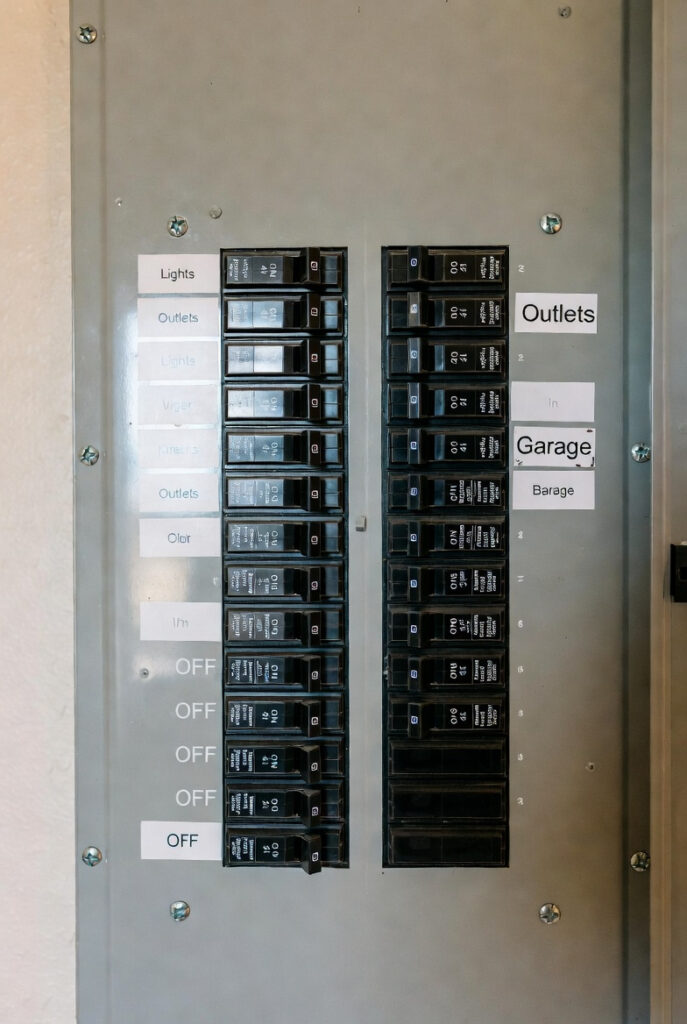
When the grid goes down during a winter storm you do not need your electric dryer or oven to survive but you absolutely need your furnace and fridge. A critical load sub panel is how you ensure that essential gear stays powered while non-essentials go dark. Without one even a solid 10 kWh battery bank can die in under 2 hours instead of lasting 26+ hours through a full Ontario blizzard.
When I set up the Rockwood sub-panel I put five circuits on it: fridge, chest freezer, furnace blower, well pump, and one outlet in the kitchen for phone charging and the router. That is it. Everything else the dryer, oven, dishwasher, basement lights stays on the main panel and goes dark when the grid goes down. We have never once missed those things during an outage.
Critical Load Sub Panel: The Whole House Trap
What happens when you try to back up everything: The average Ontario home uses 25-35 kWh of electricity per day. A solid residential 10 kWh battery bank powers that whole house for approximately 4-6 hours during an outage. Not 4-6 days. 4-6 hours. During a 31-hour ice storm outage that battery is dead before sunrise on day one.
Where the power goes: Most energy in a typical home is consumed by loads that are completely non-essential during an emergency electric water heater, basement dehumidifier, always-on entertainment systems, basement workshop circuits, outdoor lighting, electric oven. These loads drain your battery bank whether you need them or not.
The fuse box analogy: You would not put the radio and the fuel pump on the same fuse circuit. If the radio circuit gets overloaded you still want the fuel pump to keep the engine running. A critical load sub panel applies exactly this logic to your home luxury loads and survival loads do not belong on the same circuit.
What Goes in the Sub-Panel – Essential Circuits for Northern Winters
In Ontario, Minnesota, and Montana the critical load list has a specific cold climate priority order.
Priority 1 – Furnace Blower Motor: This is the number one survival circuit in any cold climate home. A natural gas or propane furnace requires electricity to run its blower motor and control board typically 400-600W running with a startup surge of 1,200-2,000W. Without this circuit your furnace does not run regardless of how much gas is in the tank. In a Guelph or Missoula blizzard at -25°C this is the circuit that determines whether your pipes freeze.
Priority 2 – Refrigerator and Chest Freezer: Food security over a multi-day outage. Running watts 100-200W each with startup surges of 600-900W. These draw continuously but consume relatively little over 24 hours.
Priority 3 – Well Pump (if applicable): Critical warning for Ontario and Minnesota rural properties well pumps are massive inductive loads. A 1/2 HP submersible well pump has a running draw of approximately 500-750W but a startup surge of 2,500-3,750W. If your well pump is on the critical load sub panel your inverter must be sized for that surge. See our Inductive Loads guide for the full surge calculation.
Priority 4 – Communications: Internet router, modem, and phone charger. Combined draw typically 20-50W continuous. During an extended outage communications are safety-critical weather updates, emergency contacts, coordinating with family.
Priority 5 – One Comfort Circuit: A single outlet in the main living area for device charging and a small lamp. Cold dark outages are significantly more manageable when you have light and a charged phone.
What stays OFF the sub-panel: Electric water heater (4,500W), electric dryer (5,000W), electric oven (3,000–5,000W), basement dehumidifier (300–800W of non-essential continuous draw), workshop circuits, outdoor lighting, secondary refrigerators or beverage coolers.
The Critical Load Sub Panel Wiring Logic
The power flow: Battery bank → Inverter → Critical load sub panel → Essential circuits
The inverter’s AC output feeds the sub-panel directly. The critical load sub panel is always hot when the inverter is running it does not depend on the main grid panel at all.
The main panel relationship: The main grid panel receives utility power as normal. It feeds the entire house including non-essential circuits. When the grid fails the main panel goes dead everything connected to it loses power. The critical load sub panel remains powered from the inverter regardless.
Transfer switch connection: The automatic transfer switch covered in our Automatic Transfer Switches guide sits between the grid and the inverter. During a grid outage the transfer switch isolates the grid and the inverter takes over the sub-panel loads automatically. No human intervention required.
Manual vs automatic changeover: Some critical load sub-panel setups use a manual interlock a physical switch that must be thrown to connect the inverter output to the sub-panel. Less expensive but requires someone present and acting during an outage. Automatic changeover requires no human intervention. For primary residences in cold climates automatic is strongly preferred.
The Winter Runtime Math
Scenario: 31-hour grid outage at -25°C with 10 kWh battery bank
Without a critical load sub panel whole house backup:
| Load | Running Watts |
|---|---|
| Furnace blower | 500W |
| Refrigerator | 150W |
| Chest freezer | 100W |
| Water heater | 4,500W |
| Basement dehumidifier | 400W |
| Entertainment/lighting | 300W |
| Total average | ~5,950W |
Battery runtime: 10 kWh ÷ 5.95 kW = 1.7 hours dead by midnight.
With a critical load sub panel essentials only:
| Load | Running Watts |
|---|---|
| Furnace blower (cycling) | 200W average |
| Refrigerator (cycling) | 75W average |
| Chest freezer (cycling) | 50W average |
| Router and phone charger | 30W |
| One comfort outlet | 20W |
| Total average | ~375W |
Battery runtime: 10 kWh ÷ 0.375 kW = 26.7 hours through the entire outage and beyond with solar recharging during daylight.
The difference: The critical load sub panel turns a system that dies in under 2 hours into a system that runs for over 26 hours on the same battery bank.
The Critical Load Checklist
Must Have No Exceptions:
- ☐ Furnace blower circuit size inverter for startup surge
- ☐ Refrigerator circuit
- ☐ Well pump circuit (if applicable) size inverter for LRA surge
- ☐ Communications outlet router, modem, phone charger
Should Have:
- ☐ Chest freezer circuit
- ☐ One living area outlet lamp and device charging
- ☐ Sump pump circuit (Ontario spring thaw)
Do Not Include:
- Electric water heater
- Electric dryer
- Electric oven or cooktop
- Basement workshop circuits
- Outdoor lighting
- Secondary entertainment or convenience circuits
The space heater warning: A single 1,500W space heater draws more than the entire critical load list combined. If someone plugs one into a critical load sub panel outlet during a winter outage your runtime drops from 26 hours to 4.4 hours instantly. Label the sub-panel clearly: NO SPACE HEATERS. Put it on a sign if necessary.
Pro Tip: If you do not install a critical load sub panel you are gambling your battery life on whether someone accidentally leaves a space heater plugged in or forgets to turn off the basement dehumidifier. Isolation is the only way to guarantee your critical loads get the power they need for the duration of the outage. A critical load sub panel costs $200-500 in materials plus electrician time. That investment more than doubles often triples your effective battery runtime during a real Ontario winter outage.
The Verdict
A critical load sub panel is the single highest-impact addition to any solar backup system in a cold climate home. It does not require more panels. It does not require more battery capacity. It requires a clear decision about what matters during an emergency and the wiring to enforce that decision.
Furnace. Fridge. Freezer. Well pump. Router. One outlet.
Everything else can wait for the grid to come back. Those five things cannot.
Disclosure: This article contains affiliate links. If you buy through them, GridFree Guide earns a small commission at no extra cost to you
About the Author
Robert Bertrand spent 20 years as a service advisor in the automotive industry (Lexus and Nissan), where precision diagnostics, wiring integrity, and documentation standards were non-negotiable. He brings that same technical discipline to GridFree Guide, where he researches, tests, and documents off-grid solar systems for Ontario conditions. Based in Rockwood, Ontario, every article is built on verified specifications, manufacturer data, and the real-world climate constraints of Canadian off-grid living.
As an Amazon Associate I earn from qualifying purchases. This site also contains affiliate links to other products and services. GridFree Guide earns a small commission at no extra cost to you.