
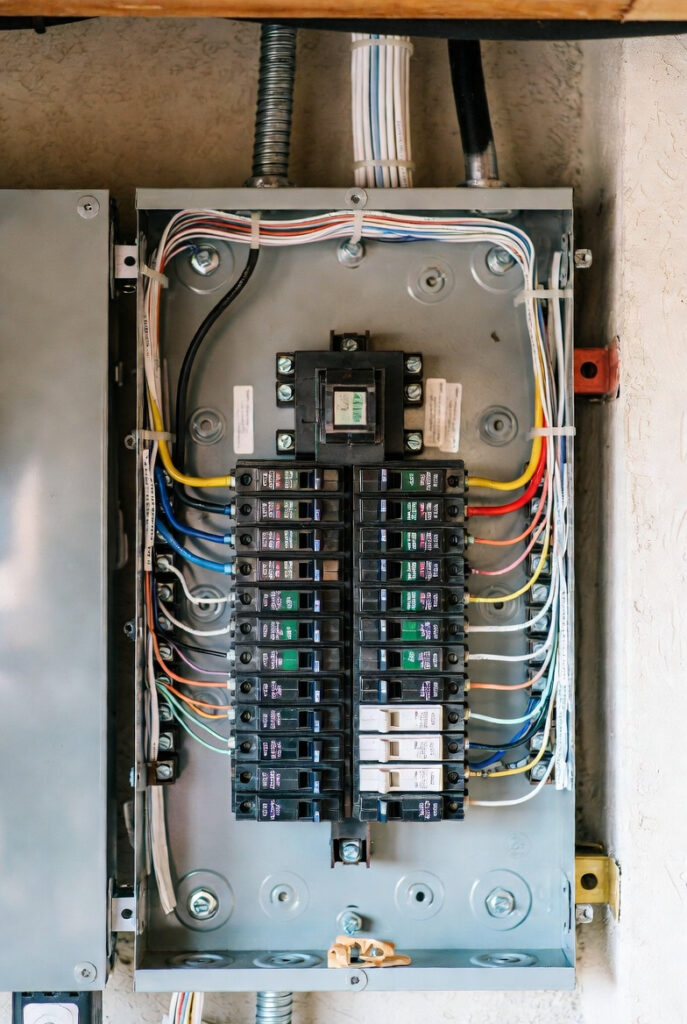
When the lights flicker and fade in sub-zero temperatures during an Ontario storm you should not have to leave your warm bed to restore power. An automatic transfer switch for solar is the invisible hand that keeps your home running sensing grid failure in milliseconds and switching to battery power before you even wake up.
Think of it like a sump pump backup. You do not want to manually activate it when the basement is flooding you need a system that senses the failure and reacts instantly to protect what matters. An automatic transfer switch for solar does exactly that for your entire home’s power.
During the ice storm that knocked out power to our Rockwood neighbourhood for 31 hours last winter the MultiPlus-II switched to battery in under a second. Amanda did not even notice the lights blink. I was watching for it and almost missed it.
Automatic Transfer Switch for Solar: What It Actually Does
The three-way traffic cop: An automatic transfer switch for solar sits at the intersection of three power sources the utility grid, your solar inverter and battery bank, and your home’s electrical panel. Its job is to ensure your home always draws from exactly one source at a time and to switch between them automatically when conditions change.
The switching sequence during a grid outage:
- Grid voltage drops to zero or falls outside acceptable range
- ATS detects the failure typically within 20 milliseconds
- ATS opens the connection to the grid isolating your home completely
- ATS closes the connection to the inverter output
- Your home runs on battery and solar power without interruption
The switching sequence when grid returns:
- Grid voltage returns and stabilizes
- ATS waits 30–60 seconds to confirm stable grid power
- ATS synchronizes inverter output phase with the grid
- ATS transfers load back to grid
- Battery bank begins recharging from grid or solar
The 20 millisecond detail: Most quality automatic transfer switches complete the grid-to-battery transfer in under 20 milliseconds faster than a human eye can detect. Your Starlink router, desktop computer, and refrigerator continue operating without a reboot or power cycle. Budget units may take 100–500 milliseconds long enough for some devices to reset.
Why Manual Transfer Is a Risk in Cold Climates
This is the cold climate reality that makes an automatic transfer switch for solar non-negotiable for Ontario, Minnesota, and Montana primary residences.
The 3am scenario: It is -25°C in Rockwood. The grid goes down at 3am. Your furnace stops. Your well pump stops. Your pipes start cooling. If your system requires manual intervention walking to an electrical panel in a cold garage, flipping a transfer switch, starting an inverter you are losing critical time while your pipes approach freezing temperature.
The unattended property scenario: Many Ontario cottage and cabin owners are not on-site when grid failures occur. A manual transfer switch does nothing if nobody is there to flip it. An automatic transfer switch for solar keeps the system running whether you are home or in Toronto.
The honest verdict on manual interlocks: A manual interlock is a camping solution. It is acceptable for a seasonal cottage where someone is always present and consequences of a missed transfer are low. For a primary residence in the North a home with a furnace, pipes, and people who sleep an automatic transfer switch for solar is the only professional-grade answer.
Standalone ATS vs Integrated Inverter-Charger
There are two ways to get automatic transfer capability in an off-grid or hybrid solar system.
Option 1 – Standalone Automatic Transfer Switch: A dedicated switching device installed between the utility grid and your existing inverter. Monitors grid voltage and automatically routes power from either the grid or the inverter to your home panel. Typical cost: $200–600 for the switch plus installation labor.
- Advantages: Works with existing inverters. Less expensive upfront. Can be added to an existing system.
- Disadvantages: Adds another component and potential failure point. Transfer time limited by relay speed. In cold humid Ontario environments cheap relay-based ATS units can develop contact resistance, arc, or stick.
Option 2 – Integrated Inverter-Charger with Built-In Transfer: A premium inverter-charger like the Victron MultiPlus-II combines the inverter, battery charger, and automatic transfer switch into a single unit. The transfer relay is internal no separate ATS device required.
- Advantages: Single integrated unit. Transfer time under 20 milliseconds. Transfer relay housed in sealed climate-controlled enclosure no exposure to humid cold air. Battery charging and transfer logic coordinated by the same firmware.
- Disadvantages: Higher upfront cost. Replaces the inverter cannot be added to an existing system without replacing the inverter.
The Victron MultiPlus-II 12/3000 is the gold standard for integrated automatic transfer in residential off-grid and hybrid systems. 50A integrated transfer switch. Under 20ms transfer time. Built-in 120A battery charger. Full VictronConnect monitoring. Fully programmable LiFePO4 charge profiles. The entire system in one unit with a 5-year warranty.
The Backfeeding Safety Reality
This is the non-negotiable safety reason every solar installation connected to the utility grid must have an automatic transfer switch for solar or equivalent isolation device.
What backfeeding is: When your solar inverter and battery bank push power onto utility lines that the grid operator believes are de-energized. During a grid outage utility workers are dispatched to repair lines they believe carry no voltage. If your system is backfeeding those lines the workers face live voltage on what they believe are dead conductors.
This is not a theoretical risk. Utility line workers have been killed by backfeed from solar installations. Anti-islanding protection is mandatory for any grid-connected inverter in Canada and the United States.
How the ATS prevents backfeeding: The ATS physically opens the connection between your home and the utility grid before connecting your inverter output to your home panel. The grid conductors entering your home are completely isolated no physical path exists for current to flow back to the utility. This break-before-make mechanism is what makes transfer switches legally and ethically mandatory.
Cold Climate ATS Reliability
This is the detail completely absent from most ATS guides.
The humid cold relay problem: Automatic transfer switches use electromechanical relays or contactors to physically switch between power sources. In Ontario, Minnesota, and Montana the temperature swings from -30°C in winter to +35°C in summer and humidity shifts dramatically through that range.
What happens to cheap relay contacts:
- Moisture condensation on cold contacts forms a thin resistive film
- This film increases contact resistance causing heat and arcing during switching
- Repeated arcing pits the contact surfaces increasing resistance further
- Eventually contacts stick in open or closed position failing to transfer or failing to disconnect
The solution for cold climate installations: Choose ATS units with sealed housings rated for the operating temperature range. The Victron MultiPlus-II’s internal transfer relay is housed inside the sealed inverter enclosure protected from ambient humidity and temperature extremes. For standalone ATS units choose NEMA 3R rated enclosures minimum for Ontario cabin and outdoor installations.
The Monthly Safety Test Protocol
This is the information gain detail no ATS guide provides.
Why monthly testing matters: An automatic transfer switch for solar that sits untested for months may have developed relay contact issues, lost its grid-sense calibration, or developed firmware faults and you will not know until a real outage reveals the problem at -30°C in January.
The monthly test – 5 minutes:
- Verify battery SoC is above 50% – confirm adequate reserve before simulating grid failure
- Note what is running – fridge, router, any active loads
- Open the main breaker between the grid and the ATS – simulates grid failure without an actual outage
- Start a timer – observe whether the ATS transfers within 1–2 seconds
- Confirm loads continue running – fridge still on, router still connected, no reboot events
- Restore main breaker – observe transfer back to grid and battery recharge beginning
- Log the result – date, transfer time observed, any anomalies
What a failed test looks like:
- Transfer takes more than 5 seconds – relay contact resistance problem
- Transfer succeeds but loads drop off – transfer time too long for your devices
- Transfer back to grid causes spike or reboot – synchronization issue
Any of these findings warrant immediate inspection before winter.
Pro Tip: If your automatic transfer switch for solar installation includes a generator as a third power source test the generator ATS separately from the solar ATS. A three-way system has two transfer events and both must be tested independently. The most common failure mode in three-way systems is the generator failing to start when the solar bank is depleted usually due to a dead starting battery on the generator that nobody checked since last winter. Test generator start monthly. Replace the starting battery every 3 years regardless of apparent condition.
The Verdict
An automatic transfer switch for solar is not a luxury upgrade for primary residences in cold climates it is the component that makes the difference between a system that protects your home and a system that requires you to protect it.
Manual interlocks are for camping. Integrated automatic transfer is for homesteads.
For Ontario, Minnesota, and Montana installations where grid outages happen in conditions that are dangerous to be outside in choose integrated transfer through a quality inverter-charger or a sealed cold-rated standalone ATS. Test it monthly. Know it works before you need it.
Disclosure: This article contains affiliate links. If you buy through them, GridFree Guide earns a small commission at no extra cost to you.
About the Author
Robert Bertrand spent 20 years as a service advisor in the automotive industry (Lexus and Nissan), where precision diagnostics, wiring integrity, and documentation standards were non-negotiable. He brings that same technical discipline to GridFree Guide, where he researches, tests, and documents off-grid solar systems for Ontario conditions. Based in Rockwood, Ontario, every article is built on verified specifications, manufacturer data, and the real-world climate constraints of Canadian off-grid living.
As an Amazon Associate I earn from qualifying purchases. This site also contains affiliate links to other products and services. GridFree Guide earns a small commission at no extra cost to you.