
You checked the sticker on your fridge: 700 watts. You bought a 2000W inverter. So why does the power cut out the second the compressor kicks in? Welcome to the world of inductive loads the most common reason well-sized off-grid systems fail at the worst possible moment.
Think of it like a car starter motor. Your battery only needs a few amps to run the radio, dash lights, and GPS. But cranking a cold engine at -20°C in Rockwood demands 400+ cold cranking amps for about one second. If your battery cannot deliver those cranking amps the engine does not start no matter how much fuel is in the tank. Inductive loads work exactly the same way.
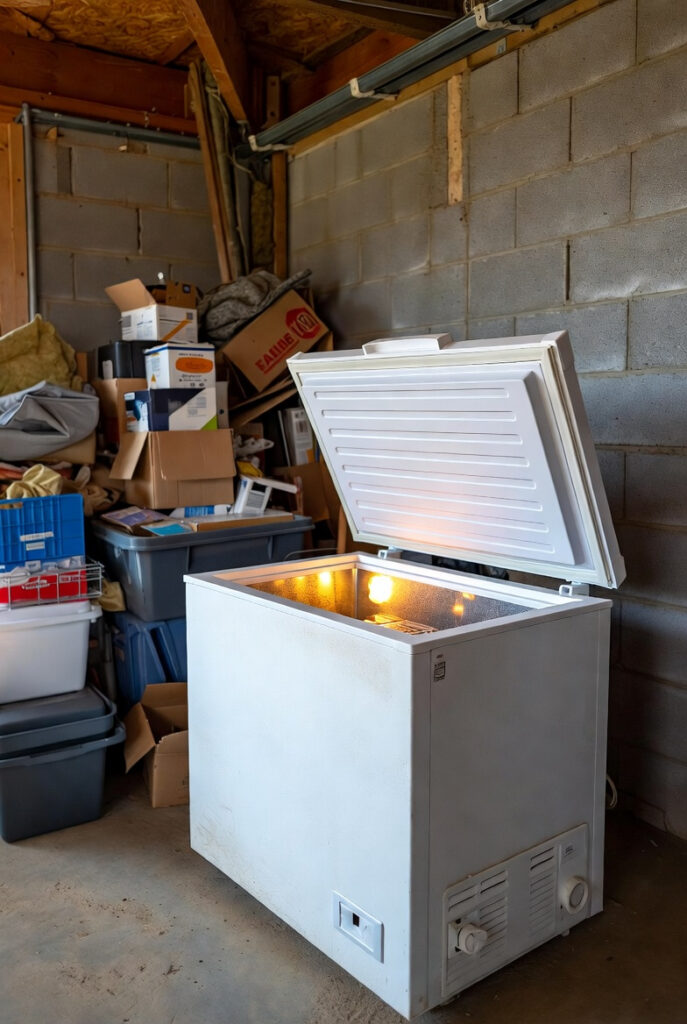
The first time I plugged our chest freezer into a 2000W inverter during a power outage in Rockwood it ran fine for two hours, then the compressor cycled off and tried to restart. The inverter beeped twice and shut down. Battery was at 80%. The problem was not power. It was solar inverter surge power.
Solar Inverter Surge Power: Running Watts vs Starting Watts
What an inductive load is: Any appliance that uses a motor or compressor to do its work. The motor needs a magnetic field to start spinning and creating that field from a standing start requires a large burst of current that has nothing to do with how much power the motor needs once it is running.
Resistive loads vs inductive loads:
- Resistive loads (toasters, space heaters, incandescent lights) consume exactly their rated wattage at startup and while running no surge
- Inductive loads (fridges, freezers, pumps, fans, power tools) need 3–7× their running wattage for the fraction of a second it takes the motor to reach operating speed
The specific surge math: A fridge compressor rated at 150W running wattage may need 900W at startup a 6× surge factor. A well pump rated at 750W running may need 3,750W at startup a 5× surge. The nameplate wattage tells you nothing useful about inverter sizing for inductive loads.
What the Peak Rating on Your Inverter Actually Means
Most inverter boxes show two numbers: a continuous rating and a peak rating. A box might say “2000W / 4000W Peak.”
What peak really means: The 4000W peak rating is available for approximately 20–100 milliseconds fractions of a second. It is not a rating you can sustain for one second let alone one minute. It exists specifically to handle the brief inrush current of a motor starting.
The misleading math: Many buyers see 4000W peak and assume their 2000W inverter can start any appliance under 4000W. That is wrong for two reasons. First the peak duration may not be long enough for the motor to reach running speed some compressors need sustained surge support for 200–500 milliseconds longer than cheap inverters can deliver. Second the voltage sag during surge can trigger the inverter’s protection circuits regardless of peak rating.
Low frequency vs high frequency inverters: Low frequency inverters which use a large iron transformer can sustain surge current for significantly longer than high frequency inverters of the same rated wattage. The transformer acts as an energy buffer. A quality low frequency inverter at 1200W continuous may start a load that kills a cheap high frequency inverter at 2000W continuous. This is one reason the Victron Phoenix is consistently recommended for starting difficult inductive loads its design sustains surge for the milliseconds that actually matter.
Why Your Battery Is Full But Your Inverter Still Trips
This is the counterintuitive failure that confuses most first-time off-grid owners.
The voltage sag mechanism: When a large inductive load starts it draws a massive surge current from the battery potentially hundreds of amps for a fraction of a second. This high current causes a temporary voltage drop across the battery’s internal resistance. A LiFePO4 battery at 80% SoC and 13.2V may momentarily sag to 11.8V or lower during a 400A surge event.
What the inverter sees: The inverter monitors its DC input voltage continuously. When it sees 11.8V below its Low Voltage Disconnect threshold it trips and shuts down. The battery was not depleted. The SoC was fine. But the momentary voltage sag from the surge triggered the protection circuit.
The solutions:
- Choose an inverter with a high enough surge rating that the surge current draw stays within the battery’s ability to deliver without excessive sag
- Use a larger battery bank more parallel capacity lowers internal resistance and reduces voltage sag
- Adjust the LVD trip threshold if your inverter allows it dropping it by 0.5-1V gives more headroom for startup surges
Common Inductive Loads in an Off-Grid Home
Every one of these appliances has a surge current dramatically higher than its running wattage:
| Appliance | Running Watts | Surge Multiplier | Startup Surge |
|---|---|---|---|
| Chest Freezer | 100W | 6× | 600W |
| Refrigerator/Compressor | 150W | 5–6× | 750–900W |
| Well Pump (1/2 HP) | 500W | 5× | 2,500W |
| Sump Pump | 400W | 5× | 2,000W |
| Window AC (5,000 BTU) | 500W | 4× | 2,000W |
| Furnace Blower Motor | 400W | 3–4× | 1,200–1,600W |
| Vacuum Cleaner | 1,000W | 3× | 3,000W |
| Washing Machine | 500W | 3× | 1,500W |
| Circular Saw | 1,400W | 3× | 4,200W |
The Ontario sump pump reality: In Rockwood and Guelph spring thaw means water. A sump pump that cannot start during a power outage because the inverter cannot handle its 2,000W startup surge means a flooded basement. This is not a theoretical risk it is the exact scenario that motivates most Ontario homeowners to take inverter surge ratings seriously. Size your inverter for your sump pump’s surge before anything else.
Locked Rotor Amps Reading the Sticker
This is the information gain detail most guides skip entirely.
What LRA means: Every motor-driven appliance has a nameplate usually on the back or bottom. Look for “LRA” (Locked Rotor Amps) or “RLA” (Rated Load Amps). LRA is the current the motor draws at the instant of startup when the rotor is stationary the worst case surge current in real measured amps.
How to use LRA for inverter sizing: Startup surge watts = LRA × AC voltage (120V in North America)
Example:
- Fridge nameplate shows LRA 8A
- Startup surge = 8A × 120V = 960W
- Your inverter needs a surge rating above 960W to start this fridge reliably
Why this matters: The LRA number on the nameplate is the actual measured value for your specific appliance not a generic estimate. It is more accurate than any surge multiplier rule of thumb. For well pumps and sump pumps where startup failure has real consequences always calculate from LRA not from generic estimates.
How to Tell if Your Inverter Can Handle Your Loads
Step 1 – Find LRA or calculate surge: Check nameplates on all motor-driven appliances. If no LRA is listed use the surge multiplier table above as a conservative estimate.
Step 2 – Identify your worst-case single surge: Which appliance has the highest startup wattage? That is your minimum inverter surge requirement plus the running load of everything else operating simultaneously.
Step 3 – Check the inverter spec sheet: Look for the peak or surge rating AND the duration. A reputable inverter manufacturer lists both. If the manufacturer does not list a surge rating that is a red flag. Reliable inverters always specify surge capacity because it is a selling point.
Step 4 – Add 25% headroom: Your worst-case calculated surge times 1.25 is your minimum inverter surge rating. This accounts for cold temperatures, aging motors with slightly higher LRA, and simultaneous start events.
The Victron Phoenix 12/1200 is specifically noted in the off-grid community for its ability to start inductive loads that kill cheaper inverters of higher continuous ratings. Its low frequency topology sustains surge current for the milliseconds that matter the difference between a compressor that starts cleanly and one that stalls and retries until your inverter gives up.
Pro Tip: If your inverter keeps tripping when a specific appliance starts before buying a new inverter try starting that appliance alone with nothing else running. If it starts successfully the problem is simultaneous surge two motors trying to start at the same time exceeding the inverter’s peak capacity. Stagger your startup sequence. Start the fridge, wait 30 seconds, then start the freezer. This simple habit eliminates most inverter trip problems without spending a dollar.
The Verdict
Solar inverter surge power is the specification most off-grid buyers ignore until their inverter trips during a power outage with a full battery. Running watts tell you almost nothing useful about whether your inverter can start your appliances. Surge watts calculated from LRA on the nameplate or from conservative surge multipliers tell you everything.
For Ontario installations with sump pumps, furnace blowers, and chest freezers size your inverter surge rating for the worst-case simultaneous startup scenario then add 25%. If the manufacturer will not publish their surge rating and duration do not buy that inverter.
Disclosure: This article contains affiliate links. If you buy through them, GridFree Guide earns a small commission at no extra cost to you.
About the Author
Robert Bertrand spent 20 years as a service advisor in the automotive industry (Lexus and Nissan), where precision diagnostics, wiring integrity, and documentation standards were non-negotiable. He brings that same technical discipline to GridFree Guide, where he researches, tests, and documents off-grid solar systems for Ontario conditions. Based in Rockwood, Ontario, every article is built on verified specifications, manufacturer data, and the real-world climate constraints of Canadian off-grid living.
As an Amazon Associate I earn from qualifying purchases. This site also contains affiliate links to other products and services. GridFree Guide earns a small commission at no extra cost to you.