
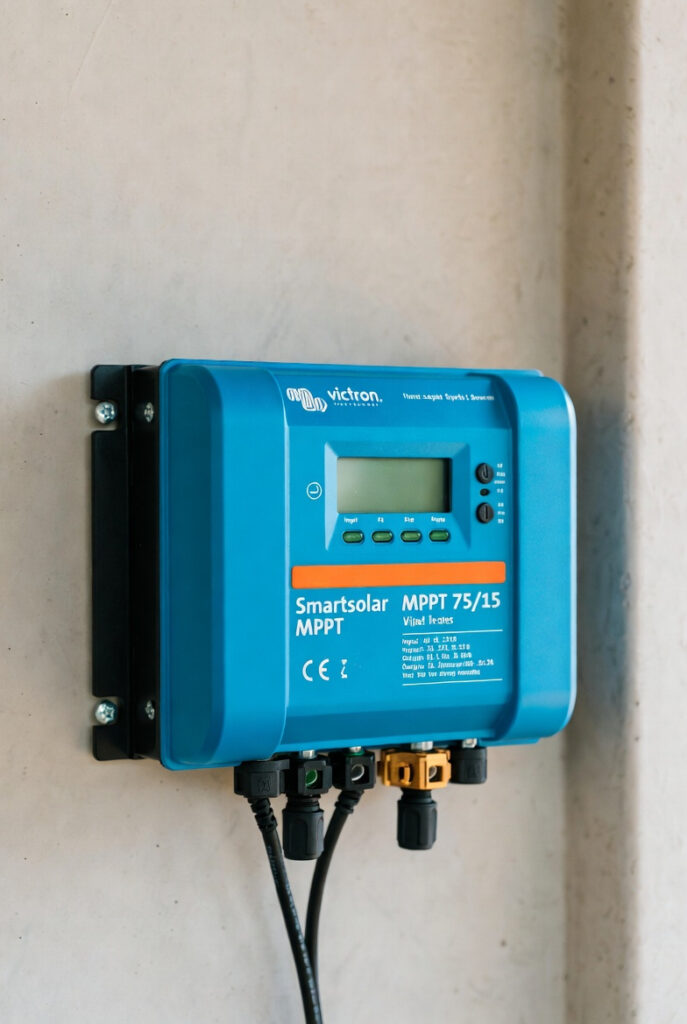
It is the most debated topic in off-grid power. Does the Victron name justify the price tag or are you just paying for the blue paint? Here is the honest answer and it depends entirely on what you are building.
Think of it like a brake job. You can buy economy pads that squeak and wear out in a year or premium ceramic pads that just work quietly for 80,000 kilometres. If you are hauling a heavy load a 24/7 off-grid home, a full-time van build, a remote cabin you want the premium pads. If you are driving a seasonal beater to the cottage twice a year the economy pads are fine.
Victron vs Renogy: The Build Quality Reality
This is where the price difference shows up most clearly.
Victron Smart Solar Mission Critical Build
Physical construction: Marine-grade aluminum housing. Fanless passive cooling no moving parts to fail. IP43 rated for dust and moisture resistance. Built for continuous 24/7/365 operation in harsh environments including marine installations, remote telecom sites, and off-grid homes.
Warranty: 5 years standard. Victron stands behind these controllers because they build them to last.
Operating temperature: -30°C to +60°C specifically relevant for Ontario and cold climate equipment living in unheated garages or outdoor enclosures. A controller that cannot survive a -30°C winter night is not a controller you can rely on. This matters equally in Minnesota, Montana, Vermont, and northern Michigan.
The fail-safe reputation: Victron controllers have a strong industry reputation for fail-safe behavior. If the controller has a fault it protects the battery. Some budget controllers when they fail have been documented to pass panel voltage directly to the battery. On a 12V LiFePO4 bank that is a destroyed battery instantly.
Renogy Rover – Solid Consumer Grade
Physical construction: ABS plastic housing. Fan-cooled moving parts that can and do fail over time. Not rated for harsh environment deployment. Built for seasonal and occasional use applications.
Warranty: 1-2 years depending on model. Reflects the expected service life for this class of controller.
Operating temperature: Typically rated to -20°C marginal for Ontario and northern US winter outdoor installations.
Where it earns its place: For a weekend camper, a seasonal van build, a garden shed, or a cottage used occasionally the Renogy Rover is a genuinely good controller at a fair price. It does what it says on the label for the applications it was designed for.
The Renogy 40A MPPT Rover is the right choice for cost-conscious DIY builds with seasonal or occasional use patterns.
The App Experience – VictronConnect vs Renogy DC Home
This is the feature gap that surprises most buyers after purchase.
VictronConnect
Widely considered the gold standard in solar monitoring. Instant Bluetooth pairing no dongle required. Real-time data plus 30 days of historical logging. Full parameter configuration charge voltages, absorption time, temperature compensation, battery type presets for every chemistry. Professional diagnostic tools built in.
The VRM Portal: Victron gear integrates with the Victron Remote Monitoring portal a cloud dashboard that lets you check your system from anywhere. If your remote property battery is dying in January while you are 500 kilometres away you know about it from your phone before the pipes freeze.
The Cerbo GX integration: For larger Victron systems the Cerbo GX networking hub connects all Victron components controller, inverter, battery monitor into one unified dashboard with full remote access. Genuinely professional-grade system monitoring.
Renogy DC Home
Functional for basic stats. Shows voltage, current, state of charge, and basic historical data. Gets the job done for simple monitoring needs.
The dongle reality: The Renogy Rover requires a separate BT-1 Bluetooth module approximately $40 extra to enable any Bluetooth monitoring at all. That $40 narrows the price gap between the two brands meaningfully.
The limitation: Parameter configuration is more limited than VictronConnect. Fine for standard installations. Becomes a constraint if you need precise charging profile tuning for LiFePO4 batteries or unusual battery configurations.
Why Warranty and Support Matter in Ontario
Ontario’s climate creates specific equipment demands that make warranty and support more important than in moderate climates. The same applies across the northern US Michigan, Minnesota, Wisconsin, Montana, Vermont.
The freeze-thaw stress: Equipment experiences repeated thermal cycling from -30°C winters to +35°C summers. This stresses electronics, seals, and connections in ways that moderate climate installations never experience. A 5-year warranty matters more when the operating environment is genuinely harsh.
The remoteness factor: Many off-grid installations are remote cottage country, rural properties, hunting camps. A controller failure at a remote property in January is not a minor inconvenience. It is a potential emergency. The reliability differential between Victron and consumer-grade controllers is most meaningful precisely in these situations.
The support reality: Victron has a professional dealer and support network in Canada and the US. Technical support is available for complex installations. Renogy support is primarily online adequate for standard questions, less useful for complex diagnostic situations.
The “Buy Once Cry Once” Calculation
The price difference between a Renogy Rover and a Victron SmartSolar is approximately $100 – 200 depending on model and sizing.
The hidden costs of buying budget first:
- Renogy BT-1 Bluetooth dongle: $40 extra
- Controller replacement at year 2-3: full price again
- Potential battery damage if controller fails unsafely: $500-$2,000
The Victron calculation: One controller. Five year warranty. No dongle. No replacement. No battery risk.
The LiFePO4 upgrade path: If you are currently using AGM batteries but plan to upgrade to LiFePO4 in the next 2-3 years start with Victron. LiFePO4 batteries require precise charging profile control that Victron handles natively. Buying Renogy now and replacing with Victron when you upgrade LiFePO4 costs more than buying Victron once.
The Victron SmartSolar MPPT 100/30 is the right choice for permanent installations, LiFePO4 systems, and any application where reliability is not negotiable.
Which One Should You Buy?
| User Profile | Recommendation | Reason |
|---|---|---|
| Weekend camper van or trailer | Renogy 40A Rover | Seasonal use, budget appropriate, no harsh environment exposure |
| Full-time van-lifer | Victron SmartSolar | Daily reliance, needs reliable monitoring, LiFePO4 likely |
| Seasonal cottage | Renogy 40A Rover | Occasional use, basic monitoring adequate |
| Year-round off-grid cabin | Victron SmartSolar | 24/7 operation, cold climate, reliability critical |
| Remote property unattended | Victron SmartSolar + VRM | Remote monitoring essential, failure has serious consequences |
| Garden shed or gate opener | PWM or basic MPPT | Neither brand needed at this scale |
Pro Tip: Before choosing based on price alone check whether your planned installation is seasonal or year-round and attended or remote. A $150 controller difference is irrelevant if a controller failure costs you a $1,500 LiFePO4 battery or leads to burst pipes at a remote property. The risk profile of your installation should drive the brand decision more than the upfront price difference.
The Verdict
Victron vs Renogy is not a competition between good and bad. It is consumer grade versus mission critical — and the right choice depends entirely on your use case.
Renogy Rover is a good controller for what it is cost-effective MPPT for seasonal and occasional use applications where the stakes are low and budget is the primary constraint.
Victron SmartSolar is the right choice when you are building something you rely on. Year-round operation. Harsh cold climate winters. LiFePO4 batteries. Remote unattended installations. Any situation where controller failure has real consequences.
If you are building for reliability buy Victron once. If you are building a seasonal weekend system Renogy is the smarter financial choice.
Disclosure: This article contains affiliate links. If you buy through them, GridFree Guide earns a small commission at no extra cost to you.
About the Author
Robert Bertrand spent 20 years as a service advisor in the automotive industry (Lexus and Nissan), where precision diagnostics, wiring integrity, and documentation standards were non-negotiable. He brings that same technical discipline to GridFree Guide, where he researches, tests, and documents off-grid solar systems for Ontario conditions. Based in Rockwood, Ontario, every article is built on verified specifications, manufacturer data, and the real-world climate constraints of Canadian off-grid living.
As an Amazon Associate I earn from qualifying purchases. This site also contains affiliate links to other products and services. GridFree Guide earns a small commission at no extra cost to you.