
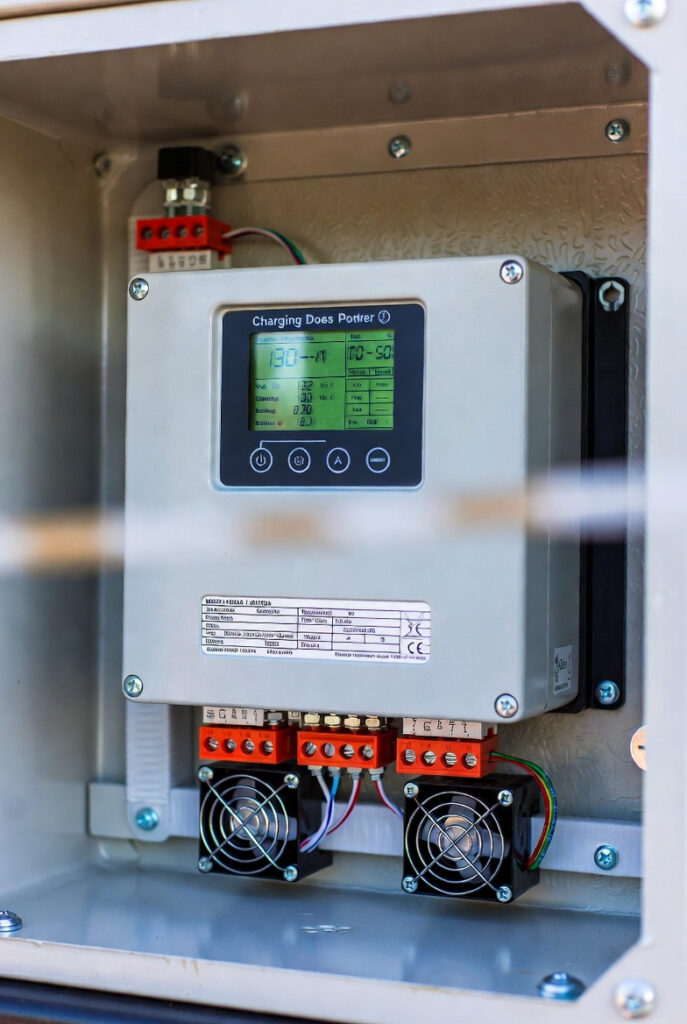
Do not let a $30 part bottleneck a $1,000 solar array. The charge controller sitting between your panels and batteries is either capturing everything your panels produce or quietly throwing money away as heat. Here is the real difference between MPPT vs PWM and why it matters more than most beginners realize.
Think of it like a transmission. A PWM controller is a single speed bike it works fine on flat ground but has no gears for hills. An MPPT controller is a 21 speed mountain bike that shifts constantly to keep the engine in its sweet spot regardless of conditions.
MPPT vs PWM: The Fundamental Difference
PWM The Basic Controller
PWM (Pulse Width Modulation) works by rapidly connecting and disconnecting the panel from the battery to control charging current. When the battery is low it connects more. When nearly full it connects less.
The critical limitation: PWM clamps the panel voltage down to match the battery voltage. A 12V battery charges at approximately 14.4V. PWM forces the panel to operate at 14.4V regardless of its ideal operating point.
Where the power goes: If your panel’s Vmp is 18 – 20V and PWM clamps it to 14.4V that difference of roughly 4 – 6 volts is simply lost as heat in the controller.
The math: A 100W panel with Vmp of 18V forced to operate at 14.4V loses approximately 20% of its potential output immediately. Your 100W panel becomes an effective 80W panel the moment you connect a PWM controller.
Where PWM makes sense:
- Tiny systems under 200W
- Panel voltage closely matches battery voltage
- Simple applications garden shed lights, gate openers, remote sensors
- Budget is the absolute primary constraint
A $30 PWM on a small simple system is a reasonable choice. The same $30 PWM on a 400W array with LiFePO4 batteries is an expensive mistake.
MPPT The Smart Controller
MPPT (Maximum Power Point Tracking) is a DC-to-DC converter. It takes whatever voltage the panel is producing 18V, 24V, 40V and converts it mathematically into the voltage and current the battery actually needs.
The key insight: Power = Voltage × Current. MPPT takes high panel voltage and converts it into additional charging current. Nothing is thrown away. The math works in your favor.
Real world efficiency gain:
- PWM captures 75–80% of panel potential
- MPPT captures 93–97% of panel potential
- Efficiency gap: 15–30% more power from the same panels
The LiFePO4 requirement: If you are using LiFePO4 batteries use only MPPT. Full stop. PWM charging profiles are too primitive for high-end BMS systems. LiFePO4 batteries require precise voltage control during absorption and float phases that PWM controllers cannot deliver accurately. Using PWM with LiFePO4 risks undercharging, BMS confusion, and premature battery degradation.
Why MPPT Is Essential for Canadian Winters
This is where MPPT earns its price premium in Ontario specifically.
The cold weather voltage effect: Solar panel voltage increases as temperature drops. On a -20°C January morning in Guelph your panel’s Vmp might climb from its rated 18V to 22–24V. The temperature coefficient working in your favor more voltage available than the spec sheet suggests.
What PWM does with that extra voltage: Ignores it. Clamps it to battery voltage. The extra voltage the Ontario winter just gave you for free disappears as heat in the controller.
What MPPT does with that extra voltage: Converts it into additional charging current. On a cold clear Ontario January day with panels running at 24V instead of 18V an MPPT controller captures that entire winter boost and turns it into faster battery charging.
The practical difference on a -20°C Ontario day:
- A 200W array connected to PWM might deliver 140–150W after voltage clamping losses
- The same 200W array connected to MPPT might deliver 185–195W capturing the cold weather voltage boost PWM throws away
Ontario winters are the strongest argument for MPPT. The season when you need every watt is exactly the season when MPPT outperforms PWM by the largest margin.
The Voltage Headroom Advantage
MPPT opens up a wiring advantage that PWM cannot match.
Series wiring with MPPT: Because MPPT handles high input voltages typically 100V or 150V maximum you can wire panels in series to produce higher voltage strings. Two 100W panels in series produce approximately 36 – 40V at Vmp instead of 18 – 20V.
Why higher voltage saves money on wire: Power loss in wiring is proportional to current squared times resistance. Higher voltage means lower current for the same power. Lower current means thinner cheaper wire over longer runs without losing power to resistance.
A real example:
- A 400W array at 12V requires approximately 33A needs heavy expensive wire over a 10 metre run
- The same 400W array at 48V requires only 8A much thinner wire, much less voltage drop, much cheaper installation
This advantage becomes significant in cabin and off-grid home installations where panels may be 15–30 metres from the battery bank.
Recommended Controllers
For mid-size systems Renogy 40A MPPT Rover: Handles up to 520W on a 12V system or 1,040W on a 24V system. Bluetooth monitoring compatible. Suitable for most residential off-grid and cabin systems.
For premium systems Victron SmartSolar MPPT 100/30: Handles up to 400W on 12V. Built-in Bluetooth. Victron’s VictronConnect app provides detailed monitoring and logging. The gold standard for quality off-grid installations that need reliable long-term data.
Victron SmartSolar MPPT 100/30
The Quick Decision Rule
Buy PWM if:
- Your system is under 200W total
- Panel voltage closely matches battery voltage
- Budget is the absolute primary constraint
- Application is truly simple shed light, gate opener
Buy MPPT no exceptions if:
- Your array is over 200W
- You are using LiFePO4 batteries
- You are in Ontario and want to capture cold weather voltage boost
- Your panel run is longer than 5 metres
- You plan to expand your system in the future
The price difference between a quality PWM and a quality MPPT is $50–150. The efficiency difference over 10 years on a 400W system is thousands of dollars in captured power. The math is not close.
Pro Tip: Size your MPPT controller for your future system not your current one. If you have 200W today but plan to add panels next year buy the 40A controller now. MPPT controllers are sized by maximum output current to the battery a 40A controller on a 12V system handles up to 480W of panels. Buying the right size once costs less than replacing an undersized controller in 18 months.
The Verdict
MPPT vs PWM is not a close competition for most real-world solar installations. PWM is a legitimate tool for small simple matched-voltage systems. For anything else anything over 200W, any LiFePO4 battery bank, any Ontario installation that wants to capture cold weather performance MPPT is the only rational choice.
Do not let a $30 controller bottleneck a $1,000 array. Buy the MPPT.
Disclosure: This article contains affiliate links. If you buy through them, GridFree Guide earns a small commission at no extra cost to you.
About the Author
Robert Bertrand spent 20 years as a service advisor in the automotive industry (Lexus and Nissan), where precision diagnostics, wiring integrity, and documentation standards were non-negotiable. He brings that same technical discipline to GridFree Guide, where he researches, tests, and documents off-grid solar systems for Ontario conditions. Based in Rockwood, Ontario, every article is built on verified specifications, manufacturer data, and the real-world climate constraints of Canadian off-grid living.
As an Amazon Associate I earn from qualifying purchases. This site also contains affiliate links to other products and services. GridFree Guide earns a small commission at no extra cost to you.