
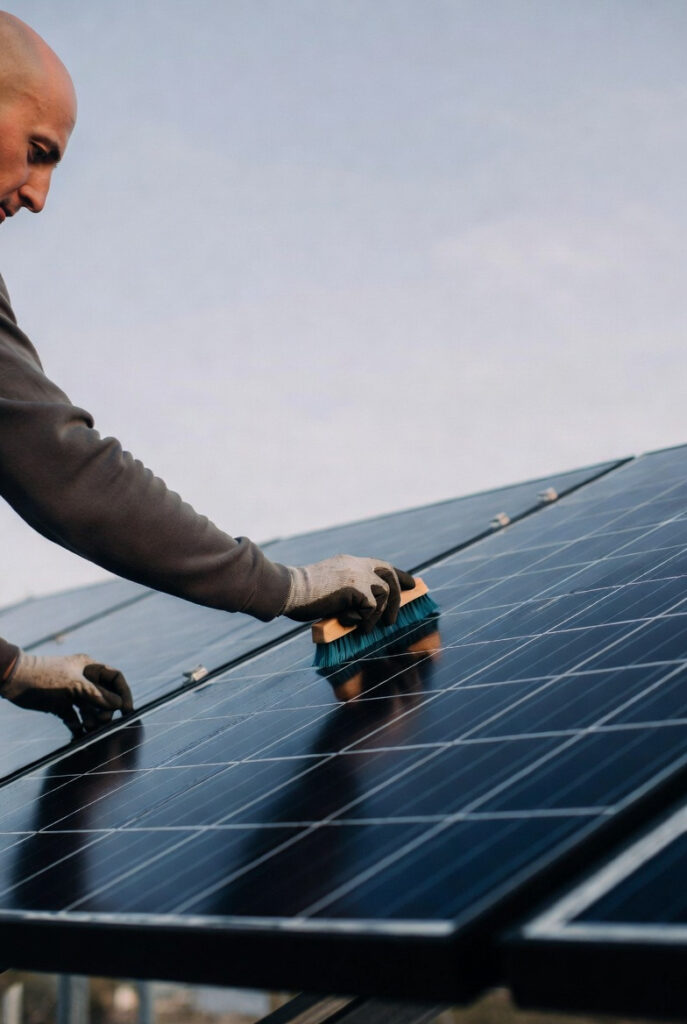
You would not drive your car for a year without washing the windshield. The glass gets progressively dirtier and your visibility drops so gradually you barely notice until you actually clean it and realize how much you were missing. Solar panels work the same way. Knowing how to clean solar panels is basic maintenance that most owners skip and quietly pay for in lost production every single day.
Think of it like a radiator flush. A simple maintenance task that prevents your system from underperforming exactly when you need it most.
How to Clean Solar Panels: What You Actually Need
Most panel cleaning requires nothing more than:
- Soft bristle brush or squeegee on a telescopic pole
- Plain water ideally distilled or low-mineral content
- Mild dish soap solution for stubborn soiling only rinse thoroughly
The telescopic pole keeps you safely on the ground for ground-mounted and low-roof panels. For anything you cannot reach from ground level see the safety section below before climbing.
The right tools: A telescopic squeegee with a soft rubber blade and an attached soft brush head is the ideal tool for most residential panels. Reach without climbing. Soft contact with the glass. Quick squeegee finish removes water spots.
Search Amazon for “solar panel cleaning kit telescopic” for ready-made options.
The Efficiency Tax: Why Dirty Panels Cost You Money
Dirt is a silent tax on your system output that compounds every day.
The real numbers:
- Light dust accumulation: 2–5% output reduction
- Pollen season coating: 5–10% output reduction
- Bird droppings on active cells: 10–25% output reduction on affected strings
- Heavy soil and grime: up to 15–25% sustained output reduction
A 200W panel losing 10% to dirt produces 180W. Over a year of 4 peak sun hours per day that is 292kWh of lost production at $0.15/kWh that is $43.80 of lost value from one panel. A 4-panel system losing 10% costs approximately $175/year in lost production.
Cleaning four panels takes 20 minutes twice a year. The math is simple.
The Ontario-specific efficiency tax: Spring pollen in Ontario is severe particularly May and June. A single pollen event can coat panels with a yellow film visible from the ground. Summer wildfire smoke from northern Ontario and western Canada leaves a fine particulate residue. Autumn brings leaf debris and increased bird activity. Each season brings its own soiling pattern.
The Thermal Shock Warning
This is the biggest rookie mistake in solar panel cleaning and the most expensive.
What is thermal shock: On a hot sunny day panel surfaces reach 50–70°C. Spraying cold water particularly well water at 10–15°C onto a hot glass surface creates an instant temperature differential. Tempered glass can survive significant impact but it is vulnerable to sudden thermal gradients. The result can be micro-cracks or in worst cases a shattered panel.
The rule: Never clean panels when they are hot. Clean in the early morning before the sun has heated the glass. Clean in the late evening after the panels have cooled. Clean on overcast days when panels remain cool throughout.
The practical test: If you can hold your hand flat on the panel surface for 5 seconds comfortably it is safe to clean. If it is uncomfortably warm – wait.
When and How Often to Clean
Spring – Late April to May: Post-pollen is the most important cleaning of the year. Ontario pollen season leaves a yellow-green film that significantly reduces output. Clean after the main pollen release typically mid to late May.
Summer – After smoke events: Ontario now experiences significant wildfire smoke events. Smoke leaves a fine oily particulate on panel surfaces. Clean within a week of any major smoke event lasting more than 2–3 days.
Autumn – September to October: Leaf debris, bird activity before migration, and general organic matter accumulation. A clean before winter ensures your panels enter the low-production season at full efficiency.
Winter – Generally leave it: Snow on panels typically slides off once it reaches a critical mass panels are dark and warm enough to self-clear on most sunny days. Do not walk on roofs to clear snow. A soft roof rake from ground level is the only safe option for clearing heavy snow accumulation.
The snow rake rule: Use a plastic or foam-edged roof rake never metal. Metal edges scratch the anti-reflective coating. Soft foam or rubber edges clear snow without contact damage.
Common Mistakes: What NOT to Do
High-pressure washing – Never: Pressure washers force water into frame seals, junction boxes, and cell interconnects. Even a modest pressure washer can compromise panel integrity. Use low pressure or gravity-fed water flow only.
Abrasive sponges or brushes – Never: Any abrasive contact scratches the anti-reflective coating on the glass surface. Scratches permanently reduce light transmission. Use only soft bristle brushes or rubber squeegees.
Harsh chemical cleaners – Never: Household cleaners, glass cleaners with ammonia, and acidic cleaners strip the anti-reflective coating and leave residue that degrades performance. Plain water handles 95% of cleaning situations.
Soap – Use sparingly: Soap leaves a thin film on the glass surface that actually attracts more dust. If you use a mild dish soap solution for stubborn soiling rinse extremely thoroughly multiple passes with clean water. Residual soap film will reduce output more than the original dirt did.
Cleaning hot panels – Never: Thermal shock risk. Always wait until panels are cool. See the thermal shock section above.
Roof Safety: What You Need to Know Before Climbing
The ground-level rule: If you can reach your panels safely with a telescopic pole from ground level stay on the ground. Always. A telescopic pole extending 4–6 meters handles most residential ground-mount and low-pitch roof installations without any climbing.
If you must go on the roof:
- Dry conditions only – wet roofs are dangerous regardless of slope
- Non-slip footwear – rubber soles, no exceptions
- Never work alone – someone on the ground at all times
- Avoid walking on panels – weight concentration can crack cells
- Do not touch junction boxes or exposed wiring
The electrical reality: Solar panels generate electricity whenever light hits them. There is no off switch. Even in low light conditions a panel produces enough voltage to cause a shock. Never cut or disconnect wiring unless you are qualified to do so.
Pro Tip: Check your panel output on your battery monitor or charge controller before and after cleaning at the same time of day with similar sky conditions. The before-and-after comparison shows the actual efficiency gain from cleaning and it is usually more motivating than any theoretical number. Most owners are surprised by the visible jump in production after their first proper clean.
The Seasonal Cleaning Schedule
| Season | When | What to Address |
|---|---|---|
| Spring | Late May post pollen | Pollen film, winter grime, debris |
| Summer | After smoke events | Wildfire particulate, bird droppings |
| Autumn | September–October | Leaves, bird activity, organic matter |
| Winter | Leave it snow self-clears | Use soft roof rake only if heavy accumulation |
Two proper cleans per year minimum. Spring and autumn. Add summer if there are significant smoke events.
The Verdict
Knowing how to clean solar panels is the simplest and cheapest maintenance task in off-grid solar. It requires basic tools, 20 minutes twice a year, and one firm rule never clean hot panels.
The efficiency tax from dirty panels is real and measurable. The thermal shock risk from cleaning hot panels is real and expensive. Avoid both with a simple schedule and the right tools.
Clean in spring after pollen. Clean in autumn before winter. Use a soft brush and plain water. Stay on the ground when you can. Check your output numbers before and after.
Disclosure: This article contains affiliate links. If you buy through them, GridFree Guide earns a small commission at no extra cost to you.
About the Author
Robert Bertrand spent 20 years as a service advisor in the automotive industry (Lexus and Nissan), where precision diagnostics, wiring integrity, and documentation standards were non-negotiable. He brings that same technical discipline to GridFree Guide, where he researches, tests, and documents off-grid solar systems for Ontario conditions. Based in Rockwood, Ontario, every article is built on verified specifications, manufacturer data, and the real-world climate constraints of Canadian off-grid living.
As an Amazon Associate I earn from qualifying purchases. This site also contains affiliate links to other products and services. GridFree Guide earns a small commission at no extra cost to you.