
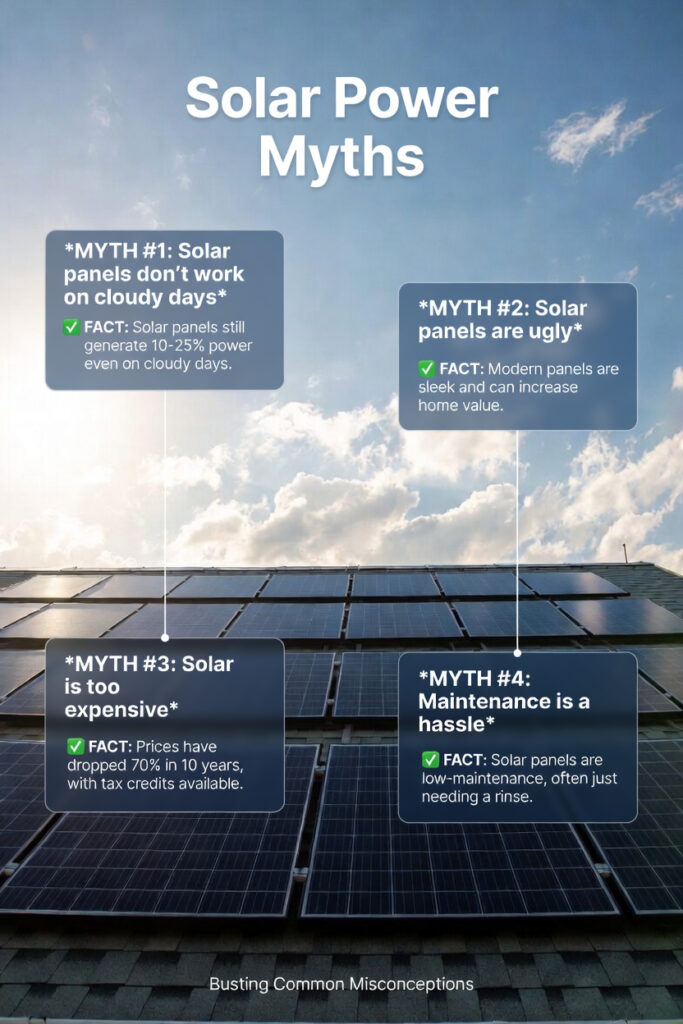
Solar power myths are everywhere and most of them are dead wrong. From people who swear solar only works in Arizona to those convinced panels stop working the moment clouds roll in. These misconceptions keep good people from making smart energy decisions. Let’s go through the biggest solar power myths one by one and set the record straight.
TL;DR Quick Myth Summary
- Cold weather does NOT kill solar production – panels actually prefer cold clear days
- Solar is NOT too expensive – costs have dropped dramatically and the ROI is real
- Cloudy days do NOT stop solar – UV light still penetrates cloud cover
- Maintenance is NOT complicated – no moving parts, minimal upkeep
- You do NOT need a perfect south-facing roof – there are workarounds
Common Solar Power Myths
Myth 1: Solar Doesn’t Work in Cold Weather
Photovoltaic cells actually perform better in cold clear conditions than hot hazy ones. Panels are rated at 25°C in lab conditions but on a cold bright January day in Ontario they can exceed that rated output. Heat is the enemy of panel efficiency, not cold. Every degree above 25°C reduces output slightly. Every degree below it can improve output.
The real winter challenge isn’t cold it’s shorter daylight hours and snow coverage. Both are manageable with proper system sizing and panel angle. Natural Resources Canada confirms that solar PV works effectively across all Canadian provinces.
Myth 2: Solar Is Too Expensive
The cost of solar has dropped dramatically and continues to fall. LiFePO4 battery costs have dropped over 80% in the last decade alone. A basic reliable off-grid starter system now ranges from $500 to $3,000 depending on size.
The average Canadian household pays $150–200/month for grid electricity $1,800 to $2,400 every year. A properly sized solar system can pay for itself in 3–7 years and then generate free power for over two decades.
The “too expensive” myth was relevant in 2010. It doesn’t hold up in 2026.
Myth 3: Solar Panels Need Constant Maintenance
Solar panels have no moving parts. Basic maintenance involves three things:
- Wipe panels clean a few times per year
- Check connections annually
- Monitor battery charge levels
That’s it. Compare that to a gas generator oil changes, fuel storage, spark plugs, carburetor issues, and pull-start failures at 2am during a blackout. Solar wins on maintenance by a wide margin.
Myth 4: Cloudy Days Kill Solar Production
UV light still penetrates cloud cover. Your panels produce power on cloudy days just less of it. Real world production typically ranges from 10–25% of rated output depending on cloud density. That’s not zero.
On a properly sized system with adequate battery storage cloudy days are completely manageable. The solution isn’t avoiding clouds it’s sizing your system correctly for worst-case scenarios.
Myth 5: You Need a Perfect South-Facing Roof
South-facing is ideal but not required. East or west facing panels lose about 15–25% output compared to south-facing real but manageable. Ground-mounted panels, adjustable tilt stands, and portable setups solve the roof orientation problem entirely.
Don’t let an imperfect roof stop you from going solar. Adjust your system size slightly to compensate and move forward.
Pro Tip: The best way to test solar before committing to a full installation is starting with a portable power station and one panel. Run it for a full winter to see what it produces in real-world conditions. The Anker SOLIX C1000 Gen 2 paired with a Renogy 100W Solar Panel is the perfect low-commitment starting point.
The Verdict
Solar power myths spread fast because solar is still new enough that most people don’t have personal experience with it. That’s changing quickly.
Cold weather won’t kill your panels. Clouds won’t stop your system. The cost is manageable. Maintenance is minimal. You don’t need a perfect roof.
What you do need is accurate information. That’s what we’re here for.
What’s the Weirdest Thing You’ve Heard About Solar?
We’ve covered the most common solar power myths but we know there are more out there. What’s the strangest thing someone told you about solar? Drop it in the comments below the best ones will get their own full debunking article.
Internal Links
- How Much Solar Power Do I Actually Need?
- How Does Solar Power Work
- Natural Resources Canada Solar PV
Disclosure: This article contains affiliate links. If you buy through them, GridFree Guide earns a small commission at no extra cost to you.
About the Author
Robert Bertrand spent 20 years as a service advisor in the automotive industry (Lexus and Nissan), where precision diagnostics, wiring integrity, and documentation standards were non-negotiable. He brings that same technical discipline to GridFree Guide, where he researches, tests, and documents off-grid solar systems for Ontario conditions. Based in Rockwood, Ontario, every article is built on verified specifications, manufacturer data, and the real-world climate constraints of Canadian off-grid living.
As an Amazon Associate I earn from qualifying purchases. This site also contains affiliate links to other products and services. GridFree Guide earns a small commission at no extra cost to you.