
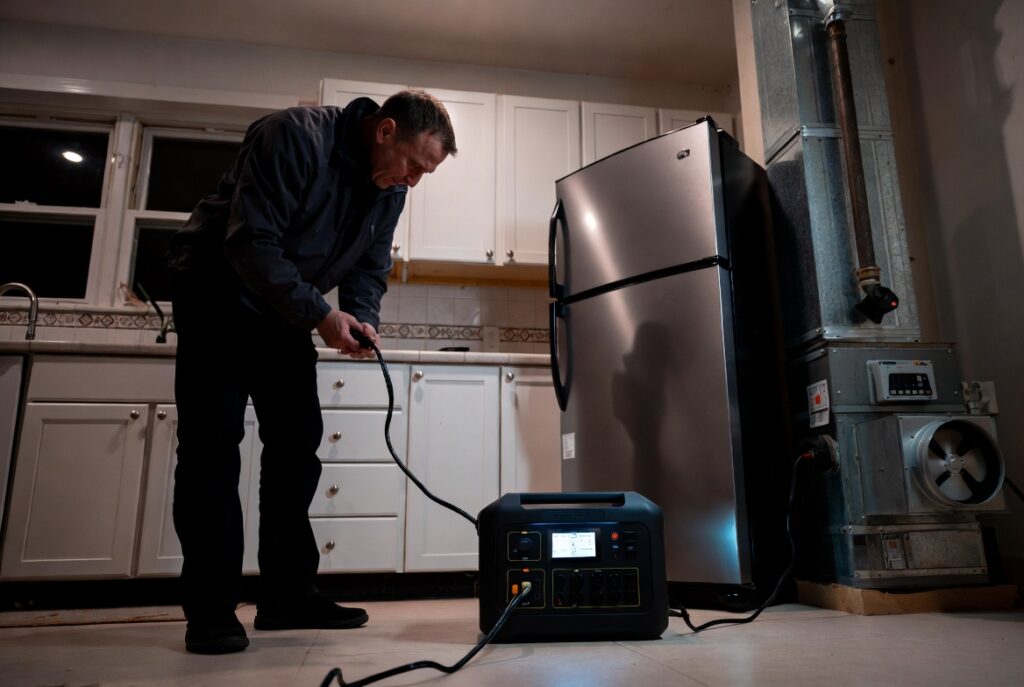
A portable power station rated at 1000W does not run 1000W of appliances through an Ontario ice storm. The rating is a ceiling, not a guarantee. Startup surge from motor-driven loads like refrigerators and sump pumps trips the overload protection in under 3 seconds. The gap between rated capacity and real-world runtime decides whether you make it through the night.
In Ontario, a portable power station serves a specific role in the backup power hierarchy. It handles critical loads like CPAP machines, LED lighting, phone charging, and small refrigerators during 12 to 48 hour outages. It does not replace a full off-grid solar system for extended outages. For system sizing fundamentals, see the solar sizing guide.
What the 1000W Rating Actually Means
Every portable power station has two numbers that determine performance. The wattage rating in watts describes how much power the unit can deliver at any moment. The capacity rating in watt-hours describes how much total energy the unit stores. A 1000W unit with 1,056Wh of capacity delivers 1000W for roughly one hour at full load.
Drop the load to 100W and the same portable power station runs for approximately 10 hours. Drop it to 50W for a CPAP machine and runtime extends past 20 hours. The math is straightforward until startup surge enters the calculation, when motor-driven appliances draw 2 to 3 times rated wattage. That spike decides whether your unit stays on or trips.
The Startup Surge Problem in Ontario Blackouts
A standard refrigerator runs at 150W but draws 400 to 600W at startup when the compressor kicks in. A sump pump runs at 800W but surges to 1,300 to 2,000W. A window AC unit rated at 500W demands 1,200 to 1,500W at startup. Any of these surges can exceed a 1000W portable power station rating and trip the overload protection instantly.
During Ontario ice storms, the sump pump is often the most critical load. A flooded basement during a power outage causes $10,000 to $30,000 in damage. However, most 1000W portable power station units cannot handle the 1,300W sump pump startup surge. This is why surge headroom matters more than the nameplate wattage on the box.
The Anker SOLIX C1000 Gen 2 addresses this with a 2,000W surge capacity. That headroom covers refrigerator compressor startups at 480W and most furnace fan motors at 600 to 800W. A unit rated at only 1,000W surge trips on the first compressor cycle. The surge specification is the single most important number for Ontario backup use.
Pro Tip: During an Ontario blackout, run appliances in priority order. CPAP first, refrigerator second, lighting third. Never plug everything in at once. Stagger your loads and a 1000W portable power station lasts far longer than running all loads simultaneously.
The Rockwood Ice Storm Runtime Test
Field diagnostic from Rockwood, Wellington County, Ontario during a 36-hour ice storm in January 2025. System tested was an Anker SOLIX C1000 Gen 2 portable power station with 1,056Wh capacity and 2,000W surge rating. Loads included a CPAP at 50W, a refrigerator at 150W average, LED lighting at 30W, and two phones at 40W.
Total overnight consumption from 6 PM to 6 AM measured 820Wh across all four loads. The portable power station reached morning with 18 percent capacity remaining. The refrigerator startup surge hit 480W three times overnight and the 2,000W surge headroom handled each spike without tripping. A unit with only 1,000W surge rating would have tripped on the first compressor cycle.
The critical finding was that the CPAP drew 400Wh overnight, nearly half the total bank capacity. Removing the humidifier attachment dropped CPAP consumption to 240Wh. That single adjustment extended total runtime by approximately 3 hours, enough to reach morning solar charging.
Ontario Portable Power Station Load Chart
| Appliance | Running Watts | Startup Surge | 8-Hour Runtime (Wh) |
|---|---|---|---|
| CPAP (no humidifier) | 30 to 60W | 60W | 240 to 480 |
| Refrigerator (cycling) | 150W avg | 400 to 600W | 120 to 200 |
| LED Lights (3 bulbs) | 30W | 30W | 240 |
| Phone Charging (2) | 40W | 40W | 120 |
| Small Fan | 40W | 40W | 320 |
| Sump Pump | 800W | 1,300 to 2,000W | Intermittent |
| Window AC (5000 BTU) | 500W | 1,200 to 1,500W | 4,000 |
What 1000W Cannot Handle in an Ontario Blackout
The load chart above assumes LFP chemistry inside the portable power station. LFP holds voltage more consistently under load than older lithium-ion cells. A 1,056Wh LFP unit delivers usable power down to 10 percent SoC without voltage sag. Older NMC chemistry units lose output power below 30 percent SoC, effectively reducing usable capacity by 20 percent.
Heat-generating appliances drain a portable power station in under 2 hours. An electric space heater at 1,500W empties a 1,056Wh bank in approximately 40 minutes. An electric kettle at 1,200W runs for under an hour and a hair dryer at 1,875W exceeds most units entirely. These loads belong on a generator, not a battery.
In Ontario, the critical winter distinction is heating versus everything else. A portable power station keeps your CPAP running and your fridge cold, but it does not heat your home. Propane or a wood stove handles space heating while the battery protects electrical essentials. For the full backup power hierarchy, refer to the Solar Battery Guide.
Choosing the Right Portable Power Station for Ontario
The Anker SOLIX C1000 Gen 2 provides 1,056Wh of LFP storage with a 2,000W surge rating. The surge headroom handles refrigerator and furnace fan startups without tripping. LFP chemistry provides over 3,000 charge cycles at 80 percent depth of discharge. That cycle life translates to roughly 8 years of daily use before capacity drops below 80 percent.
Pair it with a Renogy 100W Solar Panel for daytime recharging during extended outages. The panel connects directly to the C1000 input port with an MC4 to barrel adapter included in the box. No charge controller is needed because the portable power station has its own MPPT controller built in. This makes the solar pairing a true plug-and-play solution for Ontario backup.
For Ontario ice storms lasting beyond 24 hours, solar input extends runtime indefinitely for critical loads under 200W. The panel produces approximately 360Wh on a clear January day at 1.5 peak sun hours. That replaces roughly one third of a typical overnight draw, stretching a 36-hour backup into a multi-day solution. For more on what a 1000W unit actually runs, see our guide on 1000W solar generator blackout loads.
Portable Power Station Code Compliance in Ontario
NEC Article 480 covers battery-based power systems including portable power stations used as temporary backup. Units operated without permanent wiring in a plug-and-play configuration do not typically require permits. However, any permanent connection to a home electrical panel requires a transfer switch and an ESA inspection. Contact the NFPA (National Fire Protection Association) for current requirements.
CEC Section 64 governs Ontario-specific standards for battery systems connected to residential loads. A portable power station used portably with extension cords does not require an ESA permit in most jurisdictions. Permanent installation with a transfer switch requires an ESA permit and inspection. Contact the ESA (Electrical Safety Authority) before any permanent installation.
- Choose a unit with at least 2,000W surge rating. This handles refrigerator and sump pump startups during Ontario ice storms.
- Run appliances in priority order: CPAP first, refrigerator second, lighting third. Stagger loads to extend runtime past the overnight window.
- Pair the unit with a 100W solar panel for daytime recharging. A single panel extends a 36-hour backup into multi-day coverage for critical loads.
Frequently Asked Questions
Can a 1000W portable power station run a sump pump?
Most 1000W units cannot handle the 1,300 to 2,000W startup surge from a sump pump. You need a unit with at least 2,000W surge capacity or a soft start device on the pump. The Anker SOLIX C1000 Gen 2 handles most sump pumps with its 2,000W surge rating.
How long will a portable power station run a CPAP machine?
A 1,056Wh unit runs a CPAP without humidifier at 30 to 60W for 17 to 35 hours. With the humidifier attached, draw increases to 80 to 100W and runtime drops to 10 to 13 hours. Remove the humidifier during outages to maximize runtime.
Can I use a portable power station indoors during a blackout?
Yes. LFP portable power stations produce zero emissions and operate safely indoors. This is the primary advantage over gas generators, which produce carbon monoxide and must run outside. Place the unit on a hard surface with adequate ventilation for heat dissipation.
How fast does a 100W solar panel recharge a portable power station?
A 100W panel produces approximately 360Wh on a clear Ontario July day at 4.5 peak sun hours. In January at 1.5 peak sun hours, output drops to approximately 120Wh. A fully depleted 1,056Wh unit takes roughly 3 clear July days to recharge from one panel. In January, expect 9 clear days.
This build is engineered within the 48V DC Safety Ceiling. Diagnostic logic is based on 20+ years of technical service experience. All structural and electrical installations must be verified by a Licensed Professional and comply with your Local AHJ.
About the Author
Robert Bertrand spent 20 years as a service advisor in the automotive industry (Lexus and Nissan), where precision diagnostics, wiring integrity, and documentation standards were non-negotiable. He brings that same technical discipline to GridFree Guide, where he researches, tests, and documents off-grid solar systems for Ontario conditions. Based in Rockwood, Ontario, every article is built on verified specifications, manufacturer data, and the real-world climate constraints of Canadian off-grid living.
As an Amazon Associate I earn from qualifying purchases. This site also contains affiliate links to other products and services. GridFree Guide earns a small commission at no extra cost to you.