
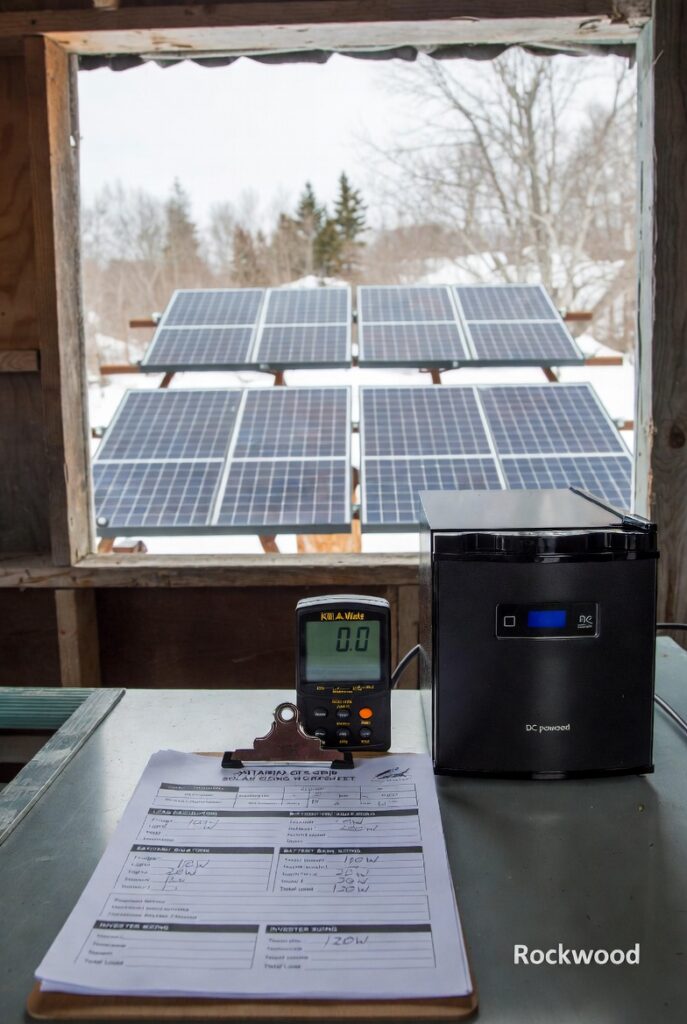
How much solar power you need in Ontario depends on a load calculation, not a panel count. In the spring of 2023 I walked through my own setup in Rockwood, Wellington County with a clipboard and measured every load: the DC chest fridge at 38W average, LED shop lighting at 22W for five hours, the laptop at 65W for three hours, and phone charging at 20W overnight. The total came to 1,340Wh per day.
Before that calculation I had been operating on a guess. I bought two Renogy 100W panels because a YouTube video said 200W was enough for a basic setup. The panels produced over 800Wh on clear summer days and the battery was full by 10 AM. By 2 PM the charge controller was in float and every watt after that went nowhere. I had over-panelled and under-batteried by guessing instead of measuring.
Once I had the 1,340Wh daily load confirmed, the sizing math ran itself. I needed 200Ah of LFP battery capacity for 1.5 days of autonomy. I needed 400W of panels to refill that battery on an Ontario summer day at 4.5 peak sun hours. Every component I bought after that calculation was exactly right the first time. The question is always answered in the same order: load first, battery second, panels third.
How Much Solar You Need Starts With Daily Load, Not Panels
The load calculation is the foundation. Write down every electrical device you run, its wattage, and the hours per day you use it. Multiply wattage by hours for each device to get watt-hours. Add all the watt-hours together. That sum is your daily energy load, and every other component size flows from it.
A realistic Ontario off-grid cottage load looks like this. A 12V DC chest fridge running 24 hours at 38W average draws 912Wh. LED lighting at 25W for five hours draws 125Wh. A laptop at 65W for three hours draws 195Wh. Phone charging draws approximately 30Wh. A water pump running 30 minutes at 180W draws 90Wh.
| Appliance | Typical Wattage | Daily Hours | Daily Wh |
|---|---|---|---|
| DC chest fridge (12V) | 38W avg | 24h | 912Wh |
| LED lighting | 25W | 5h | 125Wh |
| Laptop | 65W | 3h | 195Wh |
| Phone and device charging | 15W | 2h | 30Wh |
| Water pump (well or pressure) | 180W | 0.5h | 90Wh |
| Small inverter loads | 200W | 1h | 200Wh |
| Total | 1,552Wh/day |
Add 25 percent to your calculated daily load for real-world system losses. MPPT conversion, wiring resistance, battery efficiency, and inverter losses all reduce usable energy. For a 1,552Wh measured load the design load becomes approximately 1,940Wh per day. A Kill-A-Watt meter costs approximately $35 and plugs inline with any AC appliance to measure actual wattage.
| Sizing Approach | Generic Online Calculator | Ontario Master Tech Standard |
|---|---|---|
| Load source | Estimated from averages | Measured with Kill-A-Watt meter |
| PSH reference | US national average (5.0+) | Ontario seasonal (1.5 to 4.5) |
| Winter factor | Not included | 1.25x correction applied |
| Battery DoD | Often assumes 100% | 80% LFP, 50% AGM |
| Autonomy days | 1 day or none | 1.5 to 3 days for gray streaks |
| Cold Voc | Ignored | 1.25x correction at minus 30C |
Ontario Peak Sun Hours: How Much Solar Your Location Delivers by Season
Peak sun hours are not hours of daylight. They measure how many hours per day your location receives sunlight at 1,000 watts per square metre. Southern Ontario averages 4.5 to 5.0 peak sun hours in June and July. In January that drops to 1.5 to 2.5 peak sun hours. These are published irradiance values from Natural Resources Canada.
A system sized for summer will run short in winter. For a cottage used May through September, size for summer at 4.5 PSH. For a year-round cabin that needs January power, size for winter at 1.5 to 2.5 PSH or accept generator backup from November through February.
| Season | Southern Ontario PSH | Design Use |
|---|---|---|
| June to August | 4.5 to 5.0 PSH | Seasonal cottage, RV, portable |
| March to May / Sept to Oct | 3.5 to 4.0 PSH | Three-season cabin |
| November to February | 1.5 to 2.5 PSH | Year-round requires oversizing |
| Annual average | 3.5 PSH | Year-round with winter generator |
The panel formula answers how much solar power you need once you have your design load and PSH. Divide the design daily load by your PSH figure. For the 1,940Wh design load at 4.5 summer PSH: 1,940 divided by 4.5 equals 431W of panels. Four Renogy 100W panels gives 400W. For winter at 2.5 PSH: 1,940 divided by 2.5 equals 776W. Year-round Ontario systems often need 800W to 1,200W even for modest loads.
How Much Solar Plus Battery: The Sizing Formula That Works
Battery sizing comes before panel sizing in the correct sequence. The bank needs to cover your daily load for at least 1.5 days without solar input. This autonomy protects you from consecutive overcast days.
For the 1,552Wh daily load, minimum usable capacity is 1,552 times 1.5 equals 2,328Wh. At 12V that is approximately 194Ah usable, rounded to 200Ah. LFP batteries deliver 200Ah usable from 200Ah rated at 100 percent DoD. AGM requires 400Ah rated to get 200Ah usable at 50 percent DoD. For a detailed chemistry comparison, see the LiFePO4 vs AGM guide.
The Fergus Undersizing Diagnostic
Field diagnostic from Tower Street, Fergus, Centre Wellington, Ontario, October 2024. System was a 600W solar array with 200Ah LFP bank. The owner reported that the system was not keeping up with loads. Panel output was confirmed adequate for the rated capacity.
Load audit revealed three uncounted devices: a 240W chest freezer running 24 hours, an electric kettle at 1,400W for 20 minutes every morning, and a second fridge in the garage on an inverter. Actual daily load measured 3,180Wh, more than double the assumed load from the YouTube tutorial she had followed.
Resolution was removing the electric kettle from solar (switched to propane) and turning off the garage fridge from October to May. The 600W array went from perpetually failing to charging the 200Ah bank to 95 percent by 2 PM on clear days. A $35 Kill-A-Watt meter and one weekend of measurement would have prevented months of frustration and a service call.
Charge Controller Sizing for Ontario Arrays
The charge controller bridges the panels and battery, and its rating determines how much solar power actually reaches your bank. For a 400W array of 12V panels, the Victron SmartSolar MPPT 100/30 handles the load with room to spare. Its 100V maximum PV input accepts panels in series and its 30A charge current covers 360W at 12V.
An undersized charge controller is one of the most common bottlenecks. The panels produce more than the controller can pass to the battery, and the surplus is wasted as heat. As you scale beyond 400W or move to 24V or 48V, the controller rating must scale with it. For panel specifications see the best 100W solar panel guide.
The Minimum Viable System vs the Full Ontario Standard
The minimum viable answer to how much solar power you need for Ontario blackout preparedness is simpler than most expect. Anker SOLIX C1000 Gen 2 holding 1,024Wh with 2,000W continuous output. It charges from zero to full in 49 minutes on AC or from two 200W panels in approximately four hours. For critical devices during a 24 to 48 hour outage this single unit covers the load with no permanent installation.
The full Ontario standard for a permanent installation is 400W of fixed panels, 200Ah of LFP storage, a Victron MPPT charge controller, and a pure sine wave inverter sized for the largest single load. That combination handles the 1,340 to 1,550Wh daily loads in the examples above. For RV installations see the RV solar panels guide.
NEC and CEC: Code Compliance for Ontario Solar Installations
NEC 690 governs solar PV system design and installation. NEC 690.7 requires maximum system voltage calculated at the coldest expected operating temperature, not at the 25C lab reference. For Ontario systems stored outdoors, this calculation must use minus 30C or colder. NEC 690.9 governs overcurrent protection and NEC 690.12 requires rapid shutdown capability. Contact the NFPA (National Fire Protection Association) for current NEC 690 requirements.
CEC Section 50 governs all solar PV installations in Ontario. An ESA permit is required before energizing any solar array connected to a battery bank on any Ontario property. This applies to homes, cottages, sheds, and outbuildings regardless of system size. Contact the ESA (Electrical Safety Authority) for current permit requirements before beginning any installation.
Pro Tip: The biggest mistake when calculating how much solar power you need is using a summer YouTube tutorial for a year-round installation. Arizona tutorials use 5.5 to 6.5 peak sun hours. Southern Ontario in January gets 1.5 to 2.5. The same 400W array that fills a 200Ah battery by noon in July barely holds 50 percent SoC on a clear January day. If your system needs winter power, divide your design load by 2.5 PSH, not 5.0.
- For 24 to 48 hour blackout preparedness, start with an Anker SOLIX C1000 Gen 2 plus two 100W panels. No permanent installation required. Measure your actual usage over one season before scaling to a permanent system.
- For a three-season cottage from May through October, install 400W of fixed panels, 200Ah LFP storage, and a Victron MPPT 100/30. This covers a 1,340Wh daily load at 4.5 summer PSH with daily surplus for battery top-up.
- For year-round off-grid power including January, install 800W to 1,200W of panels, 400Ah LFP storage, and an oversized MPPT controller. Size for 2.0 to 2.5 winter PSH, not summer. Every other season will run in surplus.
Frequently Asked Questions
How much solar power do I need to run a fridge off-grid in Ontario?
A 12V DC chest fridge at 38W average needs approximately 912Wh per day. At 4.5 Ontario summer PSH, a single 200W panel produces roughly 900Wh. In practice you always have other loads, so size your array for the full daily load. Measure actual fridge consumption with a Kill-A-Watt meter for a full week before finalizing panel count.
How much solar do I need for a 200Ah battery in Ontario?
To refill a 200Ah LFP battery that discharged 50 percent overnight (100Ah or 1,200Wh) at 4.5 summer PSH, you need approximately 267W of panels for recovery alone. Add daytime loads and you typically need 400W to 500W total. In January at 2.5 PSH, the same recovery requires 480W minimum. Year-round systems with 200Ah LFP should plan 600W to 800W of panels.
How much solar is needed to run a well pump off-grid in Ontario?
A 0.5HP 120V well pump draws 800 to 1,000W and runs for 30 to 60 minutes total per day, consuming 400 to 1,000Wh daily. The critical challenge is startup surge at 3 to 5 times running wattage. Factor the daily Wh into your load calculation and confirm your inverter surge rating covers the pump startup current.
Why does my Ontario solar system work in summer but fail in winter?
Southern Ontario drops from 4.5 PSH in July to 1.5 PSH in January. A 400W array producing 1,800Wh in summer produces only 600Wh in January. The panels are fine. The design reference was wrong. Size for January PSH if you need year-round power.
This build is engineered within the 48V DC Safety Ceiling. Diagnostic logic is based on 20+ years of technical service experience. All structural and electrical installations must be verified by a Licensed Professional and comply with your Local AHJ.
About the Author
Robert Bertrand spent 20 years as a service advisor in the automotive industry (Lexus and Nissan), where precision diagnostics, wiring integrity, and documentation standards were non-negotiable. He brings that same technical discipline to GridFree Guide, where he researches, tests, and documents off-grid solar systems for Ontario conditions. Based in Rockwood, Ontario, every article is built on verified specifications, manufacturer data, and the real-world climate constraints of Canadian off-grid living.
As an Amazon Associate I earn from qualifying purchases. This site also contains affiliate links to other products and services. GridFree Guide earns a small commission at no extra cost to you.